
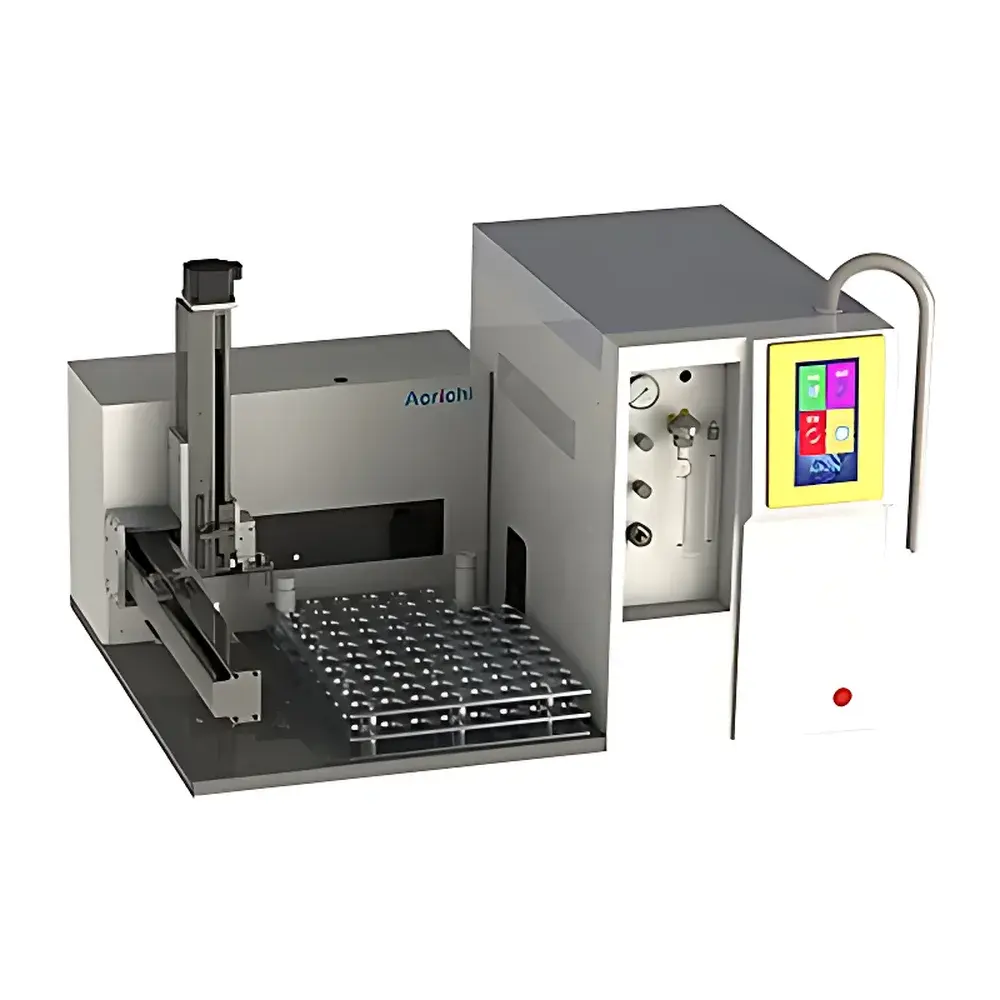
Acrichi PTC-56 Automated Solid-Liquid Integrated Purge and Trap Concentrator
| Brand | Acrichi |
|---|---|
| Origin | Beijing, China |
| Model | Acrichi PTC-56 |
| Sample Capacity | 56 positions |
| Injection Precision | RSD ≤ 10% |
| Trap Temperature Range | Ambient to 450 °C |
| Purge Sample Heating Range | Ambient to 100 °C |
| Sample Vial Cooling Range | −40 °C to Ambient |
| Purge Flow Rate | 10–150 mL/min (continuously adjustable) |
| Cold Trap Temperature Range | −40 °C to Ambient (electronic cooling) |
| Focusing Trap Ramp Rate | >4800 °C/min |
| Dimensions | 650 × 880 × 530 mm |
| Weight | ~40 kg |
| Power | 220 V, 50 Hz, 800 W |
Overview
The Acrichi PTC-56 is a fully automated, solid-liquid integrated purge and trap concentrator engineered for trace-level volatile organic compound (VOC) analysis in environmental, regulatory, and research laboratories. It operates on the principle of dynamic headspace extraction: inert gas purging displaces VOCs from aqueous or solid-phase matrices into a heated transfer line, where analytes are adsorbed onto a cryogenically cooled or thermally controlled trapping column. Subsequent rapid thermal desorption—enabled by a high-ramp-rate focusing trap (>4800 °C/min)—delivers sharp, reproducible analyte bands directly into the GC or GC-MS inlet. Designed for compliance-critical workflows, the PTC-56 supports method-defined sample handling across drinking water (EPA Method 524.4, 524.3), wastewater (EPA Method 524.2), soil (EPA Method 5021B), and sediment matrices—without hardware modification or manual intervention.
Key Features
- Fully automated 56-position sample carousel with robotic arm precision handling, enabling unattended operation for multi-day batch runs
- Independent temperature control across nine critical zones: purge heater (ambient–100 °C), six-port valve manifold (ambient–220 °C), transfer line (ambient–220 °C), focusing trap (ambient–450 °C), cold trap (−40 °C to ambient, electronic cooling), water removal trap (ambient–400 °C), steam generator (ambient–90 °C), solid-sample vial heater (ambient–100 °C), and ambient reference sensor
- Integrated leak detection and real-time fault diagnostics with audible/visual alerts and system log recording
- Inert-flow path architecture: all internal surfaces contactable by carrier gas are passivated stainless steel or fused silica-lined; zero dead volume connections eliminate carryover
- No cold spots in gas pathway: six-port valve and transfer lines housed within a thermally insulated heating chamber maintaining uniform temperature stability (±1 °C)
- Dual-stage water management: selective condensation at the cold trap followed by active dehydration in the dedicated water removal trap (up to 400 °C), minimizing water vapor load on downstream GC columns and detectors
- Touchscreen HMI with intuitive workflow navigation, real-time status dashboard, and embedded method editor supporting up to 10 user-defined protocols
Sample Compatibility & Compliance
The PTC-56 accommodates 40-mL EPA-standard vials (with septa), 22-mL solid-phase vials with crimp caps, and custom containers via adapter kits. Solid samples—including soils, sediments, sludges, and plant tissues—are processed using programmable thermal equilibration and sparging parameters compliant with EPA Methods 5021B and 8260D. Liquid samples cover potable water, groundwater, surface water, wastewater, and leachates per EPA Methods 524.2–524.4 and ISO 15681-2. The system’s design supports GLP/GMP documentation requirements: audit trail logging, user access levels, electronic signature capability, and full traceability of method parameters, run history, and calibration events. While not pre-certified, its architecture aligns with FDA 21 CFR Part 11 data integrity expectations when deployed with validated LIMS or chromatography data systems.
Software & Data Management
Control firmware includes time-stamped event logging (start/stop, temperature deviations, pressure anomalies, valve actuations), exportable as CSV or XML. Method files store complete thermal profiles, flow sequences, timing logic, and instrument state configurations. Remote monitoring is supported via Ethernet TCP/IP interface; external GC/MS trigger signals (TTL or relay) initiate synchronized acquisition. Data export interfaces support direct integration with Agilent MassHunter, Thermo Chromeleon, and Waters Empower via ASCII-based command protocols. Audit-ready reports include sample ID, injection sequence, trap desorption temperature profile, purge duration, and system diagnostic flags—all timestamped and digitally signed.
Applications
- Regulatory monitoring of trihalomethanes (THMs), benzene, toluene, ethylbenzene, xylenes (BTEX), vinyl chloride, and chlorinated solvents in drinking water per U.S. EPA and EU Directive 2020/2184
- Soil gas screening and landfill leachate characterization under ASTM D6866 and ISO 16067-1
- Pharmaceutical residual solvent analysis in excipients and final dosage forms (ICH Q3C guidelines)
- Food safety testing for off-flavor compounds (e.g., geosmin, 2-methylisoborneol) in bottled water and beverages
- Forensic toxicology screening for volatile intoxicants (e.g., ethanol, acetone, isopropanol) in biological fluids
- Environmental fate studies involving biodegradation kinetics of chlorinated hydrocarbons in microcosms
FAQ
Does the PTC-56 support both aqueous and solid-phase samples without hardware reconfiguration?
Yes. The system uses a unified sample carousel accepting standard 40-mL liquid vials and 22-mL solid vials, with independent thermal control for each matrix type.
What level of method validation support is provided?
The instrument includes built-in performance verification routines: blank tracking, spike recovery checks, system suitability tests (SST), and retention time locking compatibility with GC methods.
Can the cold trap temperature be maintained below −30 °C during extended purge cycles?
Yes. The electronic cooling module sustains stable operation at −40 °C with <±1 °C stability over 90-minute purge durations.
Is the water removal trap compatible with high-humidity soil extractions?
Yes. The heated water trap (up to 400 °C) actively decomposes condensed moisture and prevents ice formation during cryofocusing, ensuring consistent trap efficiency across variable sample water content.
How is cross-contamination between samples mitigated?
Through physical separation of purge gas and backflush gas paths, inert-surface materials, and automated bake-out cycles between runs—validated by <0.1% carryover for BTEX at 5 µg/L spike levels.
Related Products





