
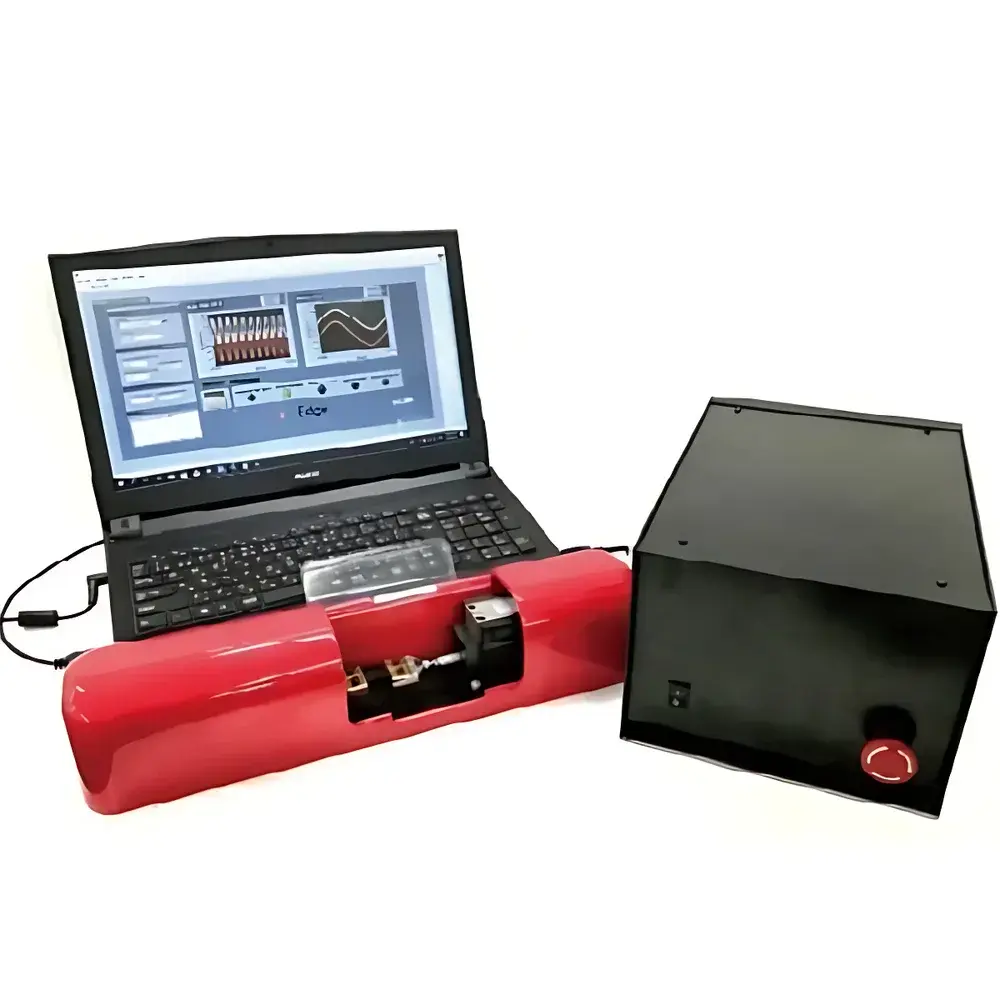
AcroEdge Syclus Compact Fatigue Testing System
| Brand | AcroEdge |
|---|---|
| Origin | Imported |
| Manufacturer Type | Authorized Distributor |
| Model | Syclus |
| Instrument Category | Compact Vibration-Based Fatigue Tester |
| Frequency Range | 1–20 Hz |
| Maximum Displacement Amplitude | ±600 µm |
| Load Capacity | ±25 N (±0.5% nonlinearity) |
| Sample Dimensions | Length 25–35 mm |
| Geometry | Films, Fibers, Thin Specimens |
| Control Interface | USB-connected PC with Dedicated Software |
| Sampling Rate | Up to 2000 pts/sec |
| Data Storage Modes | Linear (N cycles per T minutes) or Logarithmic (10, 100, 1000, …, 10ⁿ cycles) |
| Failure Detection | Programmable load threshold trigger with pre-failure cycle preservation (3 cycles prior to failure) |
| System Dimensions (Tester) | L100 × W100 × H500 mm (vertical orientation) |
| Controller Dimensions | L250 × W250 × H150 mm |
| Tester Mass | ~3 kg |
| Controller Mass | ~5 kg |
| Power Supply | 100 V, 10 A |
Overview
The AcroEdge Syclus Compact Fatigue Testing System is a precision-engineered, benchtop vibration fatigue tester designed for high-resolution cyclic mechanical evaluation of low-stiffness, dimensionally constrained specimens—including polymer films, electrospun fibers, thin elastomeric sheets, and micro-scale composite laminates. Unlike conventional servo-hydraulic or electromagnetic resonance fatigue systems, the Syclus employs a direct-drive electromagnetic shaker architecture operating in controlled sinusoidal displacement mode, enabling stable harmonic excitation across a 1–20 Hz frequency band with sub-micron amplitude fidelity. Its core measurement principle relies on closed-loop force-displacement synchronization, where real-time load cell feedback (±25 N range, ±0.5% nonlinearity) and high-fidelity LVDT or strain-gauge-compatible displacement sensing jointly characterize stress–strain hysteresis, energy dissipation, and progressive damage evolution under repeated loading. The system is expressly engineered for early-stage material screening, quality consistency assessment, and failure mechanism mapping—particularly where sample volume, lab footprint, or power infrastructure limits prohibit use of full-scale testing platforms.
Key Features
- Compact vertical configuration (100 × 100 × 500 mm) with total tester mass under 3 kg—designed for integration into fume hoods, gloveboxes, or shared instrumentation labs.
- Electromagnetic actuation delivering precise ±600 µm peak-to-peak displacement at frequencies from 1 to 20 Hz, with programmable waveform symmetry (tension–tension, tension–compression, compression–compression).
- Dual-channel synchronized acquisition at up to 2000 samples per second—supporting high-resolution cycle-by-cycle analysis of load, displacement, and derived metrics (e.g., stiffness decay, hysteresis area, phase lag).
- Intelligent failure detection: user-definable load threshold triggers automatic test termination and archival of the three complete cycles immediately preceding mechanical rupture.
- Flexible data retention strategies—linear (N cycles per time interval) or logarithmic (10¹, 10², 10³, …, 10ⁿ) sampling—to balance temporal resolution with storage efficiency during long-duration tests (up to 10⁷ cycles).
- Modular mechanical interface: customizable chucks, grips, and extensometry mounts compatible with ASTM D882 (thin plastics), ISO 527-3 (films), and ISO 13934-1 (textile tensile fatigue) specimen geometries.
Sample Compatibility & Compliance
The Syclus accommodates specimens 25–35 mm in length with cross-sectional dimensions adaptable to fibers (diameters ≥50 µm), free-standing films (thicknesses 10–500 µm), and miniaturized biomedical patches or battery separator membranes. All mechanical interfaces comply with ISO/IEC 17025 traceability requirements for calibration of force and displacement transducers. While not certified to ASTM E466 or ISO 1099 for high-cycle metal fatigue, the system meets functional equivalency for low-cycle, high-strain polymer and biomaterial fatigue per ISO 13761 and ASTM F2129 (corrosion-fatigue of medical devices). Data export formats (CSV, XLSX) support GLP-compliant documentation, and audit trails—including parameter changes, trigger events, and calibration timestamps—are embedded in every dataset for regulatory review.
Software & Data Management
Control and analysis are executed via AcroEdge’s proprietary SyclusControl Suite—a Windows-based application communicating over USB 2.0 with deterministic latency (<2 ms). The software provides dual-mode operation: Setup Mode enables definition of amplitude, frequency, gauge length, preload magnitude (0–10 N initial static load), and failure criteria; Measurement Mode delivers real-time oscilloscope-style visualization of load vs. displacement Lissajous plots, cycle-averaged hysteresis loops, and statistical summaries (min/max/mean load, peak-to-peak displacement drift, cycle count). All raw waveforms and metadata are stored in timestamped folders with SHA-256 checksums. Export options include Excel-compatible .csv, MATLAB .mat, and HDF5 for downstream machine learning pipelines. Software versioning and user access logs conform to FDA 21 CFR Part 11 readiness guidelines for electronic records.
Applications
- Accelerated lifetime prediction of biodegradable sutures and hydrogel wound dressings under physiological-frequency cyclic strain (0.5–5 Hz).
- Batch-to-batch consistency validation of roll-to-roll coated optical films subjected to packaging-level flex fatigue.
- Structure–property correlation in nanofiber mats: quantifying how electrospinning parameters influence fatigue resistance at 10–100 kcycles.
- Preclinical evaluation of soft robotic actuators—tracking stiffness degradation and hysteresis widening across 10⁴–10⁶ cycles.
- Educational laboratories: hands-on instruction in S–N curve construction, Coffin–Manson relationships, and crack initiation modeling using accessible, low-risk specimens.
FAQ
What types of materials are most suitable for testing on the Syclus?
Polymeric films, synthetic and natural fibers, thin elastomers, hydrogels, and flexible electronics substrates—especially when specimen mass is <1 g and thickness is <1 mm.
Can the Syclus perform tests under environmental control (e.g., humidity or temperature)?
Yes—the open-frame mechanical design permits integration with third-party environmental chambers (e.g., Vötsch or ESPEC units), provided chamber ports accommodate the 100 mm × 100 mm base footprint and USB/data cabling.
Is calibration traceable to national standards?
Force and displacement sensors are factory-calibrated against NIST-traceable references; full calibration certificates (including uncertainty budgets) are supplied with each system.
Does the software support automated reporting for quality documentation?
Yes—customizable report templates generate PDF outputs containing test parameters, summary statistics, representative hysteresis loops, and failure event logs, all compliant with ISO 9001 internal audit requirements.
What maintenance is required for long-term operational stability?
No routine mechanical servicing is needed; annual verification of sensor linearity and timing synchronization is recommended using AcroEdge’s diagnostic utility suite.



