
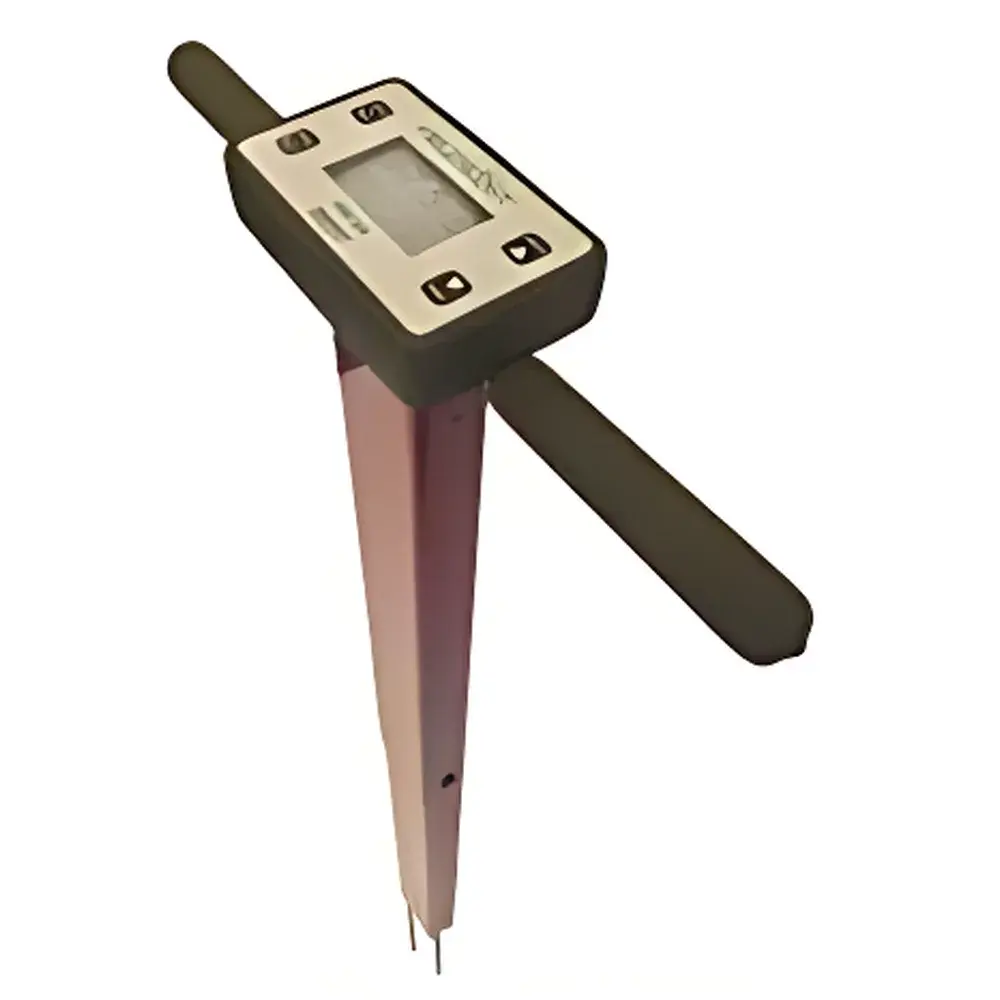
Active Spectrum TDR350 Soil Moisture, Temperature, and Electrical Conductivity Analyzer
| Brand | Active Spectrum |
|---|---|
| Origin | USA |
| Model | TDR350 |
| Instrument Type | Multi-parameter Soil Analyzer |
| Probe Length Options | 3.8 cm, 7.6 cm, 12 cm, 20 cm |
| Measurement Principle | Time-Domain Reflectometry (TDR) |
| Volumetric Water Content (VWC) Range | 0–saturation |
| VWC Resolution | 0.1% VWC |
| VWC Accuracy | ±3.0% (at EC < 2 mS/cm) |
| Temperature Range | −30°C to +60°C |
| Temperature Resolution | 0.1°C |
| Temperature Accuracy | ±1°C |
| EC Range | 0–5 mS/cm |
| EC Resolution | 0.01 mS/cm |
| EC Accuracy | ±0.1 mS/cm |
| Probe Diameter | 0.5 cm |
| Probe Spacing | 3.3 cm |
| Data Storage Capacity | >50,000 geotagged records |
| Display | Backlit LCD |
Overview
The Active Spectrum TDR350 is a field-deployable, multi-parameter soil sensor engineered for high-reproducibility measurement of volumetric water content (VWC), bulk electrical conductivity (EC), and soil temperature using time-domain reflectometry (TDR). Unlike capacitance-based sensors susceptible to salinity-induced drift, the TDR350 employs electromagnetic pulse propagation along calibrated stainless-steel waveguides to directly quantify dielectric permittivity—enabling robust, calibration-stable VWC determination across the full range from dry to saturated conditions. Its dual-sensor architecture simultaneously captures EC and temperature at the same physical location as the TDR measurement, allowing real-time salinity correction of VWC readings per ASTM D5745 and ISO 11274 guidelines. Designed for long-term unattended operation or handheld spot monitoring, the TDR350 delivers traceable, physics-based data essential for irrigation scheduling, drought assessment, soil hydrological modeling, and regulatory compliance in agricultural, turfgrass, rangeland, and environmental research applications.
Key Features
- True TDR-based measurement architecture with factory-calibrated waveguide geometry (0.5 cm diameter, 3.3 cm inter-rod spacing) ensuring minimal sensitivity to soil texture and density variations.
- Four interchangeable probe lengths (3.8 cm, 7.6 cm, 12 cm, and 20 cm) enabling stratified profiling of root-zone moisture and salinity without requiring multiple instruments.
- Integrated dual-channel sensing: simultaneous acquisition of VWC, bulk EC (0–5 mS/cm), and temperature (−30°C to +60°C) with on-device salinity correction applied to VWC output.
- Onboard Bluetooth 5.0 and GPS module supporting georeferenced data logging; all measurements stored with UTC timestamp, latitude/longitude, altitude, and probe depth metadata.
- High-capacity non-volatile memory retaining over 50,000 measurement records with full audit trail—compatible with GLP-compliant data export workflows.
- Ergonomic telescoping mounting bracket with depth-locking mechanism for rapid, repeatable insertion across heterogeneous field conditions.
- Backlit monochrome LCD display with intuitive menu navigation, real-time graphing of temporal trends, and immediate pass/fail threshold alerts based on user-defined VWC or EC limits.
Sample Compatibility & Compliance
The TDR350 is validated for use in mineral soils (sand to clay loam), organic substrates (peat, compost), and engineered growing media (e.g., sand-based golf greens). It complies with ASTM D5745 (Standard Test Method for Determination of Soil Moisture Content Using Time Domain Reflectometry), ISO 11274 (Soil Quality — Determination of Soil Water Retention Characteristics), and USDA-NRCS Soil Survey Field and Laboratory Methods Manual protocols. Its EC compensation algorithm aligns with US Salinity Laboratory Handbook recommendations for accurate VWC interpretation under variable salinity regimes. The device meets IEC 60529 IP67 ingress protection rating and operates within FCC Part 15 and CE RED directive limits for radio emissions.
Software & Data Management
Data retrieval is supported via Active Spectrum’s proprietary desktop application (Windows/macOS) and mobile companion app (iOS/Android), both implementing AES-256 encryption for secure transmission and storage. Raw TDR waveform files (.tdr) are preserved alongside processed parameters, enabling post-acquisition reprocessing using alternate calibration models (e.g., Topp equation, Roth et al. 1992, or user-defined dielectric mixing models). Export formats include CSV, Excel (.xlsx), and NetCDF4 for integration into GIS platforms (ArcGIS, QGIS) and statistical analysis environments (R, Python pandas). Audit logs record operator ID, firmware version, calibration date, and any parameter edits—supporting FDA 21 CFR Part 11 and EU Annex 11 requirements where electronic records serve as primary data.
Applications
- Precision irrigation management in row crops, orchards, and vineyards through dynamic VWC–EC–temperature feedback loops.
- Turfgrass health monitoring on golf courses, sports fields, and municipal landscapes to prevent overwatering and leaching.
- Rangeland and pasture condition assessment for drought early-warning systems and rotational grazing planning.
- Long-term soil moisture network deployment in climate observatories and LTER (Long Term Ecological Research) sites.
- Calibration and validation of satellite-based soil moisture products (e.g., SMAP, Sentinel-1) at ground-truth reference stations.
- Greenhouse and controlled-environment agriculture (CEA) substrate monitoring for hydroponic and aeroponic systems.
FAQ
What is the recommended calibration frequency for the TDR350?
Factory calibration is stable for ≥24 months under normal field use; annual verification against gravimetric samples or certified reference soils (e.g., NIST SRM 2709a) is advised for regulatory reporting.
Can the TDR350 be used in frozen soil?
Yes—the instrument measures dielectric properties regardless of phase state; however, VWC interpretation below 0°C requires application-specific ice-dielectric models and is not included in default firmware.
Does the GPS module support differential correction (e.g., SBAS or RTK)?
The integrated GPS provides autonomous WAAS/EGNOS-corrected positioning (±3 m CEP); external RTK receivers may be paired via NMEA 0183 serial output for sub-meter geolocation.
Is the probe compatible with automated data loggers (e.g., Campbell Scientific CR series)?
Yes—TDR350 supports SDI-12 v1.4 communication protocol and can be daisy-chained with up to 62 sensors on a single bus.
How does EC correction improve VWC accuracy in saline soils?
Bulk EC alters the apparent dielectric constant; the TDR350 applies a physically derived correction term (based on Looyenga’s mixing model) to isolate the water-phase contribution, reducing VWC error by up to 50% at EC > 2 mS/cm.







