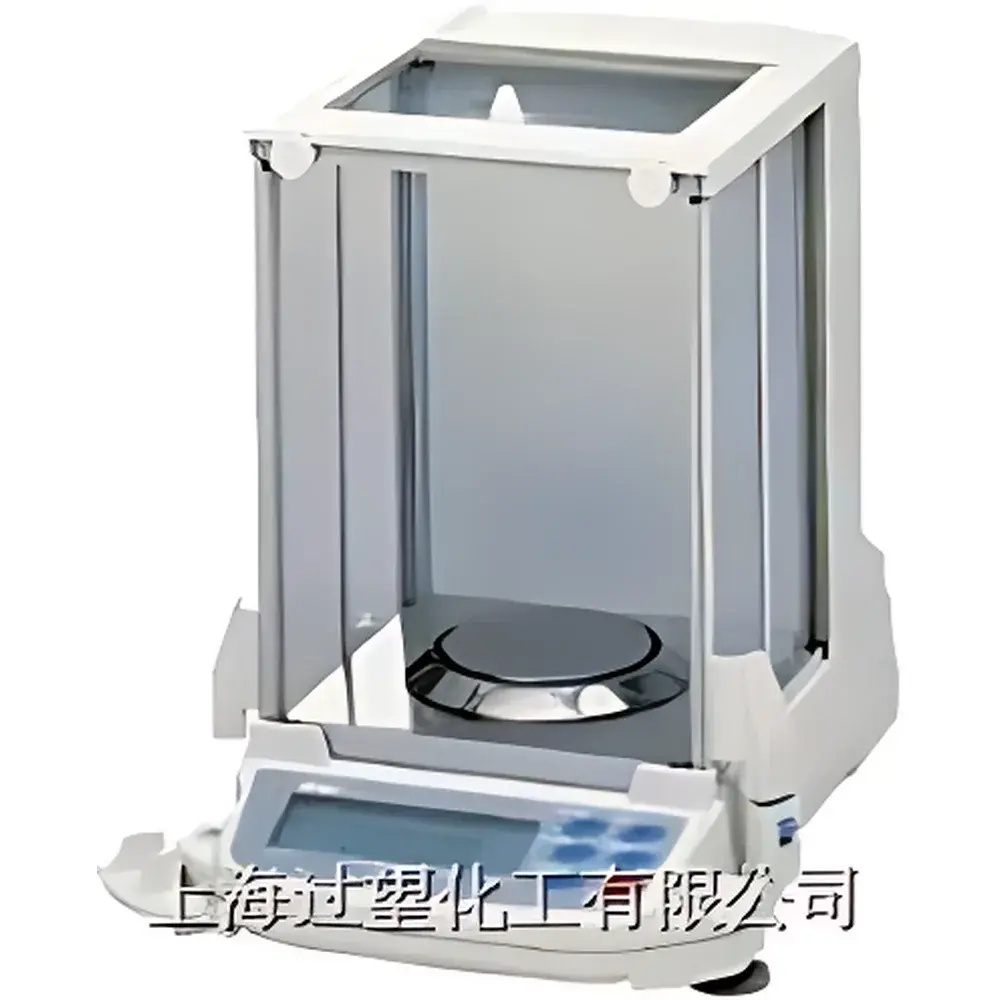
A&D GR Series Precision Analytical Balance
| Brand | A&D |
|---|---|
| Origin | Japan |
| Model | GR-300 / GR-202 / GR-200 / GR-120 |
| Capacity | 120–310 g |
| Readability | 0.01–0.1 mg |
| Pan Diameter | 85 mm |
| Dimensions (W×D×H) | 249 × 330 × 328 mm |
| Weight | ~6.0 kg |
| Calibration | Internal motorized砝码, one-touch auto-calibration |
| Environmental Compensation | Automatic temperature & drift correction |
| Interface | RS-232 standard |
| Compliance | GLP, GMP, GCP, ISO/IEC 17025 |
| Software | WinCT Data Acquisition Suite |
Overview
The A&D GR Series Precision Analytical Balance is a high-stability, microgram-level mass measurement instrument engineered for laboratories requiring traceable accuracy, operational repeatability, and regulatory compliance. Utilizing electromagnetic force restoration (EMFR) technology, the GR Series delivers consistent weighing performance across fluctuating ambient conditions—critical for QC labs, pharmaceutical R&D, and reference material certification. Each unit integrates a precision load cell with active thermal compensation, real-time drift monitoring, and automatic environmental adjustment based on internal temperature and air density modeling. Designed and manufactured in Japan, the GR Series adheres to A&D’s stringent quality control protocols aligned with JIS B 7721 and meets the mechanical and metrological requirements of OIML R76 Class I. Its sealed draft shield with ergonomic glass door handle minimizes convection-induced error while enabling rapid sample access—essential for high-throughput analytical workflows.
Key Features
- Internal motorized calibration mass with one-touch auto-calibration—eliminates manual weight handling and reduces operator-induced variability.
- Automatic environmental compensation system continuously monitors internal temperature gradients and adjusts zero point and sensitivity in real time.
- Draft shield with low-torque, finger-grooved glass door handle ensures smooth, vibration-free opening and closing—optimized for stability-sensitive measurements.
- Multi-unit display support (g, mg, ct, oz, lb, etc.) with programmable decimal places and configurable weighing modes (net/gross/tare, parts counting, percent weighing, density determination).
- Integrated RS-232 interface compliant with ANSI/TIA/EIA-232-F standards; supports bi-directional communication for remote command execution and data export.
- Robust aluminum die-cast base and stainless-steel weighing pan (Ø85 mm) provide mechanical rigidity and corrosion resistance under routine laboratory use.
Sample Compatibility & Compliance
The GR Series accommodates standard analytical vessels—including weighing boats, crucibles, vials, and filter papers—within its centrally positioned Ø85 mm pan. The draft shield aperture and interior height allow unrestricted placement of tall containers up to 200 mm in height. All models comply with Good Laboratory Practice (GLP) and Good Manufacturing Practice (GMP) documentation requirements: each weighing event logs timestamp, operator ID (via optional keypad input), balance ID, calibration status, and environmental parameters. Audit trails meet FDA 21 CFR Part 11 criteria when used with WinCT software configured for electronic signatures and secure user authentication. Full traceability aligns with ISO/IEC 17025:2017 Clause 7.8.2 (result reporting) and ASTM E1153-22 (standard guide for analytical balance qualification).
Software & Data Management
WinCT-Balance software (included) provides validated data acquisition, statistical analysis, and report generation. It enables automated export of raw weighing data (CSV, TXT, XLSX), configurable pass/fail limits with visual alerts, and batch-wise summary statistics (mean, SD, CV%, min/max). The software supports audit trail review with immutable timestamps and user-action logging—fully compliant with GLP/GMP data integrity principles. Data encryption, role-based access control, and electronic signature functionality satisfy 21 CFR Part 11 Subpart B requirements for closed systems. Optional integration with LIMS via ASCII protocol or custom API wrappers facilitates seamless data flow into enterprise quality management systems.
Applications
- Pharmaceutical formulation: Active pharmaceutical ingredient (API) dispensing, excipient ratio verification, and stability study sample preparation per USP & EP monographs.
- Reference material certification: Certified reference material (CRM) mass assignment under ISO Guide 35, requiring ≤0.02% relative uncertainty at 100 g load.
- Environmental testing labs: Filter weighing for PM2.5/PM10 gravimetric analysis per EPA Method IO-4.2 and ISO 12103-1.
- Academic research: Isotope dilution mass spectrometry (IDMS) sample preparation, catalyst loading quantification, and nanomaterial dispersion dosing.
- Food & beverage QA: Nutrient fortification validation, allergen cross-contamination threshold testing, and net content verification per NIST Handbook 133.
FAQ
What calibration standards does the GR Series support?
The GR Series performs internal calibration using factory-traceable weights certified to ISO/IEC 17025-accredited standards. External calibration with NIST-traceable Class E2 or F1 weights is supported via user-initiated calibration mode.
Is the RS-232 interface compatible with modern Windows and macOS systems?
Yes—when paired with a USB-to-RS-232 adapter (e.g., FTDI chipset), WinCT software communicates reliably with Windows 10/11 and macOS 12+ via virtual COM port emulation.
Can the GR Series be integrated into a 21 CFR Part 11-compliant environment?
Yes—when deployed with WinCT’s validated configuration (including password policies, electronic signatures, and audit trail retention ≥6 months), it fulfills technical controls for electronic records and signatures.
Does automatic environmental correction require external sensors?
No—the GR Series uses embedded thermistors and proprietary algorithms to model air buoyancy effects and thermal drift without external hygrometers or barometers.
What is the warm-up time required for optimal accuracy?
A minimum 30-minute stabilization period after power-on is recommended; full metrological readiness (±0.0001 g repeatability) is achieved within 60 minutes under stable lab conditions (20–25 °C, <60% RH, no drafts).