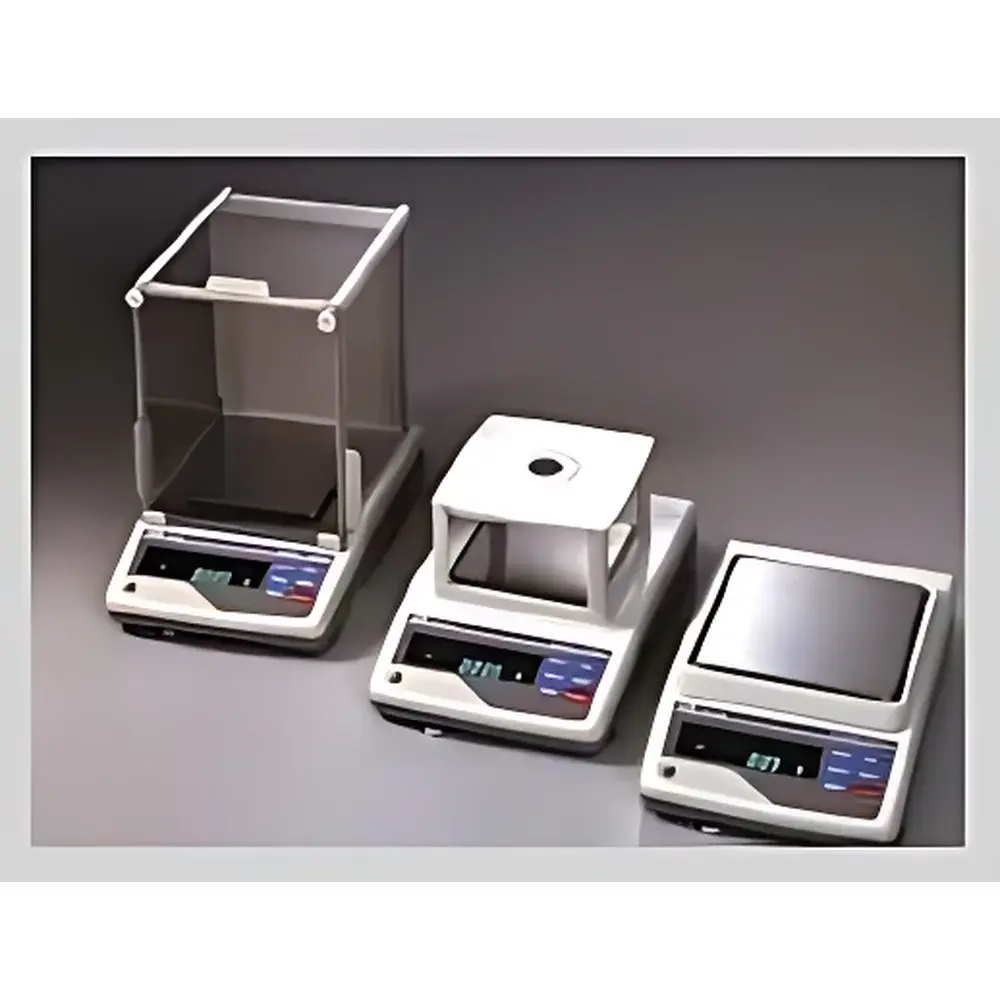
A&D GX Series Precision Electronic Balances
| Brand | A&D |
|---|---|
| Origin | Japan |
| Model | GX Series |
| Weighing Capacity Range | 210 g to 8100 g |
| Readability | 0.001 g / 0.01 g / 0.1 g |
| Repeatability | ±0.001 g / ±0.01 g / ±0.1 g |
| Linearity Error | ±0.002 g to ±0.03 g |
| Pan Size | 128 × 128 mm or 165 × 165 mm |
| Dimensions (W×D×H) | 210 × 317 × 86 mm |
| Weight | ~4.0–4.5 kg |
| IP Rating | IP54 |
| Display | High-contrast fluorescent LCD |
| Internal Calibration | Motor-driven automatic calibration with built-in weights |
| Connectivity | RS-232C interface, Win-CT software compatibility |
| Compliance | GLP, GMP, GCP, ISO standards |
| Data Storage | Up to 40 weighing records + 20 unit weight entries in counting mode |
| Auto-Power-Off | After 10 min idle |
| Weighing Modes | Standard weighing, counting, percentage, animal weighing, density (optional), comparison |
Overview
The A&D GX Series Precision Electronic Balances are high-performance laboratory balances engineered for accuracy, speed, and regulatory compliance in demanding quality control, research, and production environments. Based on A&D’s proprietary SHS (Super Hybrid Sensor) weighing technology, the GX Series employs a robust electromagnetic force compensation mechanism combined with advanced digital signal processing to deliver rapid stabilization—typically within one second—without sacrificing metrological integrity. Designed and manufactured in Japan, each balance integrates an internal motorized calibration system with traceable built-in reference masses, enabling fully automated, user-initiated calibration at any time without external weights. The series spans two performance tiers: microgram-level models (GX-200 to GX-1000, readability 0.001 g) for analytical applications, and milligram- to decigram-level models (GX-2000 to GX-8000, readability 0.01 g or 0.1 g) suited for formulation, bulk material handling, and process verification. All units conform to international metrological requirements and support audit-ready workflows under GLP, GMP, and ISO frameworks.
Key Features
- Rapid stabilization (<1 s) enabled by SHS sensor architecture and optimized damping algorithms
- Motor-driven internal calibration with certified built-in weights—no manual intervention required
- High-contrast fluorescent LCD display with wide viewing angle and ambient-light adaptability
- IP54-rated enclosure providing protection against dust ingress and water splashes during routine lab use
- Multi-mode operation: standard weighing, parts counting, percentage weighing, animal (dynamic) weighing, and optional density determination
- Programmable auto-power-off (10-minute idle timeout) and configurable data logging intervals (2 s to 10 min)
- Integrated real-time clock with calendar function for GLP-compliant timestamping of all stored records
Sample Compatibility & Compliance
The GX Series accommodates diverse sample types—from fine powders and pharmaceutical actives to irregular biological specimens—via its stable, low-profile weighing pan (128 × 128 mm or 165 × 165 mm) and draft shield-compatible design. All models meet OIML R76-1 Class II and III accuracy classifications per application tier. Regulatory readiness is embedded into firmware: electronic records include operator ID (if configured via external authentication), date/time stamps, balance ID, and calibration status—all exportable via RS-232C. The system supports full traceability per FDA 21 CFR Part 11 when used with validated Win-CT software and appropriate access controls, fulfilling documentation requirements for GMP manufacturing, clinical trial material handling (GCP), and accredited testing laboratories (ISO/IEC 17025).
Software & Data Management
Win-CT software (Windows-compatible) provides direct bidirectional communication for real-time data capture, remote configuration, and report generation. Stored datasets—including up to 40 individual weighings and 20 unit-weight entries in counting mode—are retrievable with full metadata (timestamp, net/gross/tare, mode, calibration flag). Data export formats include CSV and TXT for integration into LIMS or ERP systems. Audit trail functionality logs all critical events: calibration actions, parameter changes, and data deletions—with immutable timestamps. Optional password-protected user levels ensure role-based access control aligned with ALCOA+ principles (Attributable, Legible, Contemporaneous, Original, Accurate, Complete, Consistent, Enduring, Available).
Applications
- Pharmaceutical QC labs: active ingredient assay, tablet weight uniformity, excipient blending verification
- Chemical R&D: stoichiometric reagent dispensing, catalyst loading, reaction yield calculation
- Food & beverage QA: portion control validation, ingredient reconciliation, nutritional labeling compliance
- Academic research: gravimetric analysis, solution preparation, material density profiling (with optional kit)
- Medical device manufacturing: component weight sorting, packaging net content verification
FAQ
Does the GX Series support external calibration with traceable standards?
Yes—while internal motorized calibration is standard, all models accept external calibration using NIST-traceable weights per ISO 9001 and USP <41> guidelines.
Can the balance be integrated into a networked laboratory environment?
RS-232C enables point-to-point connection to PCs or printers; Ethernet or Wi-Fi modules are not natively supported but may be added via third-party serial servers compliant with RFC 2217.
Is the Win-CT software compliant with 21 CFR Part 11?
When deployed with documented system validation, electronic signatures, and audit trail review procedures, Win-CT satisfies Part 11 requirements for electronic records and signatures.
What maintenance is required beyond scheduled calibration?
No routine mechanical servicing is needed; users should perform daily cleaning per A&D’s recommended protocol and verify calibration before critical measurements.
How does the GX Series handle vibration or air currents in non-draft-shielded environments?
The SHS sensor’s dual feedback loop and adaptive filtering minimize drift from minor environmental perturbations, though ISO 17025-compliant operations require controlled conditions and appropriate draft shielding for Class II accuracy work.