
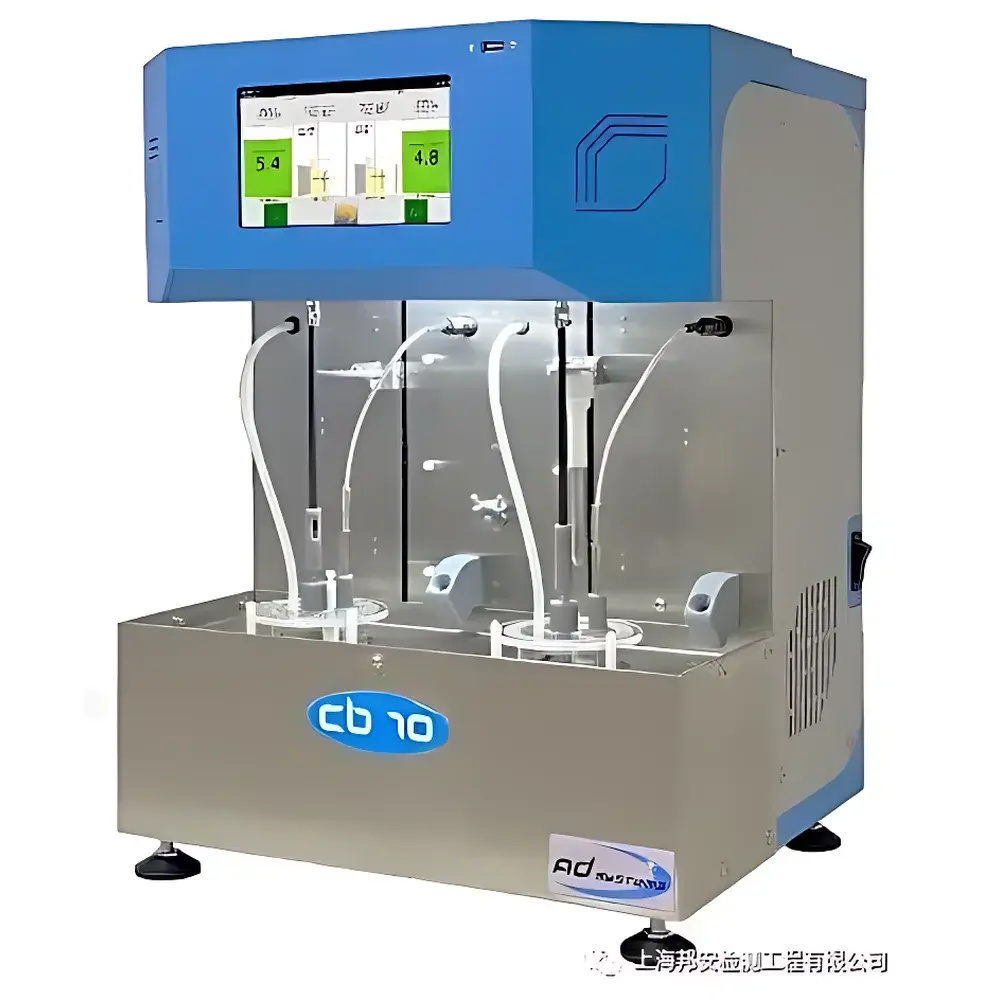
AD System CB10 Automated Rust Prevention Tester
| Brand | AD System |
|---|---|
| Origin | France |
| Model | CB10 |
| Compliance | ASTM D665, ASTM D7548, NACE TM0172, IP 135, ISO 7120, JIS K2510 |
| Test Positions | 2 independent stations |
| Automation Level | Fully automated water injection, temperature ramping, stirring, specimen immersion & retrieval |
| Interface | Touchscreen with embedded calibration datasets |
| Safety | Direct-drive low-torque motor with immediate stall detection and emergency stop |
| Integration | Compatible with CT10 Corrosion Rating Station for end-to-end automated evaluation |
Overview
The AD System CB10 Automated Rust Prevention Tester is a precision-engineered instrument designed for standardized evaluation of rust-inhibiting properties in petroleum-based lubricants, hydraulic fluids, turbine oils, and marine engine oils. It operates on the fundamental principle of controlled corrosion acceleration under defined thermal, mechanical, and aqueous conditions—mimicking real-world service environments where water ingress compromises oil film integrity and initiates ferrous metal oxidation. The system strictly adheres to internationally recognized test protocols including ASTM D665 (Standard Test Method for Rust-Preventing Characteristics of Inhibited Mineral Oil in the Presence of Water), ASTM D7548 (Standard Test Method for Determining Rust-Inhibiting Properties of Lubricating Greases), NACE TM0172 (Laboratory Evaluation of Corrosion Inhibitors for Oilfield Applications), IP 135, ISO 7120, and JIS K2510. Unlike manual or semi-automated alternatives, the CB10 eliminates operator-dependent variables—such as inconsistent water dosing, imprecise temperature stabilization, or delayed specimen immersion—ensuring high inter-laboratory reproducibility and compliance with GLP and GMP documentation requirements.
Key Features
- Fully automated test sequence: integrated heating, magnetic stirring, precise deionized water injection (±0.1 mL accuracy), timed specimen immersion, and post-test automatic specimen lifting for visual or digital assessment
- Dual independent test stations enable parallel evaluation of two samples under identical environmental conditions—reducing throughput time by up to 50% compared to single-station systems
- Embedded touchscreen interface with preloaded method templates aligned to ASTM, ISO, and NACE standards; supports user-defined parameter sets with password-protected access levels
- Direct-drive low-torque motor with real-time torque monitoring: halts rotation within <100 ms upon mechanical obstruction—preventing damage to specimens, stir bars, or vessel walls
- Onboard calibration dataset storage ensures traceable instrument performance verification without external software or USB dependency
- Thermal control accuracy of ±0.5 °C across 28–82 °C operating range, validated per ASTM E74 and ISO/IEC 17025 calibration guidelines
Sample Compatibility & Compliance
The CB10 accommodates standard ASTM D665 test vessels (250 mL glass beakers) and accepts ferrous test specimens conforming to ASTM D665 specifications—including polished, degreased, and weighed steel rods (12.7 mm × 76 mm, 1010 carbon steel). It supports both inhibited and uninhibited base oils, synthetic esters, polyalkylene glycols (PAGs), and greases (with optional viscosity-adjusted protocol modules). All operational parameters—including water addition volume (typically 30 mL), immersion duration (24 h or 48 h), temperature setpoint (e.g., 60 °C for D665A, 82 °C for D665B), and stirring speed (300 rpm ±5 rpm)—are programmable and auditable. The system meets functional requirements for regulatory submissions under FDA 21 CFR Part 11 when paired with compliant electronic record systems, and its design aligns with ISO/IEC 17025 clause 6.4.10 regarding equipment suitability for intended use.
Software & Data Management
The CB10 operates autonomously without PC dependency, yet exports timestamped test logs (CSV format) via USB port—including start/end times, actual vs. setpoint temperatures, water injection confirmation, motor torque profiles, and operator ID. Audit trails retain all parameter modifications with date/time stamps and user credentials. When deployed in regulated environments, the device integrates seamlessly with LIMS platforms through RS-232 or Ethernet (optional module), supporting structured data exchange compliant with ASTM E1384 and ISO 15197. All firmware updates are digitally signed and version-controlled, ensuring integrity during validation lifecycle management.
Applications
- Quality control of rust inhibitors in turbine and hydraulic oils per OEM specifications (e.g., GEK 32568, Siemens TLV 9013)
- R&D screening of additive packages for improved hydrolytic stability and interfacial protection
- Third-party certification testing for API RP 500 and ISO 8502-3-compliant corrosion resistance claims
- Field oil analysis laboratories performing routine rust prevention verification in accordance with refinery QC protocols
- Contract testing organizations requiring auditable, repeatable execution of multi-standard corrosion assessments
FAQ
Does the CB10 require external water purification or conditioning systems?
No—the instrument is designed for direct connection to laboratory-grade deionized water (≥1 MΩ·cm resistivity); built-in flow sensors and pressure regulators ensure consistent delivery without auxiliary hardware.
Can test methods be modified to accommodate non-standard immersion durations or temperatures?
Yes—user-defined protocols may be created and saved, though deviations from ASTM/ISO/NACE reference methods must be documented per internal SOPs and reported transparently in final test reports.
Is the CB10 compatible with the CT10 Corrosion Rating Station for automated image-based assessment?
Yes—CB10 and CT10 share synchronized communication protocols (Modbus RTU over RS-485), enabling unattended transfer of specimen IDs and test metadata to initiate digital rust grading immediately after retrieval.
What maintenance intervals are recommended for long-term reliability?
Quarterly verification of thermal sensor accuracy and annual recalibration of water delivery subsystem are advised; full calibration certificates traceable to national metrology institutes (LNE, France) are available upon request.






