
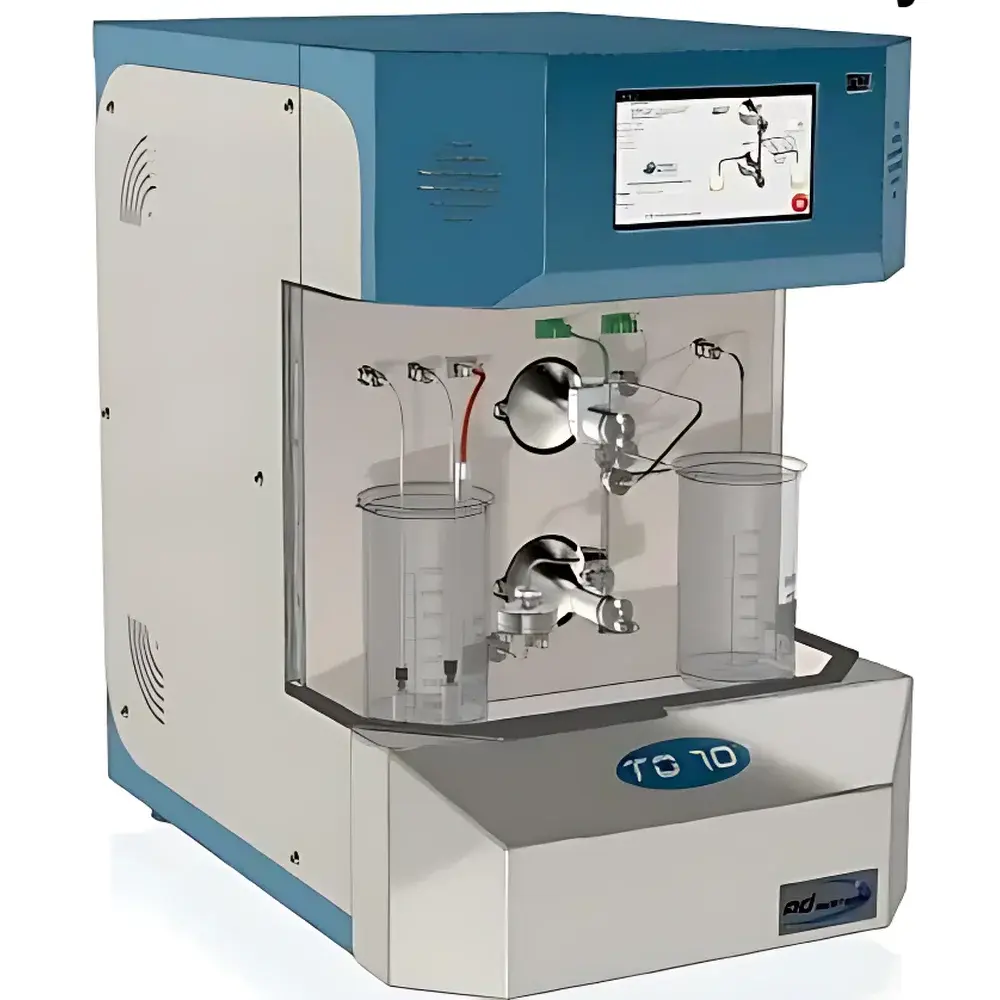
AD System TO10 Jet Fuel Thermal Oxidation Stability Tester
| Brand | AD System |
|---|---|
| Origin | France |
| Model | TO10 |
| Test Standards | ASTM D3241, GB/T 9169, IP 323, ISO 6249 |
| Temperature Range | 100–380 °C |
| Pressure Drop Range | 0–750 mmHg (auto-bypass +700 mmHg) |
| Test Duration | 4–600 min |
| Air Flow Rate | 1.5 L/min (programmable) |
| Fuel Flow Control | Dual 5 mL syringe pumps (±1% accuracy) |
| Temperature Sensing | Class 1 K-type thermocouples |
| Cooling Method | Peltier + heat pipe (liquid-free) |
| Dimensions | 440 × 600 × 670 mm |
| Weight | 60 kg |
| Power Supply | 100–240 V, 8 A, 50/60 Hz |
| Operating Ambient | +10 to +35 °C |
| Connectivity | Ethernet (RJ45), USB ×2, optional USB printer |
| Data Storage | Integrated DR10 ITR interface with automated result transfer via Ethernet |
Overview
The AD System TO10 Jet Fuel Thermal Oxidation Stability Tester is a fully automated benchtop instrument engineered for precise evaluation of thermal oxidative degradation behavior in aviation turbine fuels—primarily Jet A, Jet A-1, JP-5, and JP-8—under controlled high-temperature, pressurized airflow conditions. It operates on the principle of accelerated thermal stress testing: fuel is continuously metered through a heated stainless-steel tube while exposed to regulated, humidified air flow; oxidation-induced deposit formation is quantified by monitoring differential pressure across the test section over time. This methodology directly correlates with real-world fuel system fouling potential in aircraft engines and auxiliary power units (APUs), making the TO10 essential for compliance with specification limits defined in ASTM D3241 (Standard Test Method for Thermal Oxidation Stability of Aviation Turbine Fuels) and its international equivalents (ISO 6249, IP 323, GB/T 9169). Unlike conventional oven-based or static tube methods, the TO10 replicates dynamic flow conditions and enables reproducible, operator-independent assessment of deposit onset temperature, induction period, and pressure rise kinetics.
Key Features
- Dual independent 5 mL precision syringe pumps for consistent, maintenance-free fuel delivery; flow rate programmable per test method with ±1% volumetric accuracy
- Automated, humidity-compensated air injection system with integrated RH sensor—alerts users when desiccant replacement is required
- Modular heated tube assembly with rapid-mount design for precise axial positioning and thermal uniformity verification
- Independent temperature control architecture using Peltier elements and passive heat-pipe cooling—eliminates external coolant circulation and associated maintenance
- Programmable thermal ramp profiles: up to 21 preloaded or user-defined test protocols compliant with ASTM, ISO, IP, and GB standards
- Real-time differential pressure monitoring (0–750 mmHg range) with automatic bypass activation at +700 mmHg to prevent system overpressure
- Integrated DR10 ITR interface enabling bidirectional Ethernet communication (RJ45) for automated result synchronization, audit-ready data export, and remote diagnostics
- Intuitive touchscreen HMI with graphical workflow navigation, built-in service mode featuring interactive schematic diagnostics, and symbol-level component status verification
Sample Compatibility & Compliance
The TO10 is validated for use with all common hydrocarbon-based aviation turbine fuels meeting DEF STAN 91-91, MIL-DTL-83133, and ASTM D1655 specifications. It accommodates sample volumes as low as 15 mL per test, minimizing material consumption during qualification screening. All hardware and firmware comply with CE marking requirements (2014/30/EU EMC Directive and 2014/35/EU Low Voltage Directive). The instrument supports GLP-compliant operation through timestamped, user-authenticated test logs, immutable result storage, and full traceability of calibration events and parameter changes—fully aligned with FDA 21 CFR Part 11 data integrity expectations when paired with validated LIMS integration. Test reports include raw pressure/time curves, derivative analysis, induction point identification, and pass/fail determination against specified pressure thresholds (e.g., 30 mmHg ΔP per ASTM D3241).
Software & Data Management
Control and analysis are managed via embedded Linux-based firmware with a web-accessible configuration interface. All test parameters—including temperature setpoints, ramp rates, airflow duration, and fuel flow profiles—are stored in encrypted internal memory. Results are automatically archived in a relational database structure accessible via USB mass storage or Ethernet (SMB/CIFS protocol). The DR10 ITR connection enables seamless integration into centralized laboratory data systems: completed tests trigger event-driven data pushes containing CSV-formatted kinetic curves, metadata (operator ID, instrument serial, calibration status), and digital signatures. Audit trails record every user action—including method edits, calibration initiations, and result exports—with ISO/IEC 17025-aligned timestamps and role-based access controls.
Applications
- Quality assurance of batch-certified jet fuels prior to distribution or military acceptance
- Stability screening of alternative aviation fuels (SAF), including Fischer–Tropsch, HEFA, and alcohol-to-jet blends
- Formulation development support for antioxidant package optimization (e.g., BHT, hindered phenols)
- Investigation of fuel–material compatibility with elastomers, seals, and fuel system coatings under thermal stress
- Root-cause analysis of field-reported fuel filter plugging or heat exchanger fouling incidents
- Regulatory submission testing for civil aviation authorities (EASA, FAA, CAAC) requiring documented oxidation stability performance
FAQ
What standards does the TO10 support out-of-the-box?
ASTM D3241, ISO 6249, IP 323, and GB/T 9169 are preconfigured; up to 21 additional custom protocols can be loaded via USB.
Is external cooling water required?
No—the system uses solid-state Peltier modules combined with copper heat-pipe technology for active heating and passive heat dissipation, eliminating dependence on chilled water or glycol loops.
How is fuel flow accuracy maintained over time?
Dual syringe pumps are calibrated using gravimetric NIST-traceable procedures; no consumable tubing or valves require periodic replacement, ensuring long-term flow stability without recalibration drift.
Can test data be exported to LIMS without manual intervention?
Yes—via Ethernet-connected DR10 ITR, results are pushed automatically in structured CSV/JSON format with embedded metadata, supporting automated ingestion into major LIMS platforms (e.g., LabWare, STARLIMS, Thermo SampleManager).
What safety features prevent overheating or overpressure during extended tests?
Hardware-enforced dual-layer protection: independent K-type thermocouple monitoring triggers immediate thermal shutdown if deviation exceeds ±5 °C from setpoint; pressure transducer feedback activates mechanical bypass at 700 mmHg, independent of software state.







