Adam Equinox Semi-Micro Analytical Balance
| Brand | Adam |
|---|---|
| Origin | United Kingdom |
| Manufacturer Type | Original Equipment Manufacturer (OEM) |
| Import Status | Imported |
| Model | EAB Series |
| Instrument Type | Analytical Balance |
| Capacity Range | 200–500 g |
| Readability | 0.01 mg / 0.1 mg |
| Maximum Capacity | 510 g |
| Repeatability | 0.02 mg |
| Calibration | Fully Automatic Internal Calibration and Optional External Calibration |
| Compliance | GLP-Compliant Data Logging, ISO/IEC 17025 Supportable, ASTM E898-22 Referenced Procedures |
Overview
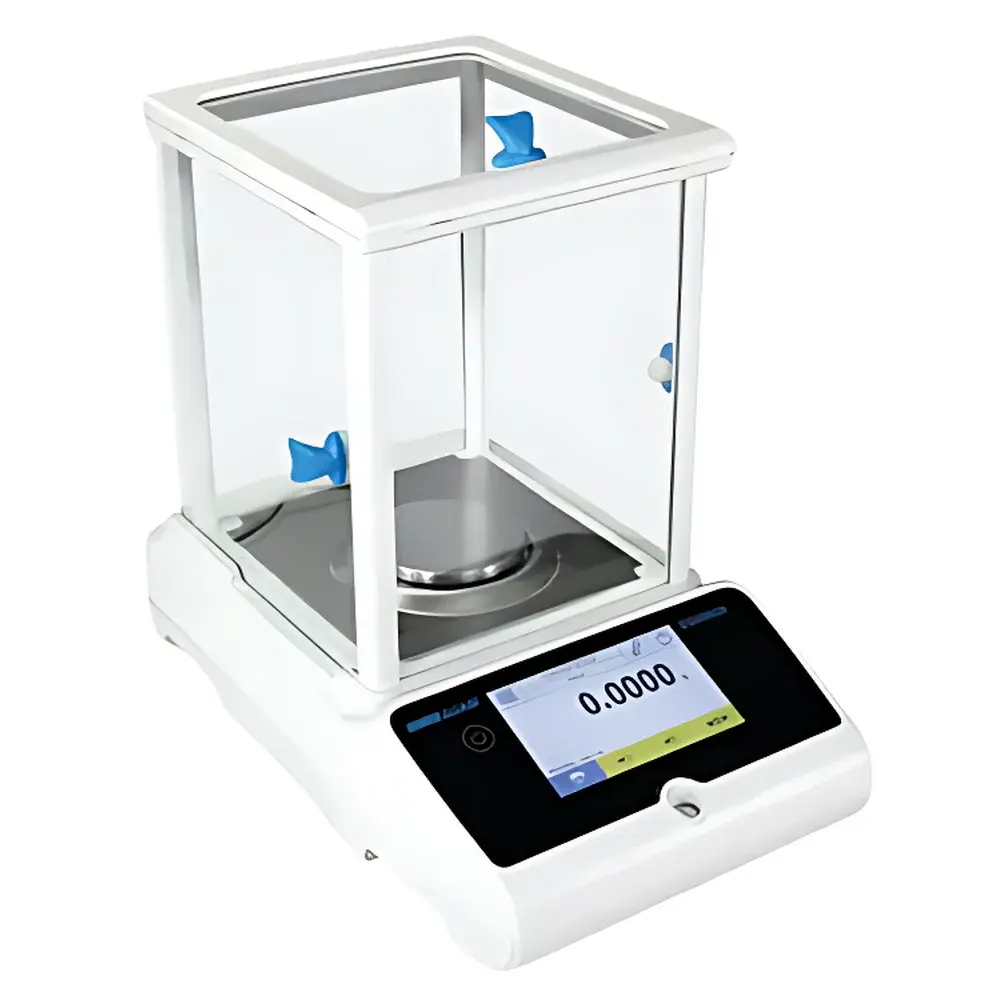
The Adam Equinox Semi-Micro Analytical Balance is a high-precision mass measurement instrument engineered for laboratories requiring trace-level accuracy in demanding analytical workflows. Utilizing electromagnetic force restoration (EMFR) technology, the Equinox delivers stable, drift-compensated weighing performance under variable environmental conditions. Its core architecture integrates temperature-compensated load cells, active damping algorithms, and real-time environmental monitoring to ensure metrological integrity across daily operation. Designed for applications where uncertainty budgets must remain below ±0.02 mg repeatability—such as reference standard preparation, pharmaceutical assay validation, catalyst mass dosing, and nanomaterial formulation—the Equinox meets the functional requirements of ISO 9001-certified quality systems and supports audit-ready documentation per FDA 21 CFR Part 11 when paired with compliant software.
Key Features
- 5-inch capacitive touchscreen (800 × 480 px) with intuitive icon-driven navigation and multi-language UI (English, Spanish, French, German, Chinese, Japanese)
- Integrated leveling system with dual-axis bubble level and height-adjustable stainless-steel feet for rapid horizontal alignment
- 304 stainless-steel weighing pan (80 mm diameter) optimized for chemical resistance and ease of decontamination
- Standard glass draft shield (192 × 195 × 230 mm W×D×H) with quick-release mechanism and anti-static coating
- Dual calibration options: fully automatic internal calibration (i-models) or user-initiated external calibration using certified weights (e-models)
- Configurable digital filtering to suppress mechanical vibration and acoustic interference without compromising response time
- GLP-compliant data output: timestamped printouts via RS-232 or USB-connected printers; auto-inclusion of operator ID, balance ID, and environmental metadata
- Password-protected access control with role-based permissions (operator, supervisor, administrator)
- Onboard storage (internal flash memory) for ≥10,000 measurement records, including statistical summaries and calibration logs
- Pre-tared weighing mode and programmable sample counting (PCS) with selectable unit weight averaging over up to 100 reference parts
Sample Compatibility & Compliance
The Equinox accommodates diverse sample forms—including powders, granules, lyophilized solids, micro-vials, and small metallic components—within its 80 mm stainless-steel pan and enclosed draft shield. Its 510 g maximum capacity and 0.01 mg readability support both semi-micro (1–100 mg) and standard analytical (100 mg–500 g) use cases without hardware reconfiguration. All models comply with international metrological standards: OIML R76-1 (2021), EN 45501:2015, and ANSI/NCSL Z540.3–2013. The balance’s firmware implements deterministic data handling protocols aligned with ISO/IEC 17025:2017 clause 7.7 (result reporting) and supports traceable calibration intervals per ASTM E898-22 (Standard Guide for Selection and Use of Laboratory Balances).
Software & Data Management
Data export is supported via native RS-232 serial protocol (ASCII format) and USB virtual COM port emulation. Raw measurements, timestamps, operator codes, and environmental readings (temperature, humidity if externally monitored) are structured into CSV-compatible streams for integration with LIMS, ELN, or custom QA databases. Internal memory retains full audit trails—including calibration events, parameter changes, and error logs—with immutable timestamps. When used with validated third-party software (e.g., LabX™ or custom Python-based parsers), the Equinox satisfies 21 CFR Part 11 requirements for electronic records and signatures, provided system-level access controls, audit trail review functions, and electronic signature workflows are implemented at the host application layer.
Applications
- Pharmaceutical QC: Active pharmaceutical ingredient (API) dispensing, reference standard dilution, tablet weight uniformity testing per USP <905>
- Materials science: Catalyst loading precision, thin-film deposition mass verification, nanoparticle yield quantification
- Academic research: Stoichiometric reagent preparation, gravimetric titration endpoint confirmation, isotope-enriched compound handling
- Food & beverage: Nutrient fortification verification, additive concentration profiling, moisture loss determination
- Environmental testing: Filter mass gain analysis (PM2.5/PM10), soil organic carbon quantification, sediment trap calibration
- Forensics & toxicology: Controlled substance mass verification, evidence chain-of-custody documentation
FAQ
What is the difference between internal and external calibration models?
Internal calibration (i-models) uses a built-in motorized weight and temperature-compensated actuator for fully automated recalibration triggered manually or on schedule. External calibration (e-models) require manual placement of certified weights; however, they retain all other Equinox features including GLP logging and touchscreen interface.
Does the Equinox support density determination?
Yes—when used with an optional density kit (including sinker, thermometer, and liquid bath), the balance executes ASTM D792-22 and ISO 1183-1 density protocols via built-in calculation modes for solid and liquid samples.
Can the balance be integrated into a networked laboratory environment?
While the Equinox lacks native Ethernet or Wi-Fi, its RS-232 and USB I/O ports enable reliable integration with centralized data acquisition servers via industrial-grade serial-to-Ethernet converters or USB-over-IP gateways compliant with IEEE 802.3.
Is the draft shield removable for large-sample weighing?
The glass draft shield is designed for secure, tool-free removal and reinstallation; however, removing it invalidates calibration validity for sub-0.1 mg measurements and is only recommended for gross weighing tasks outside metrological specifications.
How does the Equinox handle electrostatic interference during low-mass weighing?
The balance incorporates grounded metal shielding around critical sensor electronics and supports optional ionizer integration via USB I/O; users are advised to maintain relative humidity >40% and use antistatic labware to minimize charge-related drift.