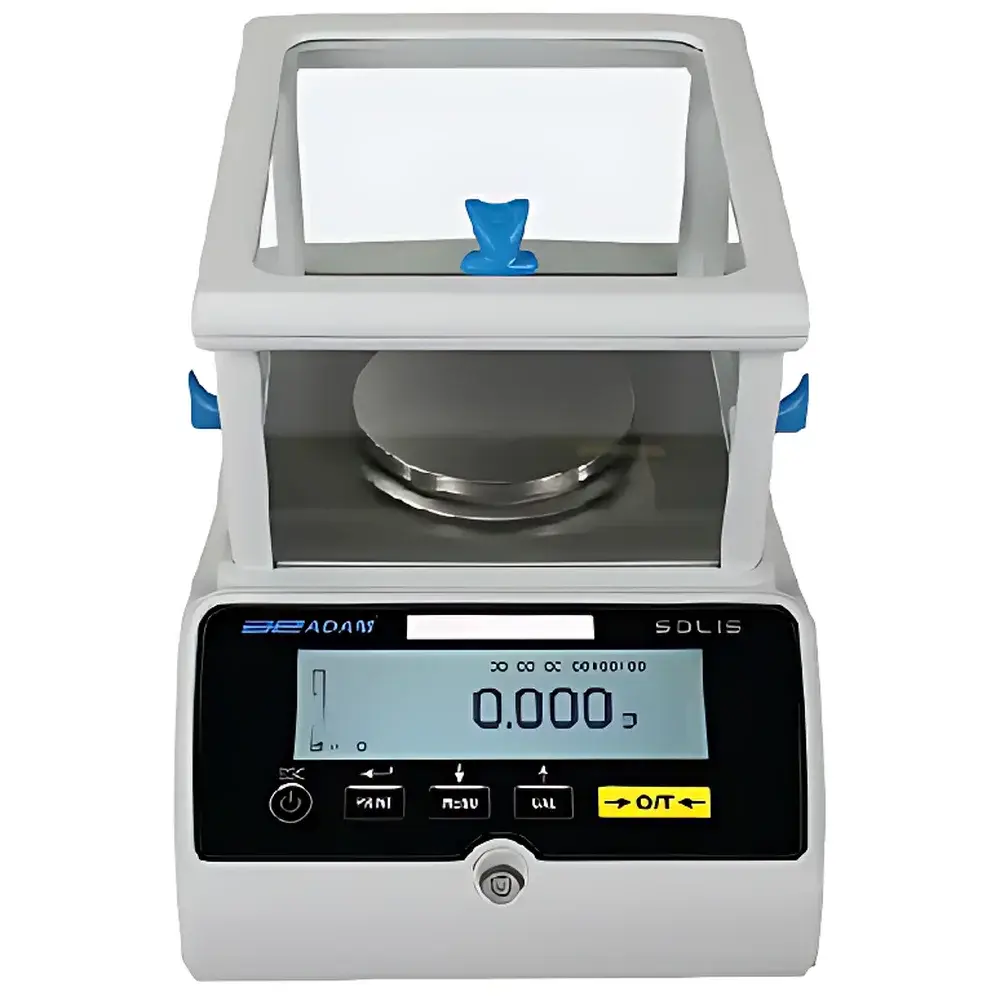
Adam Solis SPB Series Precision Balance
| Brand | Adam |
|---|---|
| Origin | United Kingdom |
| Manufacturer Type | Original Equipment Manufacturer (OEM) |
| Product Category | Imported Instrument |
| Model | SPB363i / SPB723i / SPB1203i / SPB2103i (Internal Calibration) / SPB363e / SPB723e (External Calibration) |
| Weighing Capacity | 360 g – 2100 g |
| Readability | 0.001 g |
| Repeatability | ±0.002 g |
| Linearity Error | ±0.003 g to ±0.005 g |
| Stabilization Time | ≤3 s |
| Calibration | Internal (i-series) or External (e-series) |
| Display | 15-mm-high graphical LCD |
| Pan Size | 110 mm diameter |
| Draft Shield | Standard tempered glass square shield (192 × 195 × 115 mm, W×D×H) |
| Housing Material | ABS plastic |
| Dimensions (W×D×H) | 224 × 374 × 219 mm |
| Net Weight | 6.4 kg (i-series), 6.7 kg (e-series) |
| Power Supply | 24 V DC, 50/60 Hz, 500 mA adapter |
| Operating Temperature | 10 °C – 30 °C |
| Connectivity | RS-232 |
| Weighing Units | g, mg, ct, GN, lb, oz, ozt, dwt, mm, tl.T, tl.H, tl.S, T, user-defined |
| Compliance | GLP-compliant data logging (date/time stamp), password protection, audit-ready operation |
Overview
The Adam Solis SPB Series Precision Balances are laboratory-grade weighing instruments engineered for high reproducibility, metrological stability, and operational robustness in regulated and non-regulated environments. Built on a fundamental principle of electromagnetic force compensation (EMFC), the SPB series delivers consistent mass measurement by dynamically balancing the gravitational force acting on a sample against a precisely controlled electromagnetic counterforce. This architecture ensures minimal drift, low thermal sensitivity, and intrinsic linearity across the full weighing range—critical attributes for applications requiring traceable, ISO/IEC 17025-aligned measurements. Designed and manufactured in the United Kingdom by Adam Equipment—a globally recognized OEM with over 45 years of metrology expertise—the SPB balances meet stringent mechanical and electrical design standards for Class II and III precision applications per OIML R 76-1 and EN 45501. Their compact footprint, integrated draft shield, and ergonomic interface make them suitable for benchtop deployment in QC labs, university teaching facilities, pharmaceutical R&D, and industrial process support where space efficiency and regulatory readiness are prioritized.
Key Features
- Electromagnetic force compensation (EMFC) transduction system ensuring long-term stability and minimal zero drift
- High-contrast 15-mm graphical LCD with intuitive icon-driven navigation and multi-language support (English, Spanish, French, German, Chinese, Portuguese)
- Integrated level indicator and adjustable leveling feet for rapid horizontal alignment—essential for maintaining metrological integrity under variable floor conditions
- Tempered glass square draft shield (192 × 195 × 115 mm) with optimized airflow geometry to minimize convective interference without compromising accessibility
- 304 stainless steel weighing pan (Ø110 mm) resistant to corrosion, abrasion, and chemical exposure—facilitating rapid decontamination between samples
- Dual calibration options: fully automatic internal calibration (i-series) with motorized weight actuation, or external calibration (e-series) using certified reference masses compliant with ISO 9001 and ISO/IEC 17025 traceability requirements
- Digital filtering algorithms configurable to suppress low-frequency mechanical vibrations (e.g., from HVAC systems or adjacent equipment)
- GLP-compliant data output via RS-232: auto-stamped timestamps (date/time), user ID prompts, and printable reports meeting FDA 21 CFR Part 11 documentation expectations when paired with compliant software
- Password-protected configuration mode preventing unauthorized modification of calibration parameters, unit settings, or security thresholds
- Multi-function weighing modes including parts counting (with preset unit weight), percentage weighing, checkweighing with visual/audible deviation alerts, dynamic/animal weighing, density determination (with optional kit), formulation, and totalization
Sample Compatibility & Compliance
The Solis SPB balances accommodate a broad spectrum of sample types—from powders and granules to small solid components and liquid-filled containers—within their defined capacity and readability envelope. The 304 stainless steel pan and sealed ABS housing provide compatibility with mild solvents, aqueous solutions, and routine cleaning agents (e.g., 70% ethanol, isopropanol). All models comply with electromagnetic compatibility (EMC) directives (EN 61326-1) and safety standards (EN 61010-1), and support GLP/GMP workflows through mandatory features including operator authentication, timestamped result export, and audit trail generation (when interfaced with validated third-party LIMS or ELN platforms). While not intrinsically rated for hazardous locations, the SPB series is routinely deployed in ISO Class 5–8 cleanrooms and cGMP manufacturing support labs where environmental control is maintained externally.
Software & Data Management
Data capture is natively supported via standard RS-232 serial protocol, enabling seamless integration with laboratory information management systems (LIMS), electronic lab notebooks (ELN), or custom SCADA interfaces. Output format follows ASCII-based, delimiter-free syntax compatible with Microsoft Excel, LabChart, and industry-standard data acquisition software. Optional PC software (e.g., Adam DU Recorder) provides real-time graphing, statistical analysis (mean, SD, CV%), batch reporting, and automated PDF export—all preserving original timestamp metadata. For regulated environments, the balance supports 21 CFR Part 11 compliance when used with validated software that enforces electronic signatures, role-based access control, and immutable audit logs. Internal memory retains up to 1000 records with time/date stamps, accessible via direct printout or serial dump.
Applications
- Quality control testing in pharmaceutical, food, and chemical manufacturing (e.g., raw material verification, tablet weight checks, excipient dispensing)
- Academic and research laboratories performing gravimetric analysis, stoichiometric preparation, and method validation per USP , EP 2.1.3, or ASTM E898
- Calibration laboratories conducting intermediate checks and uncertainty budgeting for lower-tier mass standards
- Industrial R&D labs executing formulation development, blend uniformity assessment, and packaging fill-weight optimization
- Veterinary and agricultural labs performing feed rationing, seed counting, and nutrient concentration assays
- Teaching laboratories demonstrating metrological principles, error propagation, and statistical process control fundamentals
FAQ
What is the difference between internal and external calibration models?
Internal calibration (i-series) uses an integrated motorized calibration weight and automatic sequence triggered manually or on schedule; external calibration (e-series) requires manual placement of certified weights and is typically preferred where independent verification or third-party audit is required.
Is the SPB series compliant with ISO/IEC 17025 requirements?
Yes—when operated within specified environmental conditions (10–30 °C, ≤80% RH non-condensing), calibrated using traceable standards, and documented per organizational SOPs, the SPB meets metrological criteria outlined in ISO/IEC 17025:2017 Clause 6.4 (Equipment).
Can the balance be connected to a networked printer or LIMS?
Direct Ethernet or Wi-Fi connectivity is not built-in; however, RS-232 output can be routed via USB-to-serial adapters or industrial protocol converters (e.g., Modbus RTU gateways) for integration into networked infrastructure.
Does the SPB support density determination?
Yes—with optional accessories (density kit including sinker, thermometer, and pycnometer stand), the balance executes Archimedean density calculations per ISO 1183-1, supporting both solid and liquid sample protocols.
What maintenance is required to sustain accuracy?
Routine cleaning of the pan and draft shield, periodic verification using Class M2 or better weights, annual preventive maintenance (PM) by authorized service technicians, and environmental monitoring (temperature/humidity/stability) per ISO 4787.