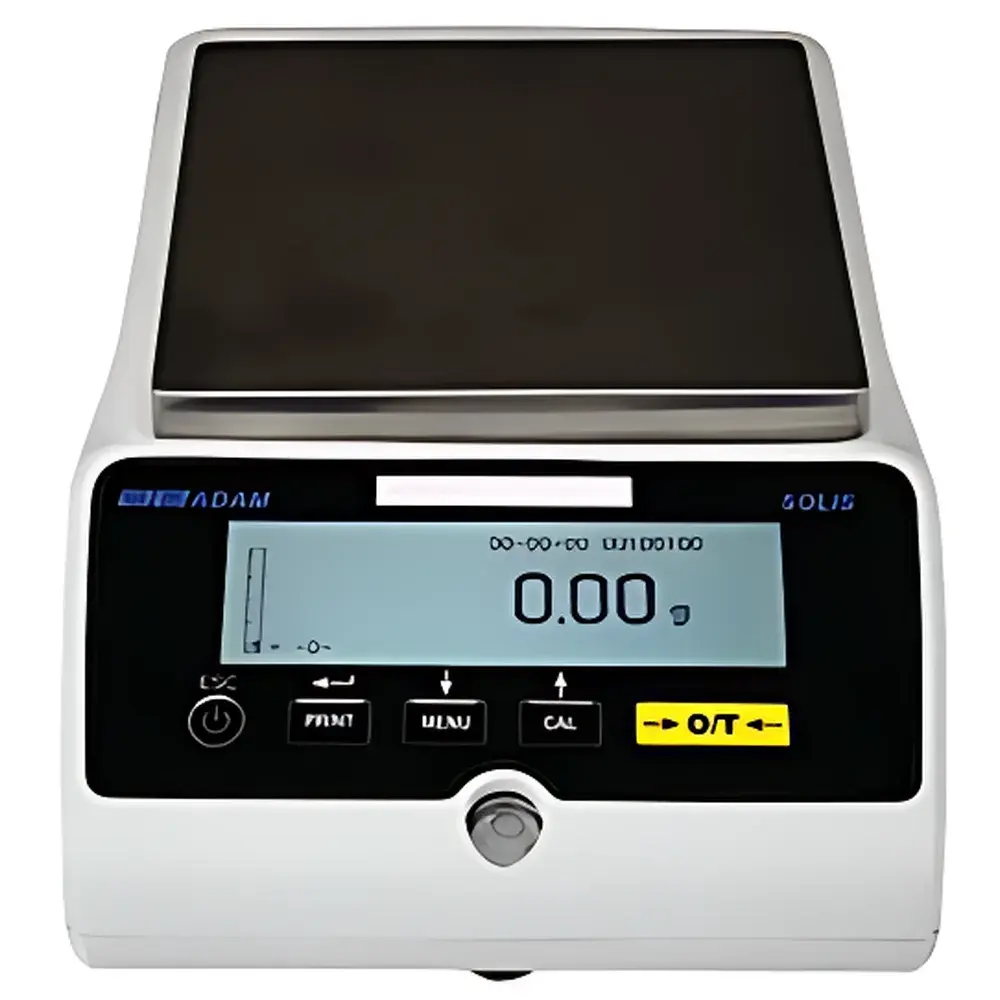
Adam Solis STB Series Precision Balance (0.01 g Readability)
| Brand | Adam |
|---|---|
| Origin | UK |
| Manufacturer | Adam Equipment |
| Type | Precision Balance |
| Model | STB |
| Capacity | 3200–8200 g |
| Readability | 0.01 g |
| Repeatability | ±0.02 g |
| Linearity Error | ±0.03–0.04 g |
| Stabilization Time | 3 s |
| Calibration | Internal (i-models) or External (e-models) |
| Display | 15 mm high graphical LCD |
| Weighing Units | g, mg, ct, GN, lb, oz, ozt, dwt, mm, tl.T, tl.H, tl.S, T, custom |
| Interface | RS-232 |
| Operating Temperature | 10–30 °C |
| Power Supply | 24 V DC, 50/60 Hz, 500 mA adapter |
| Pan Size | 185 × 185 mm |
| Dimensions (W×D×H) | 224 × 374 × 95 mm |
| Net Weight | 6.4 kg (i), 6.7 kg (e) |
| Construction | ABS housing, 304 stainless steel pan |
| Compliance | GLP-compliant data logging, password protection, audit-ready timestamped printouts |
Overview
The Adam Solis STB Series Precision Balance is an engineered solution for laboratories requiring consistent, traceable mass measurement at 0.01 g readability across capacities ranging from 3.2 kg to 8.2 kg. Designed and manufactured in the United Kingdom by Adam Equipment—a globally recognized ISO 9001-certified instrumentation manufacturer—the STB platform operates on electromagnetic force restoration (EMFR) technology, ensuring high reproducibility, low drift, and long-term stability under variable environmental conditions. Its robust mechanical architecture integrates a precision load cell with temperature-compensated electronics, enabling reliable performance in QC labs, university teaching facilities, pharmaceutical manufacturing support areas, and industrial R&D environments where GLP/GMP-aligned documentation and repeatable process control are essential.
Key Features
- High-contrast 15 mm graphical LCD display with intuitive icon-based navigation and multi-language support (English, Spanish, French, German, Chinese, Portuguese)
- Integrated leveling system with bubble level indicator and adjustable feet for rapid horizontal alignment—critical for minimizing gravitational vector error
- 304 stainless steel weighing pan (185 × 185 mm) resistant to corrosion, thermal shock, and chemical exposure; fully removable for thorough cleaning
- Dual calibration options: fully automatic internal calibration (i-models) triggered manually or on schedule; external calibration via certified weights (e-models) with user-defined calibration intervals
- Configurable digital filtering to suppress vibration-induced noise—particularly valuable in shared lab spaces or near HVAC systems
- GLP-compliant data management: timestamped printouts (date/time stamp enabled), auto-logging of calibration events, and password-protected configuration access
- RS-232 serial interface supporting bidirectional communication with LIMS, Excel, or custom data acquisition software; compatible with standard label printers and PCs without driver installation
- Eight built-in weighing modes: standard weighing, parts counting (with sample size preset), percentage weighing, checkweighing (with audible/visual alarm thresholds), animal/dynamic weighing, density determination (with optional kit), formulation, and hold-lock display
Sample Compatibility & Compliance
The STB balance accommodates diverse sample forms—including powders, granules, small components, liquid containers, and irregular solids—without compromising accuracy. Its large pan surface and low-profile design minimize wind interference and facilitate handling of bulky or tall vessels. All STB models comply with international metrological standards including OIML R76-1 (2021) and NIST Handbook 44 requirements for Class II precision balances. The device supports audit-ready workflows per FDA 21 CFR Part 11 when paired with validated software that enforces electronic signature, change control, and immutable audit trails. Optional accessories include draft shields (sold separately), printer cables, and ISO/IEC 17025-accredited calibration certificates.
Software & Data Management
While the STB operates autonomously via its front-panel interface, its RS-232 port enables seamless integration into laboratory informatics ecosystems. Raw weight data streams in ASCII format with configurable delimiters and termination characters, allowing direct ingestion into LabWare LIMS, Thermo Fisher SampleManager, or custom Python- or LabVIEW-based acquisition tools. Timestamped printouts include operator ID (if entered), calibration status, ambient temperature, and net/gross/tare identifiers—fulfilling core GLP documentation requirements. Internal memory does not store results; instead, real-time transmission ensures data integrity and eliminates post-hoc manipulation risks. Firmware updates are delivered via USB-to-serial adapters and validated through checksum verification.
Applications
- Pharmaceutical quality control: raw material verification, blend uniformity testing, and tablet weight checks per USP <905>
- Academic laboratories: stoichiometric reagent preparation, gravimetric analysis training, and student-led density experiments
- Food and beverage production: batch ingredient dosing, yield reconciliation, and packaging compliance checks
- Materials science: powder characterization, additive manufacturing feedstock verification, and composite resin mixing
- Environmental testing labs: soil sample subsampling, filter weighing pre/post-extraction, and sediment mass tracking
- Electronics manufacturing: component counting for SMT line replenishment and solder paste mass validation
FAQ
What is the difference between STB “i” and “e” model suffixes?
The “i” designation indicates internal motorized calibration; the “e” variant requires manual external calibration using traceable weights.
Does the STB meet ISO/IEC 17025 requirements for accredited testing labs?
Yes—when used with documented procedures, certified reference weights, and appropriate environmental controls (temperature stability ±2 °C, vibration isolation), the STB satisfies clause 6.4.3 for measurement equipment fitness-for-purpose.
Can the balance be connected to a networked LIMS without additional hardware?
Direct Ethernet or Wi-Fi connectivity is not supported; however, RS-232-to-TCP/IP gateways (e.g., Digi One SP) enable secure network integration with minimal configuration.
Is the display readable under low-light or UV hood conditions?
The high-brightness monochrome LCD maintains contrast across ambient light levels from 100–1000 lux; backlight intensity is fixed and non-adjustable.
How often should routine calibration be performed?
Adam recommends daily zero-checks and scheduled calibration per risk-based assessment—typically every 24 hours in regulated environments or following relocation, temperature shifts >5 °C, or after mechanical shock.