
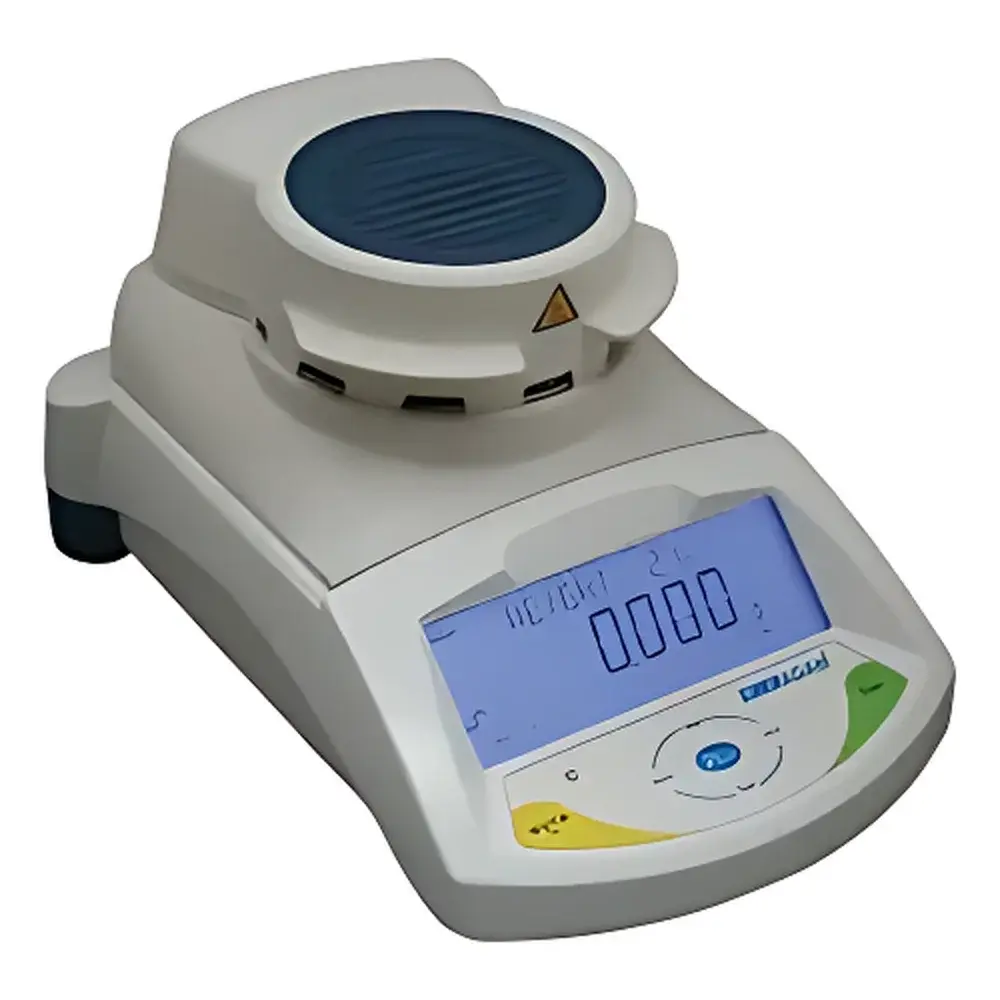
Adamek PMB53 Halogen Moisture Analyzer
| Origin | USA |
|---|---|
| Manufacturer Type | Authorized Distributor |
| Origin Category | Imported |
| Model | PMB53 |
| Pricing | Available Upon Request |
| Maximum Capacity | 50 g |
| Readability | 0.001 g / 0.01% |
| Pan Diameter | 90 mm |
| Stabilization Time | 3 s |
| Measurement Units | g, % moisture |
| Interfaces | RS-232, USB |
| Operating Temperature | 0–40 °C |
| Calibration | External |
| Display | Large blue-backlit LCD with dynamic range indicator |
| Housing | Full-metal enclosure |
| Dimensions (W×D×H) | 250 × 360 × 185 mm |
| Height Above Pan | 30 mm |
| Net Weight | 6 kg |
| Drying Temperature Range | 50–160 °C (1 °C increments) |
| Drying Duration | 1–99 min |
| Moisture Range | 0–100% |
| Heater Type | 400 W halogen lamp |
| Sample Interval | 1–59 s |
| Standard Measurement Duration | 2–20 min |
| Heating Power | 400 W |
Overview
The Adamek PMB53 Halogen Moisture Analyzer is a precision laboratory instrument engineered for rapid, reliable quantification of moisture content in solid and semi-solid samples using thermogravimetric analysis (TGA) principles. It combines a high-stability analytical balance with a controllable 400 W halogen heating system to perform real-time mass loss monitoring during controlled thermal drying. Unlike traditional oven-drying methods requiring hours, the PMB53 delivers repeatable results in as little as two minutes—without compromising accuracy or traceability. Its design adheres to fundamental metrological requirements for moisture determination per ISO 13752:2015 (determination of moisture in solids by thermogravimetry), and supports method development aligned with ASTM D4442 (standard test methods for direct moisture content measurement of wood and wood-based materials) and USP <921> (Water Determination). The instrument is calibrated externally using certified mass standards and operates within a rigorously defined environmental envelope (0–40 °C), ensuring consistent performance across QC labs, R&D facilities, and production environments.
Key Features
- High-resolution dual-sensing system: 0.001 g mass resolution paired with 0.01% moisture resolution enables detection of minute compositional changes in low-moisture matrices (e.g., pharmaceutical excipients, polymer pellets, or roasted coffee beans).
- Adjustable halogen heating: Precise temperature control from 50 °C to 160 °C in 1 °C increments allows optimization for thermally sensitive materials—including dairy powders, herbal extracts, and battery electrode coatings—minimizing degradation while maximizing evaporation efficiency.
- Full-metal robust architecture: Industrial-grade aluminum alloy housing ensures mechanical stability, electromagnetic interference (EMI) shielding, and long-term repeatability under continuous operation in regulated manufacturing settings.
- Dynamic stabilization algorithm: Achieves measurement stability in ≤3 seconds post-heating cycle, reducing total assay time without sacrificing gravimetric fidelity.
- Dual communication interface: Native RS-232 and USB connectivity support seamless integration into LIMS, ELN, or MES platforms—enabling automated data capture, audit trail generation, and electronic signature compliance per FDA 21 CFR Part 11 when paired with validated software.
- Intuitive operator interface: Large blue-backlit LCD with real-time graphical moisture loss curve, pan temperature tracking, and dynamic range bar provides immediate visual feedback—critical for troubleshooting non-linear drying profiles or detecting sample spattering.
Sample Compatibility & Compliance
The PMB53 accommodates diverse sample morphologies—including granules, powders, pastes, films, and irregular solids—on its 90 mm diameter stainless-steel weighing pan. Its 30 mm clearance above the pan permits use with tall crucibles or shallow trays, supporting standardized sample preparation per ISO 6657 (milk powder moisture analysis) or AOAC 952.08 (moisture in feedstuffs). All firmware and calibration routines are traceable to NIST-traceable mass standards. While the device itself does not carry CE or UKCA marking as a standalone analyzer (as it functions as a Class II measuring instrument under MID Annex MI-001 only when integrated into a certified system), its hardware and firmware architecture comply with IEC 61000-6-3 (EMC emission limits) and IEC 61010-1 (safety requirements for electrical equipment for measurement).
Software & Data Management
Data export is supported via ASCII text format through either RS-232 or USB virtual COM port, compatible with third-party data acquisition tools (e.g., LabVIEW, MATLAB, or custom Python scripts). Raw output includes timestamp, initial mass, final mass, moisture %, drying time, set temperature, and stability flag. For regulated environments, optional validation packages—including IQ/OQ documentation templates, calibration logs, and change control records—are available upon request. Audit trails may be implemented externally via timestamped file logging; full 21 CFR Part 11 compliance requires integration with a validated electronic record system that enforces user authentication, electronic signatures, and immutable archiving.
Applications
- Pharmaceutical manufacturing: Quantification of residual solvents and hydrate water in APIs and tablet blends per ICH Q5C stability guidelines.
- Food & beverage QA/QC: Rapid verification of moisture specifications in flour, sugar, dried fruits, and pet food—supporting HACCP critical control point monitoring.
- Chemicals & polymers: Monitoring hygroscopicity of catalysts, silica gels, and engineering resins prior to extrusion or molding.
- Agricultural commodities: Field-to-lab moisture verification in grains, seeds, and forage—aligned with ISO 6496 and ASAE S352.2 protocols.
- Academic research: Method development for novel drying kinetics modeling, including Arrhenius-based activation energy estimation using multi-temperature runs.
FAQ
Is external calibration required before first use?
Yes. The PMB53 must be calibrated using certified weights traceable to national standards prior to initial operation and after any relocation or mechanical shock.
Can the instrument store multiple drying methods?
No. The PMB53 does not feature internal method memory; parameters must be manually re-entered for each run. For method persistence, external PC-based control software is recommended.
What is the minimum sample mass for valid moisture reporting?
To ensure statistical reliability and minimize relative error, a minimum net sample mass of 0.5 g is advised—particularly for samples with moisture content below 2%.
Does the halogen heater require periodic replacement?
Halogen lamps have a typical service life of 5,000–8,000 operating hours. Output degradation is gradual and detectable via reduced drying rate or inconsistent endpoint detection.
Is GLP-compliant printout functionality built-in?
The unit supports basic printer output via RS-232, but full GLP-compliant reporting—including operator ID, instrument ID, calibration status, and environmental conditions—requires external software integration.
Related Products




