
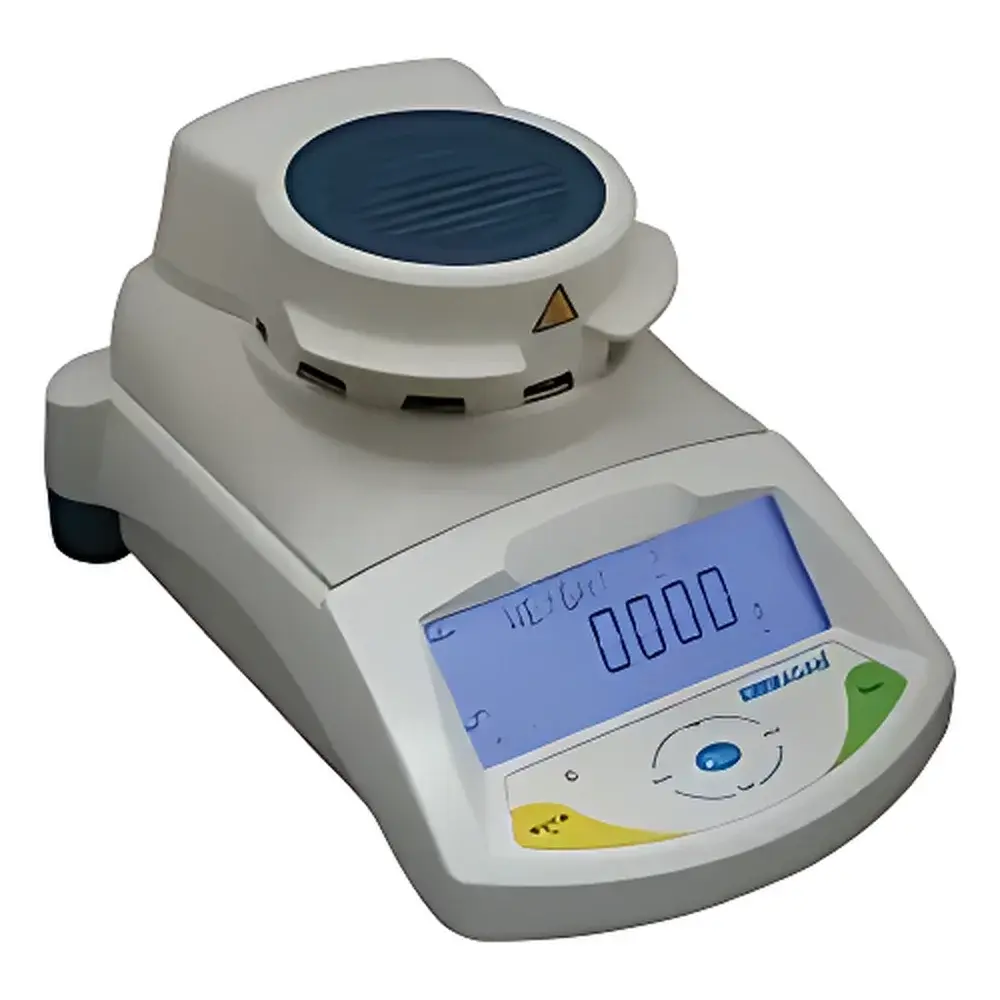
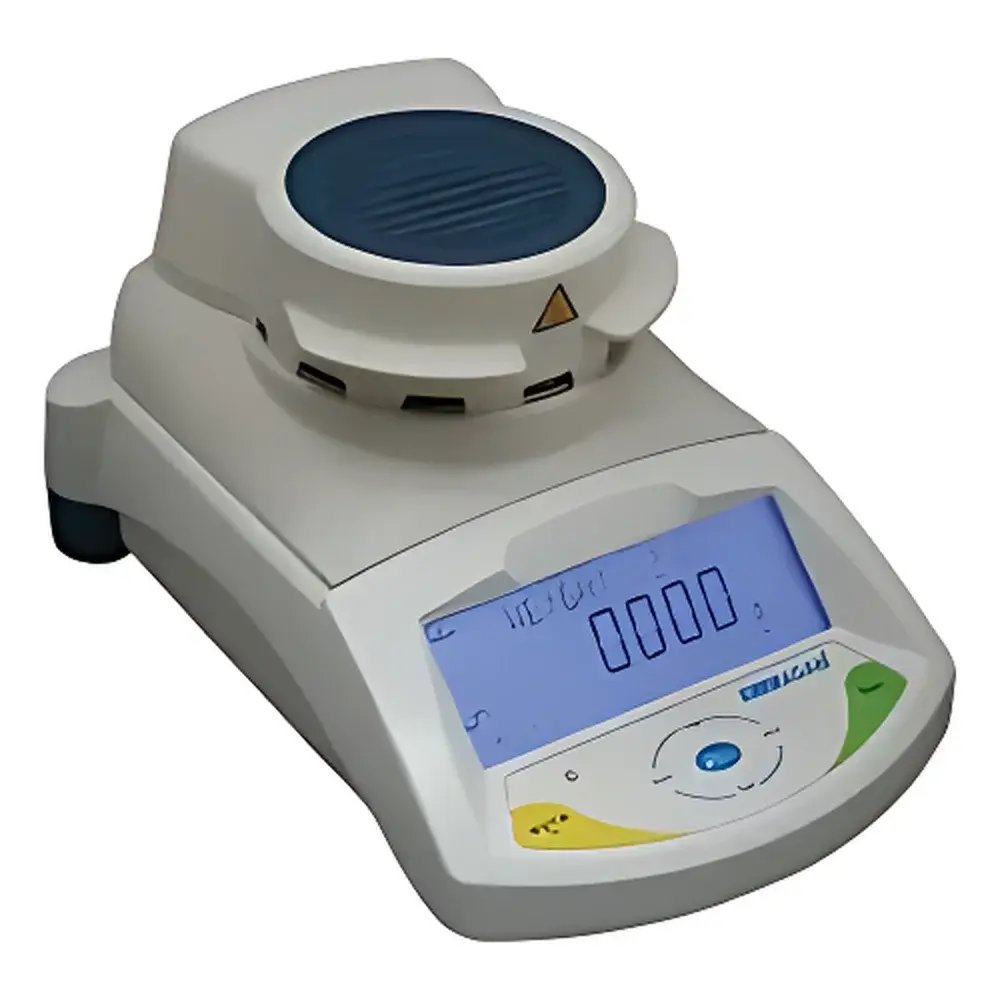
Adamek PMB53 / PMB202 Halogen Moisture Analyzer
| Brand | Adamek |
|---|---|
| Origin | United Kingdom |
| Model | PMB53 / PMB202 |
| Max Capacity | 50 g / 200 g |
| Readability | 0.001 g / 0.01 % (PMB53) |
| Repeatability | ±0.005 g / ±0.05 % (10 g sample, PMB53) |
| Heating Source | 400 W halogen lamp |
| Temperature Range | 50–160 °C (1 °C increments) |
| Drying Time | 1–99 min |
| Moisture Range | 0–100 % |
| Display | Backlit blue LCD with dual-line readout and capacity tracking bar |
| Interface | RS-232, USB Host (for USB flash drive), USB I/O (for PC connection) |
| Internal Memory | 99 test results, 49 test methods |
| External Storage | USB mass storage support |
| Pan Diameter | 90 mm |
| Pan Clearance | 30 mm |
| Dimensions (W×D×H) | 250 × 360 × 185 mm |
| Net Weight | 6 kg |
| Operating Ambient | 0–40 °C |
| Calibration | External |
| Heating Modes | Ramp, Step, Standard |
| Auto-Start | Enabled upon lid closure |
| Safety | Kensington lock slot |
| Warranty | 3 years |
Overview
The Adamek PMB53 and PMB202 Halogen Moisture Analyzers are precision thermal gravimetric instruments engineered for rapid, reliable determination of moisture content in solid and semi-solid samples across pharmaceutical, food, chemical, polymer, and quality control laboratories. Based on the principle of loss-on-drying (LOD), these analyzers combine a high-stability analytical balance with a regulated 400 W halogen heating system to deliver real-time mass loss monitoring during controlled thermal drying. Unlike conventional oven-drying methods requiring hours, the PMB series achieves full moisture quantification in as little as 2 minutes—without compromising measurement integrity or regulatory traceability. The instruments comply with core method validation requirements outlined in USP , ASTM D4457, ISO 15512, and AOAC 952.07, supporting GLP/GMP-aligned workflows through audit-ready data handling and repeatable thermal profiles.
Key Features
- High-resolution dual-range weighing systems: PMB53 (50 g / 0.001 g) and PMB202 (200 g / 0.01 g), both calibrated to ±0.01 % moisture resolution
- Programmable halogen heating with precise 1 °C temperature increments across 50–160 °C, ensuring optimal thermal energy delivery without sample charring
- Three validated drying modes—Ramp (gradual temperature increase), Step (multi-stage isothermal holds), and Standard (fixed-temperature drying)—to accommodate diverse sample matrices including hygroscopic powders, granules, pastes, and coated tablets
- Automatic start-up triggered by lid closure, minimizing operator variability and enhancing procedural consistency
- Integrated dual USB architecture: USB Host port supports direct saving of test methods and results to FAT32-formatted USB drives; USB I/O enables seamless data streaming to Windows-based LIMS or Excel via virtual COM port
- RS-232 serial interface compliant with standard ASCII command protocols for integration into automated QC lines or legacy lab networks
- Backlit blue LCD display with dual-line output showing real-time mass (g) and moisture % simultaneously, plus dynamic capacity tracking bar for immediate overload awareness
- Full-metal enclosure with ergonomic pan lift design and 30 mm clearance above the 90 mm diameter stainless-steel weighing pan—facilitating safe, contamination-free sample handling
- Kensington security slot for physical device anchoring in shared or unattended lab environments
Sample Compatibility & Compliance
The PMB53 and PMB202 accommodate a broad spectrum of non-volatile, thermally stable materials—including APIs, excipients, dairy powders, cereal grains, plastics pellets, ceramics, and soil aggregates—provided volatiles other than water contribute negligibly to mass loss under selected drying conditions. Each unit undergoes factory verification against NIST-traceable mass standards and certified reference materials (e.g., sodium tartrate dihydrate). Instrument qualification documentation (IQ/OQ) templates are available upon request. Data integrity conforms to FDA 21 CFR Part 11 requirements when used with validated third-party software or configured with electronic signature-enabled reporting modules. All firmware and calibration records maintain full revision history and user-access timestamps.
Software & Data Management
No proprietary software installation is required for basic operation: raw mass vs. time datasets export directly as .CSV files via USB drive. For advanced analysis—including kinetic curve fitting, derivative moisture rate plots, and comparative method validation—the optional Adamek Data Acquisition Software provides secure user-role management, password-protected method libraries, and automatic generation of PDF reports with embedded metadata (operator ID, timestamp, environmental conditions, calibration status). Internal memory retains up to 99 test records and 49 customizable methods, each storing full drying profile parameters (target temp, duration, mode, pause intervals). All stored entries include unique sequential IDs and tamper-evident checksums.
Applications
- Pharmaceutical QC: Moisture verification of lyophilized products, tablet blends, and sterile powders per USP
- Food safety labs: Rapid compliance testing for flour, spices, coffee beans, and pet food against Codex Alimentarius moisture limits
- Polymers & composites: Resin moisture pre-check prior to extrusion or injection molding to prevent hydrolysis defects
- Agricultural research: Field-moisture correlation studies using standardized 20-min drying protocols at 105 °C
- Academic teaching labs: Hands-on demonstration of LOD principles, statistical repeatability assessment, and method optimization exercises
FAQ
What calibration standards are recommended for routine verification?
NIST-traceable stainless-steel weights (class M2 or better) for balance verification; certified sodium tartrate dihydrate (15.66 % w/w water) for moisture recovery checks.
Can the instrument be validated for GMP production environments?
Yes—when operated with documented SOPs, scheduled performance checks, and electronic audit trails enabled via optional software, it meets Annex 11 and EU GMP Chapter 4 expectations.
Is halogen heating suitable for heat-sensitive biological samples?
Halogen lamps provide faster, more uniform surface heating than infrared quartz tubes; however, for thermolabile proteins or enzymes, lower setpoints (e.g., 50–70 °C) with extended dwell times are advised—and method suitability must be confirmed per ICH Q5C.
How does the PMB handle samples that spatter or foam during drying?
The included aluminum sample pans feature rolled edges and shallow depth; optional glass fiber filters or perforated stainless-steel lids mitigate splatter while maintaining airflow and thermal uniformity.
Does the USB I/O interface support real-time data logging into LabArchives or ELN platforms?
Yes—via ASCII-based streaming over virtual COM port; compatible with common ELN ingestion scripts using Python, LabVIEW, or vendor-provided SDKs.




