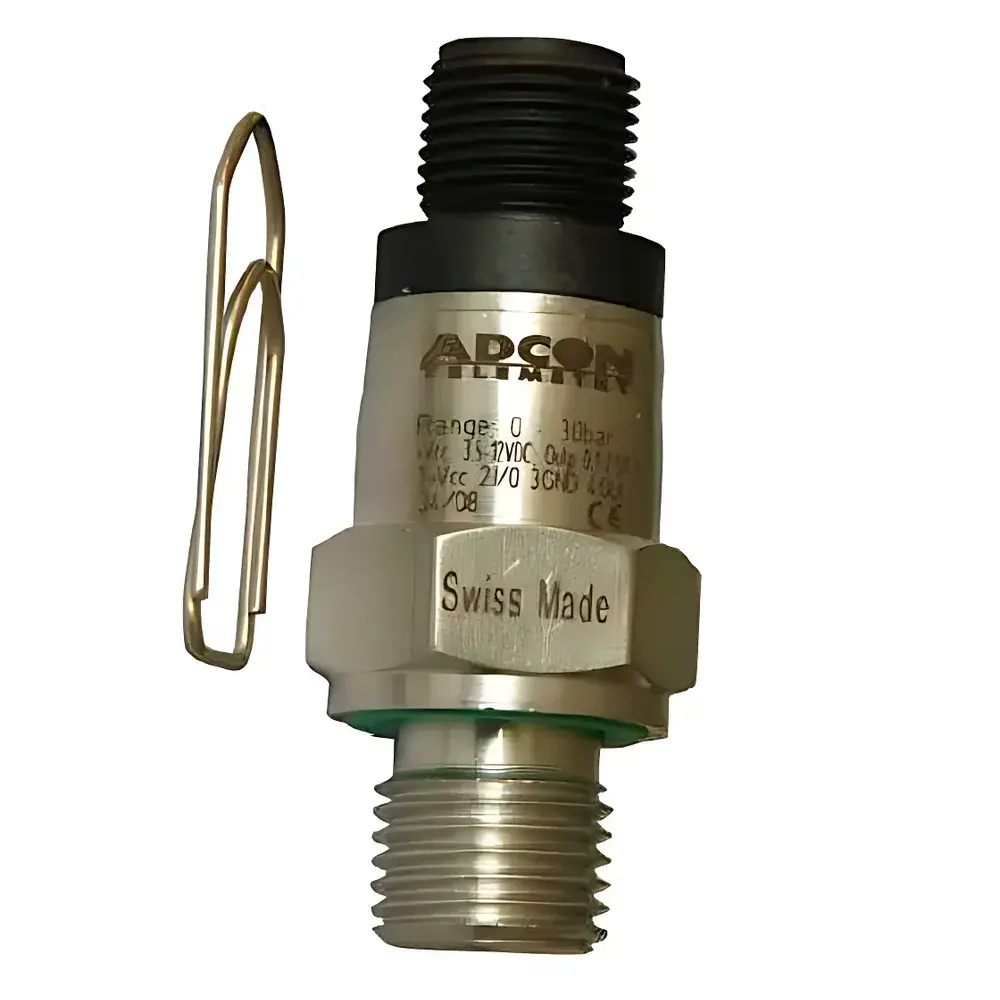
ADCON PA-1 Absolute Pressure Sensor
| Brand | ADCON |
|---|---|
| Origin | Switzerland |
| Model | PA-1 |
| Pressure Range | 0–10 bar (absolute) |
| Overpressure Limit | 20 bar |
| Operating Temperature | −40 °C to +80 °C |
| Compensated Temperature Range | 0 °C to +50 °C |
| Accuracy (0–50 °C) | ±0.1% FS typical, ±1.5% FS max |
| Linearity | ±0.25% FS typical, ±0.5% FS max |
| Sensing Principle | Piezoresistive |
| Output Signal | 0.1–2.5 V ratiometric |
| Supply Voltage | 3.5–12 V DC |
| Thread Connection | G 1/4" (NPT & G 1/2" adapters available) |
| Housing Diameter | 22 mm |
| Length | 49 mm |
| Weight | 30 g |
| Cable | Shielded PVC2 |
| Cable Length Options | 5 m or 10 m |
| Connector | 4-pin M12 male on sensor, 4-pin M12 female + 7-pin Binder M9 male on cable |
| IP Rating | IP67 |
Overview
The ADCON PA-1 Absolute Pressure Sensor is a compact, high-stability piezoresistive transducer engineered for reliable long-term pressure monitoring in demanding industrial, environmental, and hydrometric applications. Designed and manufactured in Switzerland, the PA-1 delivers traceable metrological performance with built-in digital temperature compensation — enabling consistent accuracy across its compensated range (0 °C to +50 °C). Its absolute pressure measurement principle eliminates dependency on ambient atmospheric fluctuations, making it ideal for applications requiring reference-to-vacuum calibration, such as groundwater level monitoring, tank level inference, vacuum system diagnostics, and closed-loop process control. The sensor’s robust stainless steel diaphragm and hermetically sealed ceramic housing ensure mechanical resilience against shock, vibration, and corrosive media, while its IP67-rated enclosure guarantees protection against dust ingress and temporary immersion.
Key Features
- Piezoresistive sensing element with integrated digital temperature compensation for enhanced repeatability and thermal stability
- Compact cylindrical form factor (Ø22 mm × 49 mm) with lightweight aluminum housing (30 g), optimized for space-constrained installations
- G 1/4″ BSP parallel thread interface — compatible with optional NPT or G 1/2″ adapters for flexible integration into diverse piping systems
- Ratiometric analog output (0.1–2.5 V) referenced to supply voltage, minimizing signal drift due to power rail variation
- Wide operating supply range (3.5–12 V DC), supporting battery-powered telemetry nodes and low-power data loggers
- IP67 ingress protection certified per IEC 60529, ensuring operational integrity in outdoor, subterranean, or washdown environments
- Overpressure tolerance up to 20 bar — double the full-scale rating — providing margin against transient spikes and hydraulic hammer
Sample Compatibility & Compliance
The PA-1 is suitable for non-corrosive gases and liquids compatible with stainless steel 316L and ceramic sensing elements, including potable water, wastewater, compressed air, nitrogen, and glycol-based fluids. It complies with RoHS Directive 2011/65/EU and meets EMC requirements per EN 61326-1:2013 for industrial environments. While not intrinsically safe or ATEX-certified, its low-power design (typically <1 mA at 5 V) facilitates integration into Class I, Division 2–compliant systems when deployed with appropriate barrier circuits. For regulatory validation workflows, the sensor supports GLP-compliant documentation via traceable calibration certificates (available upon request), and its stable zero-point drift (<0.02% FS/year) aligns with ISO 5725-2:2019 precision criteria for routine field instrumentation.
Software & Data Management
The PA-1 operates as a stand-alone analog transducer and requires no embedded firmware or configuration software. Its ratiometric output is directly compatible with ADCON’s family of data loggers (e.g., TDR-3, ARGUS-2) and third-party DAQ systems supporting 0–5 V or 0–10 V input ranges. When paired with ADCON’s ARGUS Cloud platform, raw voltage readings are automatically linearized using factory-derived coefficients stored in device metadata, enabling real-time conversion to engineering units (bar, psi, mH₂O) with uncertainty propagation. All logged pressure values include timestamp, supply voltage, and internal temperature metadata — supporting audit-ready data lineage per FDA 21 CFR Part 11 requirements when deployed with validated logging infrastructure.
Applications
- Groundwater and surface water level monitoring via vented or sealed piezometric installations
- Tank and reservoir level determination using hydrostatic pressure correlation (ρ·g·h)
- Leak detection and pressure decay testing in municipal water distribution networks
- Industrial process pressure feedback for pump control, filter monitoring, and HVAC differential pressure tracking
- Environmental monitoring stations requiring low-power, long-duration deployments in remote locations
- Calibration reference for secondary pressure instruments in field service and maintenance workflows
FAQ
What is the difference between absolute and gauge pressure measurement?
Absolute pressure references a perfect vacuum (0 bar abs), whereas gauge pressure references local atmospheric pressure. The PA-1 measures absolute pressure, making it essential for applications where atmospheric variation must be excluded — such as barometrically compensated water level calculations.
Can the PA-1 be used in submerged applications?
Yes — its IP67 rating permits temporary submersion up to 1 m for 30 minutes. For permanent underwater deployment, use with a vented cable or desiccant-filled housing is recommended to prevent condensation-induced drift.
Is calibration traceable to national standards?
Factory calibration is performed using deadweight testers traceable to METAS (Swiss Federal Institute of Metrology). NIST-traceable certificates are available as an optional add-on at time of order.
Does the sensor require external excitation or signal conditioning?
No — the PA-1 includes internal regulation and requires only a stable DC supply (3.5–12 V). Signal conditioning (e.g., amplification, filtering) is handled externally by the connected data logger or PLC.
How does temperature affect accuracy outside the compensated range?
Beyond 0–50 °C, thermal zero shift and span drift increase nonlinearly; operation down to −40 °C is mechanically supported but uncharacterized for metrological performance — users should apply empirical correction if high accuracy is required below 0 °C.