
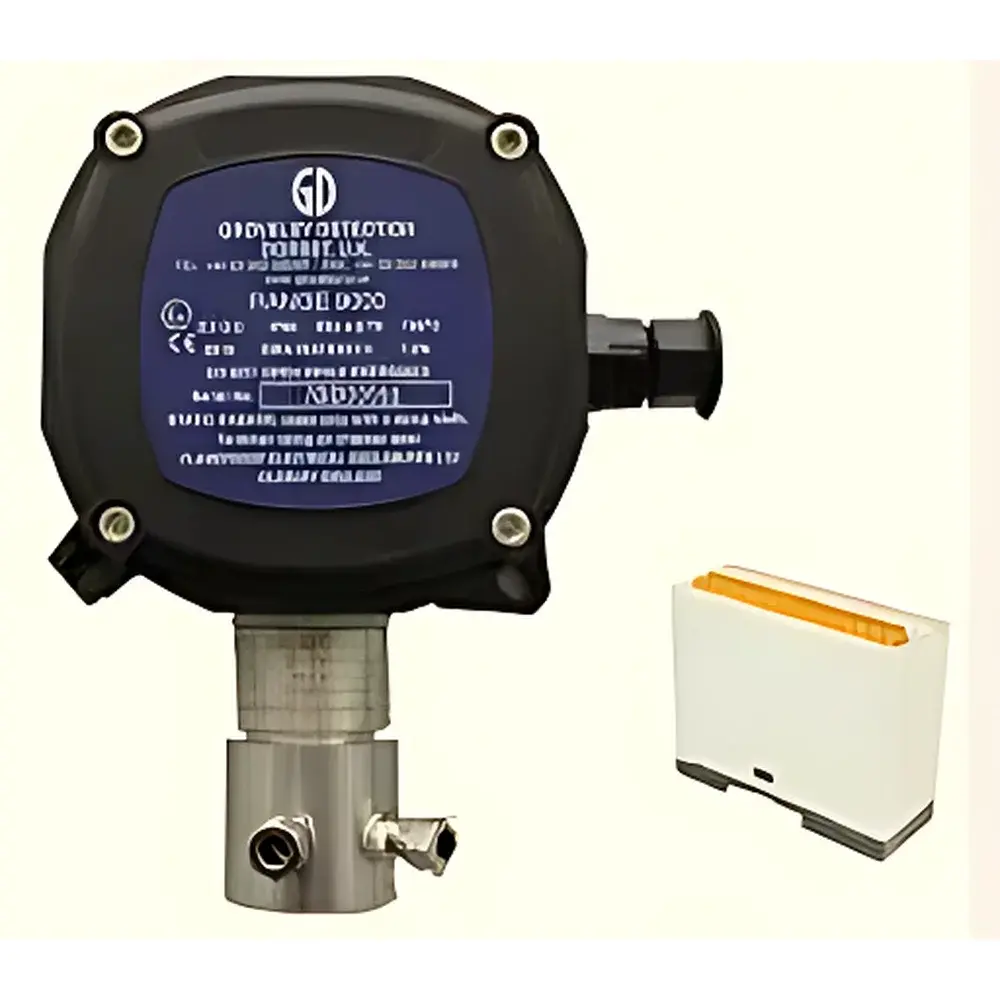
ADEV 6866 Hydrogen Concentration Analyzer
| Brand | ADEV |
|---|---|
| Origin | Italy |
| Model | 6866 |
| Sensor Type | Explosion-Proof Thermal Conductivity Detector (TCD) |
| Mounting | DIN Rail |
| Output | 4–20 mA (isolated), RS232 (9600 baud, ASCII, RTS/CTS) |
| Measurand | H₂ in N₂ or Ar (0–10%, 0–30%, 0–100%), He in Ar (0–10%, 0–30%, 0–100%), N₂ in N₂O (75–100%, 0–100%), etc. |
| Operating Temp | −20 °C to +50 °C |
| Sample Pressure | 1 bar ±100 mbar (abs. max 10 bar) |
| Sample Flow | 100–300 mL/min |
| Accuracy | ±1% FS |
| Repeatability | ±0.5% FS |
| Resolution | 0.1% FS |
| Power | 24 VDC ±10%, ≤10 W |
| Enclosure | IP65-rated DIN rail housing (85 × 100 × 35 mm) |
| Certifications | ATEX II 2G EEx d IIB + H₂ T6/T3, EMC Directive 89/336/EEC, Low Voltage Directive 73/23/EEC |
Overview
The ADEV 6866 Hydrogen Concentration Analyzer is a certified intrinsically safe, DIN-rail–mounted thermal conductivity gas analyzer engineered for continuous, real-time measurement of hydrogen (H₂) and helium (He) concentrations in inert carrier gases—primarily nitrogen (N₂) and argon (Ar)—within hazardous industrial environments. Based on the principle of thermal conductivity differential detection, the instrument compares the thermal dissipation rate of the sample gas against a sealed internal air reference within a robust, explosion-proof stainless-steel sensor head. This method delivers stable, drift-resistant quantification without consumables or catalytic elements, making it ideal for high-purity hydrogen monitoring in electrolyzer off-gas streams, semiconductor purge lines, metal annealing atmospheres, and inert gas blanketing systems. The 6866 is designed for installation in Zone 1/Zone 2 classified areas per ATEX directives, with all electronics housed in a non-hazardous location and connected via armored cable to the field-mounted TCD probe through an approved flameproof (Ex d) or increased-safety (Ex e) junction box.
Key Features
- ATEX-certified explosion-proof thermal conductivity sensor (Ex II 2G EEx d IIB + H₂ T6/T3) rated for direct installation in hazardous zones
- DIN-rail–mountable transmitter module with compact footprint (85 × 100 × 35 mm) and IP65 enclosure
- Configurable multi-range capability: supports H₂ in N₂/Ar (0–10%, 0–30%, 0–100%), He in Ar (0–10%, 0–30%, 0–100%), N₂ in N₂O (75–100% and 0–100%), and custom calibrations upon request
- Dual-output architecture: fully isolated 4–20 mA analog output (1 kV isolation, 0–300 Ω load range) and RS232 serial interface (9600 baud, ASCII protocol with hardware flow control)
- High metrological stability: ±1% full-scale accuracy, ±0.5% repeatability, and 0.1% FS resolution under specified operating conditions
- Low-power design (≤10 W @ 24 VDC ±10%) compatible with standard industrial power supplies and PLC integration
- Minimal maintenance requirement: no moving parts, no consumables, no zero/span gas required for routine operation
Sample Compatibility & Compliance
The ADEV 6866 requires conditioned sample gas meeting strict physical and chemical criteria. Sample must be non-condensing at process temperature and free of particulates, aerosols, or corrosive species (e.g., HCl, NH₃, H₂S, or halogenated hydrocarbons) that could degrade the sintered stainless-steel sensing surface. Gas must flow parallel—not impinging—to the sensor’s active surface to ensure laminar thermal exchange and avoid mechanical erosion. Standard operating pressure is 1 bar ±100 mbar; absolute pressure tolerance extends to 10 bar. Recommended volumetric flow is 100–300 mL/min, delivered via external sampling system (not included). The analyzer complies with EU Directives 2014/34/EU (ATEX), 2014/30/EU (EMC), and 2014/35/EU (LVD), carrying full conformity marking per harmonized standards EN 60079-0, EN 60079-1, EN 61326-1, and EN 61000-6-2/-6-4. It supports audit-ready operation in GLP/GMP-regulated facilities when integrated with validated sampling trains and documented calibration procedures.
Software & Data Management
Configuration and diagnostics are performed via ASCII command set over RS232 using terminal emulation software (e.g., PuTTY or Tera Term). Commands allow full setup of measurement range, output scaling, damping time, alarm thresholds, and unit selection. All parameters are stored in non-volatile memory. The 4–20 mA output is factory-calibrated to linearly represent the selected range (e.g., 4 mA = 0%, 20 mA = 100% H₂ in N₂); scaling can be redefined in-field using simple commands. While the 6866 itself does not include onboard data logging, its analog and serial outputs integrate seamlessly with SCADA systems, DCS controllers, or third-party data acquisition platforms compliant with Modbus RTU (via optional protocol converter) or OPC UA gateways. No proprietary drivers or cloud dependencies are required—ensuring long-term interoperability and cybersecurity resilience in air-gapped industrial networks.
Applications
- Hydrogen purity verification in PEM and alkaline electrolyzer off-gas streams prior to compression or fuel cell feed
- Leak detection and atmosphere integrity monitoring in hydrogen storage and distribution infrastructure
- Process gas composition control in semiconductor CVD/PVD tool purge lines and furnace annealing atmospheres
- Quality assurance of high-purity argon and nitrogen used in welding, metallurgy, and pharmaceutical inerting
- Nitrous oxide (N₂O) decomposition monitoring in medical gas production and abatement systems
- Helium recovery efficiency tracking in cryogenic and MRI magnet cooling loops
FAQ
Is the ADEV 6866 suitable for measuring hydrogen in air?
No—the analyzer is calibrated for H₂ in inert backgrounds (N₂, Ar) only. Air contains ~78% N₂ and ~21% O₂, whose thermal conductivity differs significantly from pure N₂; cross-sensitivity to oxygen and moisture will compromise accuracy.
What sampling system components are required but not supplied?
The 6866 includes only the electronic transmitter and TCD sensor. Users must provide: a particulate/moisture filter, pressure regulator, flowmeter/controller (to maintain 100–300 mL/min), sample line (stainless steel or PTFE), explosion-proof junction box, and armored cable (max 30 m, <0.5 Ω loop resistance).
Can the device be recalibrated in the field without sending it back to the manufacturer?
Yes—zero and span calibration can be performed using certified reference gases (e.g., 0% H₂ in N₂ and 10% H₂ in N₂) and the RS232 interface; full procedure is documented in the user manual.
Does the 6866 support HART or Modbus communication protocols?
Not natively. It provides RS232 ASCII and 4–20 mA only. HART or Modbus RTU output requires an external signal converter installed in the safe area.
What is the maximum ambient temperature for the transmitter module?
The electronics module is rated for −20 °C to +50 °C ambient. For higher ambient temperatures, heat shielding or cabinet cooling must be implemented per IEC 60529 and ATEX ambient temperature class requirements.







