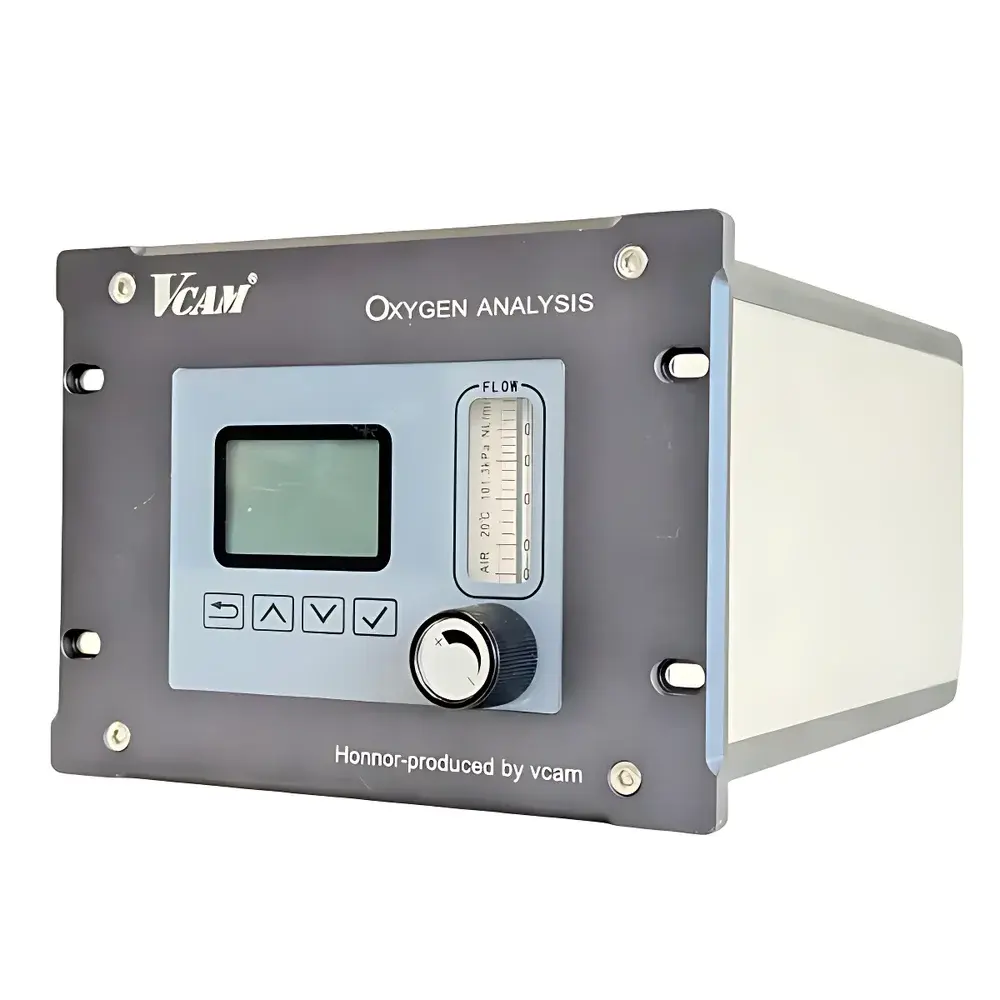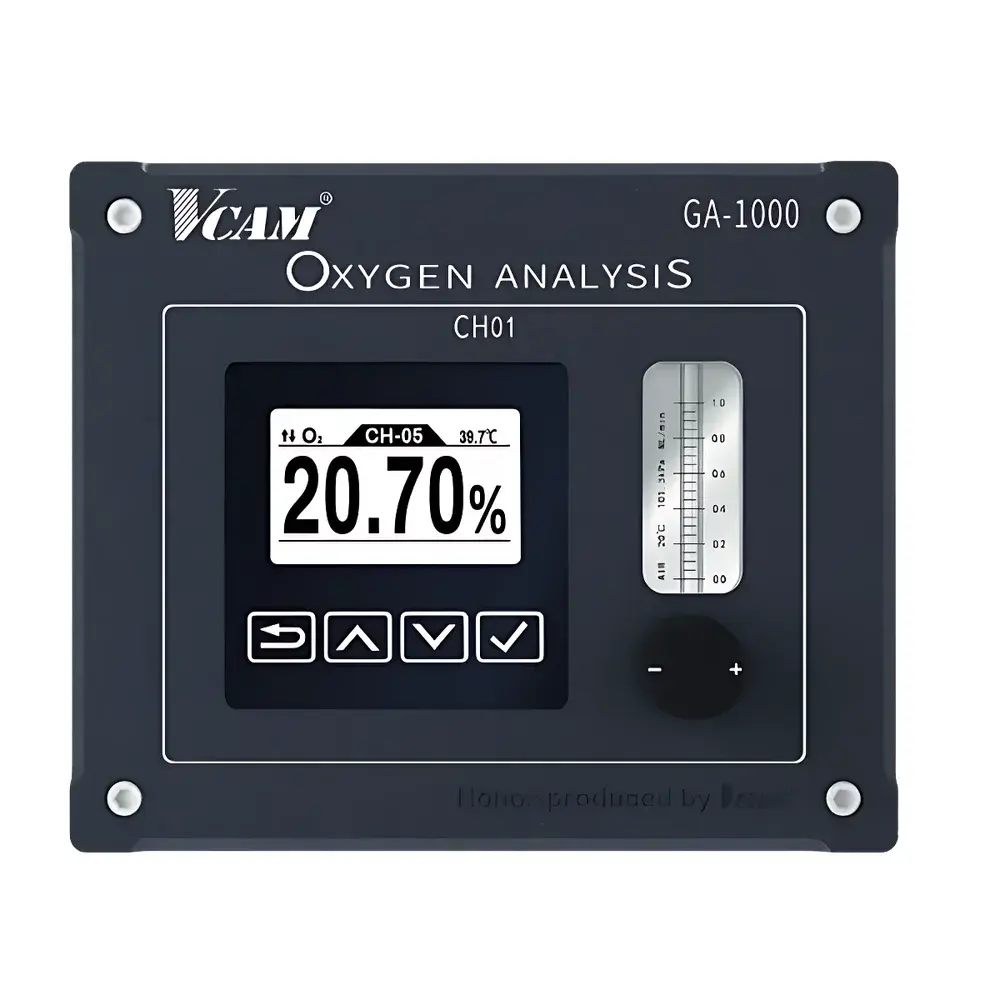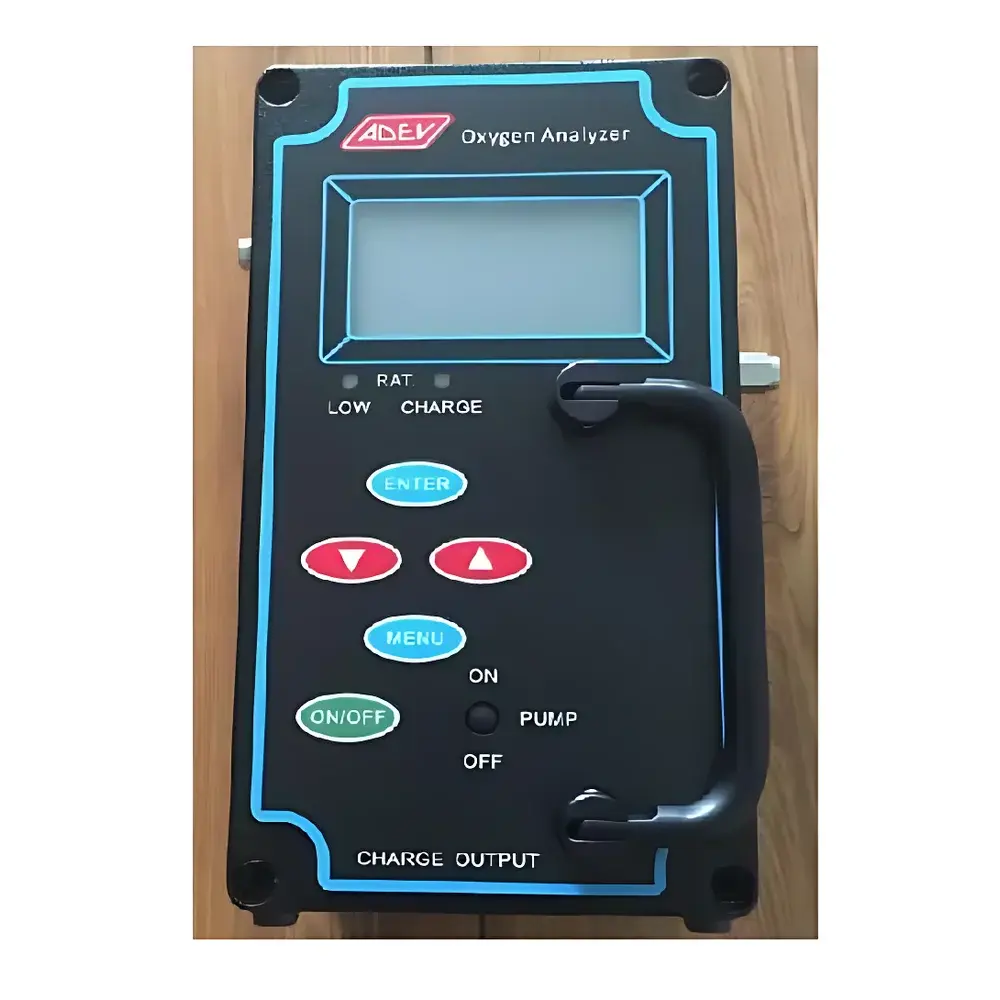
ADEV G408EC Portable Percent Oxygen Analyzer
| Brand | ADEV |
|---|---|
| Origin | Italy |
| Model | G408EC |
| Sensor Type | Electrochemical Fuel Cell |
| Measurement Range | 0–1%, 0–5%, 0–10%, 0–25% O₂ (user-selectable) |
| Accuracy | ±0.1% O₂ |
| Linearity | R² > 0.995 |
| Response Time (t₉₀) | 10 s to full scale |
| Operating Temperature | 5–45°C (GPR sensor) |
| Sample Pressure | 5–30 psig inlet, vented to atmosphere |
| Flow Rate | 0.5–5 SCFH (recommended: 2 SCFH / ~1 L/min) |
| Sensitivity | <0.5% of full scale |
| Calibration | Certified standard gas at ≥80% of selected range |
| Pressure & Temperature Compensation | Automatic |
| Display | Backlit LCD with real-time sample pressure and temperature readout (0.1% resolution) |
| Output | 4–20 mA two-wire analog output |
| Optional Alarm Output | Configurable relay or digital alarm signal |
| Power Supply | 9–28 V DC (24–28 V DC when intrinsically safe barrier used) |
| Enclosure | Anodized aluminum, NEMA 4X rated |
| Dimensions | 4" × 9" × 3" (102 × 229 × 76 mm) |
| Weight | 8 lbs (3.5 kg) |
| Wetted Materials | Corrosion-resistant alloys and fluoropolymers |
| Certifications | CE, ISO 9001 |
| Intrinsically Safe Rating | Compatible with Class I, Division 1, Groups B, C, D when used with approved safety barrier |
Overview
The ADEV G408EC Portable Percent Oxygen Analyzer is a field-deployable, electrochemical fuel cell–based instrument engineered for precise, real-time measurement of oxygen concentration across multiple industrial gas streams. Unlike paramagnetic or zirconia-based analyzers, the G408EC leverages galvanic fuel cell technology—offering high selectivity for O₂ in complex matrices without cross-sensitivity to CO₂, H₂, He, or inert gases. Its measurement principle relies on the electrochemical reduction of molecular oxygen at a catalytic cathode, generating a current linearly proportional to partial pressure. This inherent linearity—validated to R² > 0.995—and rapid 10-second t₉₀ response enable reliable process verification during commissioning, maintenance, or troubleshooting of nitrogen generation, hydrogen purification, CO₂ recovery, and natural gas conditioning systems. Designed for operational continuity in variable ambient conditions, the analyzer integrates automatic pressure and temperature compensation algorithms, ensuring metrological integrity across its full operating range (5–45°C for GPR; –20–45°C for optional XLT sensor).
Key Features
- Electrochemical fuel cell sensor with proven long-term stability and minimal drift—typical service life exceeds 24 months under continuous operation in clean, dry sample streams.
- User-selectable measurement ranges (0–1%, 0–5%, 0–10%, 0–25% O₂) via intuitive waterproof keypad interface—no firmware reprogramming required.
- NEMA 4X-rated anodized aluminum enclosure provides ingress protection against dust, water jets, and corrosion—suitable for outdoor mounting or mobile lab deployment.
- Real-time on-screen display of sample pressure (psig) and temperature (°C), enabling immediate diagnostic assessment of flow integrity and conditioning performance.
- Intrinsically safe operation certified for hazardous locations (Class I, Div. 1, Groups B, C, D) when paired with a UL-listed safety barrier—compliant with IEC 60079-11 requirements.
- Two-wire 4–20 mA analog output with HART-compatible configuration options supports integration into legacy DCS/PLC architectures without additional signal conditioning.
Sample Compatibility & Compliance
The G408EC is validated for use with helium, hydrogen, carbon dioxide, nitrogen, argon, and mixed industrial gases—including those generated by pressure swing adsorption (PSA), membrane separation, and cryogenic air separation units. Its corrosion-resistant wetted path—constructed from 316 stainless steel fittings, PTFE seals, and fluoropolymer-lined sample channels—ensures compatibility with trace moisture, low-concentration acid gases, and non-aggressive hydrocarbons. The analyzer meets CE marking directives (2014/30/EU EMC, 2014/35/EU LVD) and is manufactured under ISO 9001:2015 quality management systems. While not FDA 21 CFR Part 11–certified out-of-the-box, its calibration log and zero/span event timestamps support GLP/GMP-aligned documentation practices when deployed in pharmaceutical or food-grade gas validation workflows.
Software & Data Management
The G408EC operates autonomously without external software dependency. All configuration, calibration, and diagnostic functions are executed locally via the front-panel interface. Each calibration event—including date/time stamp, span gas concentration, and post-calibration offset—is stored in non-volatile memory and retrievable on-screen. The 4–20 mA output can be scaled to represent any user-defined range within the sensor’s physical limits, facilitating direct mapping to process control setpoints. For audit readiness, users may manually record calibration certificates issued by accredited gas suppliers (e.g., NIST-traceable O₂ standards at 20.9% or 80% of selected range). No proprietary drivers or cloud connectivity are implemented—aligning with OT security policies in critical infrastructure environments.
Applications
- Verification of O₂ removal efficiency in nitrogen generators used for blanketing, laser cutting, and electronics manufacturing.
- Monitoring residual oxygen in hydrogen purification skids prior to PEM electrolyzer feed or fuel cell stack input.
- Leak detection and purge validation in CO₂ capture and storage (CCS) compression trains and dehydration units.
- Quality assurance of medical-grade nitrogen and argon delivered to hospitals and laboratories.
- Field testing of natural gas specification compliance (ASTM D1945, ISO 8573-6) for oxygen content prior to pipeline injection.
- Commissioning support for inert gas systems aboard marine vessels and offshore platforms (DNV-GL and ABS guidelines).
FAQ
What calibration gases are recommended for routine verification?
Certified standard gases at approximately 80% of the selected measurement range—e.g., 8.0% O₂ for the 0–10% range—are required for optimal linearity validation. NIST-traceable certificates must accompany each cylinder.
Can the G408EC measure oxygen in high-humidity samples?
Yes—provided condensation is prevented upstream. The analyzer tolerates up to 95% RH at 45°C; however, a coalescing filter and refrigerated dryer are strongly advised for sustained operation in saturated gas streams.
Is sensor replacement a field-serviceable procedure?
Yes. The fuel cell module is designed as a plug-in cartridge with pre-aligned electrical and pneumatic interfaces—requiring no soldering or alignment tools. Replacement can be completed in under five minutes using standard hex keys.
Does the device support Modbus RTU or other digital protocols?
No. The G408EC is analog-output–only. Digital communication requires external signal converters compliant with ISA-50.00.01 (4–20 mA HART) or third-party gateways.
How often should zero and span calibration be performed?
For critical applications, daily zero checks and weekly span verification are recommended. In stable, low-risk environments (e.g., periodic QA sampling), monthly calibration suffices—subject to internal SOPs and regulatory requirements.