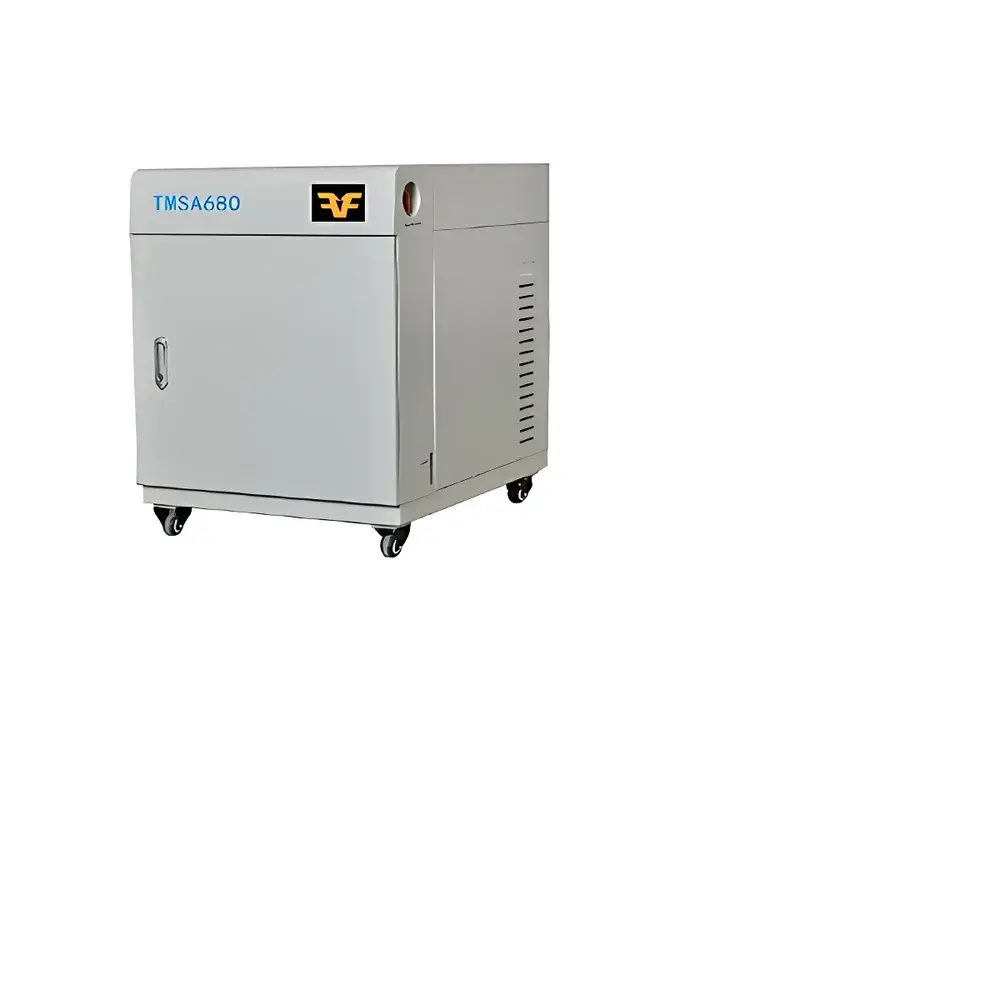
ADEV TMWA680 Automated Inert Gas Purification System
| Brand | ADEV |
|---|---|
| Origin | Beijing, China |
| Model | TMWA680 |
| Treatment Capacity | ≥200 Nm³/h |
| Working Pressure | ≤0.8 MPa |
| Inlet Argon Purity | >99.99% (O₂ ≤15 ppm) |
| Purified Output | O₂ ≤0.5 ppm, Dew Point ≤−76 °C, Total Carbon ≤0.5 ppm, Particulates ≤3.5 particles/L (≤0.1 µm, Class 100) |
| Deoxygenation & Drying Regeneration Temp | 350 °C |
| Regeneration Duration | 8 h |
| Power Consumption | 28 kW |
| Voltage/Frequency | 380 V / 50 Hz |
| Dimensions (W×L×H) | 1500×2000×2200 mm |
| Weight | ~1200 kg |
| Valve Actuation | Bürkert Solenoid Valves (10⁷ cycle lifetime) |
| Control Interface | PLC with HMI touchscreen, RS-485 & 4–20 mA analog outputs |
| Compliance | Meets and exceeds GBT 4842–2006 (High-Purity Argon Specification) |
Overview
The ADEV TMWA680 Automated Inert Gas Purification System is an industrial-grade, dual-tower argon purification platform engineered for continuous, unattended operation in semiconductor fabrication, high-purity metal processing, analytical instrumentation (e.g., ICP-MS, GDMS), and advanced materials research environments. It employs a coupled catalytic deoxygenation and adsorptive drying process: raw argon (≥99.99% purity, O₂ ≤15 ppm) passes sequentially through manganese-based ambient-temperature oxygen scavengers and high-efficiency molecular sieves to remove residual O₂, H₂O, CO₂, CH₄, hydrocarbons, and particulates down to 0.1 µm. The system operates on a true swing-bed principle—two parallel purification trains operate in alternating duty and regeneration modes—ensuring uninterrupted delivery of ultra-high-purity argon meeting or exceeding the stringent requirements of GBT 4842–2006 (equivalent to ISO 8573-1 Class 1 for particles and ISO 8573-3 Class -76 °C dew point). Unlike batch-mode purifiers, the TMWA680 integrates in-situ thermal regeneration using internally generated high-purity hydrogen (derived from a trace fraction of purified product gas), eliminating dependence on external H₂ supply lines and minimizing operational complexity.
Key Features
- True dual-tower architecture with automatic duty-switching ensures 100% gas continuity during regeneration cycles—no downtime, no pressure drop, no manual intervention required.
- Integrated in-situ regeneration: utilizes <0.5% of purified argon stream mixed with ultra-high-purity H₂ (99.9999%) for catalytic reactivation of Mn-based deoxygenation media; performed at atmospheric pressure without venting or isolation.
- Energy-optimized internal heating design reduces power consumption by >50% versus legacy external-heater systems; total installed capacity is 28 kW with intelligent thermal ramping and PID-controlled 350 °C regeneration profiles.
- Long-life consumables: manganese catalyst and 13X molecular sieve exhibit >1,000 regeneration cycles with stable performance; typical service interval extends to ~8 years under nominal inlet conditions (O₂ ≤15 ppm).
- Bürkert Type 2000/6000 series solenoid valves (IP65, 10⁷ mechanical cycles) provide fail-safe, zero-maintenance actuation of all critical process lines—including dual-stage pressure regulation downstream of vaporizer.
- Embedded real-time gas quality monitoring: integrated electrochemical O₂ analyzer and chilled-mirror dew point sensor mounted flush on front panel for direct visual verification; data logged and timestamped with full audit trail.
- Full PLC-based automation with 7-inch capacitive HMI touchscreen: displays runtime metrics, alarm history (including predictive fault warnings), regeneration status, valve position feedback, and historical trend plots.
Sample Compatibility & Compliance
The TMWA680 is validated for purification of technical-grade argon (≥99.99% purity) containing up to 15 ppm O₂, 50 ppm H₂O, and trace hydrocarbons. It is not intended for nitrogen, helium, or hydrogen feed gases without prior engineering review. All wetted components comply with ASTM A269 TP316L stainless steel standards; gasket materials meet USP Class VI requirements. System documentation supports GLP/GMP alignment: event logs include operator ID, timestamp, parameter setpoints, and change history—all exportable via USB or Modbus TCP. Firmware conforms to IEC 61508 SIL 2 functional safety principles for critical control logic. Regulatory compliance includes adherence to GB/T 4842–2006 (Chinese National Standard for High-Purity Argon), ISO 8573-1:2010 (compressed air purity classes), and EU Machinery Directive 2006/42/EC.
Software & Data Management
The embedded Siemens LOGO! PLC firmware provides deterministic real-time control with non-volatile memory retention (≥10 years). All operational parameters—including tower selection, regeneration start/stop triggers, temperature ramp rates, purge flow setpoints, and alarm thresholds—are configurable via the HMI or remote SCADA interface. Data logging captures minimum 30 days of continuous operation (O₂ reading, dew point, pressure differentials, valve states, heater duty cycle). Export formats include CSV and PDF reports compatible with LIMS integration. Optional OPC UA server enables secure connection to enterprise MES platforms. Audit trails satisfy FDA 21 CFR Part 11 requirements when paired with user-access controls and electronic signature modules (available as add-on).
Applications
- Semiconductor manufacturing: carrier gas supply for CVD, ALD, and sputtering tools requiring O₂ < 0.5 ppm and particle-free delivery.
- Materials science labs: inert atmosphere gloveboxes, arc melting furnaces, and XRD sample preparation where trace oxidation compromises structural analysis.
- Analytical laboratories: high-sensitivity elemental analysis (ICP-MS, GDMS, SIMS) demanding sub-ppb oxygen and hydrocarbon levels to suppress polyatomic interferences.
- Optical fiber preform fabrication: ultra-dry argon blanketing during vitrification to prevent OH⁻ incorporation and signal attenuation.
- Research-scale metal additive manufacturing: controlled build chamber atmospheres for reactive alloy printing (e.g., Ti-6Al-4V, Ni-based superalloys).
FAQ
What is the minimum required inlet argon purity?
Raw argon must be ≥99.99% pure with oxygen ≤15 ppm and dew point ≤−40 °C. Higher impurity loads reduce bed life and increase regeneration frequency.
Can the system regenerate while supplying gas to the process?
Yes—regeneration occurs in one tower while the other remains online; switching is fully automated and introduces no pressure fluctuation or purity deviation.
Is external hydrogen required for regeneration?
No. The system generates its own regeneration-grade H₂ from a microfraction of purified argon via integrated palladium membrane separation—zero external gas dependency.
How is compliance with GBT 4842–2006 verified?
Each unit undergoes factory acceptance testing (FAT) per Clause 5.2 of GBT 4842–2006, including 72-hour stability run at rated flow, with third-party certified gas analyzers (Trace-100 O₂, MBW DP96 dew point) validating final output specifications.
What maintenance is required during normal operation?
None beyond annual verification of sensor calibration and inspection of inlet particulate filter; all valves, heaters, and sensors are rated for >50,000 hours MTBF.
Related Products