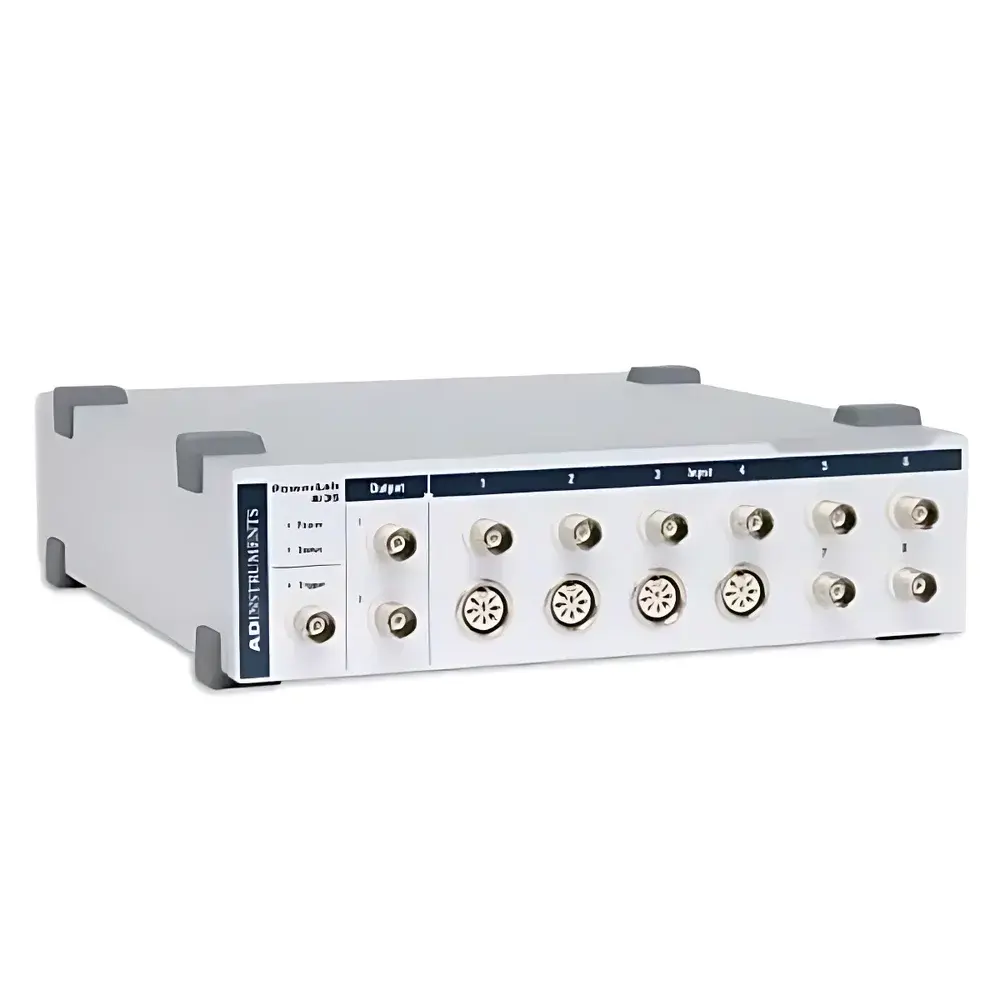
ADInstruments PowerLab 35 Physiological Signal Acquisition System
| Brand | ADInstruments (YUYANBIO is distributor, not manufacturer) |
|---|---|
| Origin | New Zealand |
| Manufacturer | ADInstruments Ltd. |
| Country of Manufacture | New Zealand |
| Model | PowerLab 35 |
| Input Sampling Rate | Up to 200 kS/s per channel (400 kS/s total) |
| ADC Resolution | 16-bit |
| Input Range | 2 mV–10 V (12 ranges) |
| Input Impedance | ~1 MΩ |
| Input Noise | <1 µVrms |
| Low-Pass Filter | 1 Hz–25 kHz (standard stepped settings) |
| Coupling | DC or AC (0.15 Hz cutoff) |
| Analog Output | 16-bit, ±10 V range, 50 mA max current |
| Trigger Input Threshold | 1.3 V (rising), 1.1 V (falling) |
| Dimensions (W×H×D) | 240 × 70 × 260 mm |
| Power Supply | 90–250 VAC, 50/60 Hz |
Overview
The ADInstruments PowerLab 35 Physiological Signal Acquisition System is a high-fidelity, computer-based data acquisition platform engineered for precision measurement and real-time analysis of biological and physiological signals in both in vivo and in vitro experimental settings. Built upon a deterministic, low-latency architecture, the system employs synchronized analog-to-digital conversion with hardware-timed sampling to ensure temporal integrity across multiple signal types—including electromyography (EMG), electrocardiography (ECG), intravascular pressure, respiratory flow, muscle tension, neural spike trains, temperature, and photoplethysmographic waveforms. Unlike legacy chart recorders or generic DAQ devices, the PowerLab 35 integrates tightly with LabChart software to deliver calibrated, traceable signal conditioning—eliminating manual gain scaling, offset correction, and post-hoc interpolation errors common in unmanaged acquisition workflows. Its design complies with fundamental requirements for reproducible life science instrumentation, including stable DC-coupled amplification, programmable anti-aliasing filtering, and galvanically isolated inputs for subject safety in human and animal studies.
Key Features
- Real-time sampling at up to 200 kS/s per channel (400 kS/s aggregate), supporting high-bandwidth neural and cardiac electrophysiology applications
- 16-bit ADC resolution with <1 µVrms input noise floor—enabling detection of microvolt-level bioelectric potentials without external preamplification
- Programmable analog input conditioning: selectable gain (2 mV–10 V full-scale), low-pass filtering (1 Hz–25 kHz), and AC/DC coupling via software control
- Automatic hardware recognition of ADInstruments signal conditioners (e.g., ML191 Bridge Amp, ML136 Spirometer Interface), ensuring correct calibration metadata propagation into LabChart
- Dual-purpose analog outputs capable of stimulus generation or closed-loop feedback control (e.g., pressure servo, muscle length clamping)
- Galvanic isolation between analog inputs and host PC—meeting IEC 61000-4-5 surge immunity and IEC 60601-1 patient-connected equipment safety standards
- Onboard 240 MHz PowerPC microprocessor with 16 MB SDRAM—offloading real-time calculations (e.g., RMS, derivative, frequency domain transforms) from host CPU
Sample Compatibility & Compliance
The PowerLab 35 acquires signals from a broad spectrum of transducers certified for biomedical use—including strain-gauge force transducers (ISO 13485-manufactured), differential pressure sensors (±100 mmHg range), thermistors (±0.1°C accuracy), piezoelectric accelerometers (for phonocardiography), and glass microelectrodes (via high-impedance headstages). All signal paths maintain traceability to NIST-traceable calibration sources through ADInstruments’ certified calibration service. The system supports GLP-compliant workflows via LabChart’s audit trail functionality (21 CFR Part 11-ready when deployed with validated IT infrastructure), and its analog input specifications align with key standards including ISO 10993-1 (biocompatibility of connected sensors), ASTM F2503 (MRI compatibility labeling), and EN 60601-2-27 (ECG monitoring equipment). Human subject protocols must comply with local ethics board requirements; the device itself is CE-marked under Medical Device Directive 93/42/EEC (Class I non-invasive).
Software & Data Management
LabChart 8 (or later) serves as the native acquisition, visualization, and analysis environment—providing FDA 21 CFR Part 11–compliant electronic signatures, version-controlled protocol templates, and export to standardized formats (MATLAB .mat, HDF5, CSV with embedded metadata). Real-time processing modules include FFT spectral analysis, event detection (threshold/rising-edge), spike sorting (with template matching), and dynamic baseline subtraction. Data files store raw ADC counts alongside calibrated engineering units (e.g., mmHg, mV, mL/s), sensor serial numbers, and user-defined experimental annotations. Integration with third-party tools is supported via TCP/IP streaming (LabChart Network Interface) and MATLAB/Python APIs (ADInstruments SDK), enabling custom algorithm deployment while preserving original acquisition provenance.
Applications
The PowerLab 35 is routinely deployed in academic and industrial research labs for hypothesis-driven investigations requiring multi-parameter synchronization. Representative use cases include: cardiovascular pharmacology (dose-response curves of vasoactive agents on isolated aortic rings), neurophysiology (in vivo hippocampal LTP recording with simultaneous EEG and behavioral video tracking), respiratory mechanics (forced oscillation technique in murine models), exercise physiology (integrated VO₂, ECG, and EMG during graded treadmill testing), and cognitive neuroscience (event-related potential paradigms with precise stimulus timing control). Its modularity supports curriculum-based teaching labs—from introductory physiology (frog sciatic nerve conduction velocity) to advanced graduate coursework (closed-loop optogenetic stimulation triggered by real-time spike detection).
FAQ
Is the PowerLab 35 suitable for human clinical trials?
The PowerLab 35 is classified as a Class I non-invasive medical device under EU MDD and is intended for research and educational use. While widely employed in IRB-approved human studies (e.g., psychophysiology, autonomic testing), it is not cleared by the FDA for diagnostic or therapeutic decision-making.
Can LabChart validate analytical methods per USP & ICH guidelines?
LabChart supports method validation documentation (linearity, accuracy, precision, robustness) via customizable report templates and raw data archiving—but formal validation must be performed by the end-user laboratory in accordance with SOPs and regulatory expectations.
Does the system support synchronization with high-speed cameras or MRI scanners?
Yes—via TTL-compatible digital I/O (including external clock input and frame-sync pulse output), enabling sub-millisecond alignment with external timing sources such as Phantom cameras or Siemens MR console triggers.
What is the warranty and calibration interval recommendation?
ADInstruments provides a 3-year limited hardware warranty. Annual calibration is recommended for GLP/GMP environments; factory recalibration services include NIST-traceable documentation and uncertainty budgets.
Are third-party sensors compatible?
Any analog-output sensor (±10 V, 0–5 V, or 4–20 mA) can interface via appropriate signal conditioners. However, automatic identification, calibration coefficient loading, and sensor-specific analysis modules are only guaranteed with ADInstruments-branded transducers.