
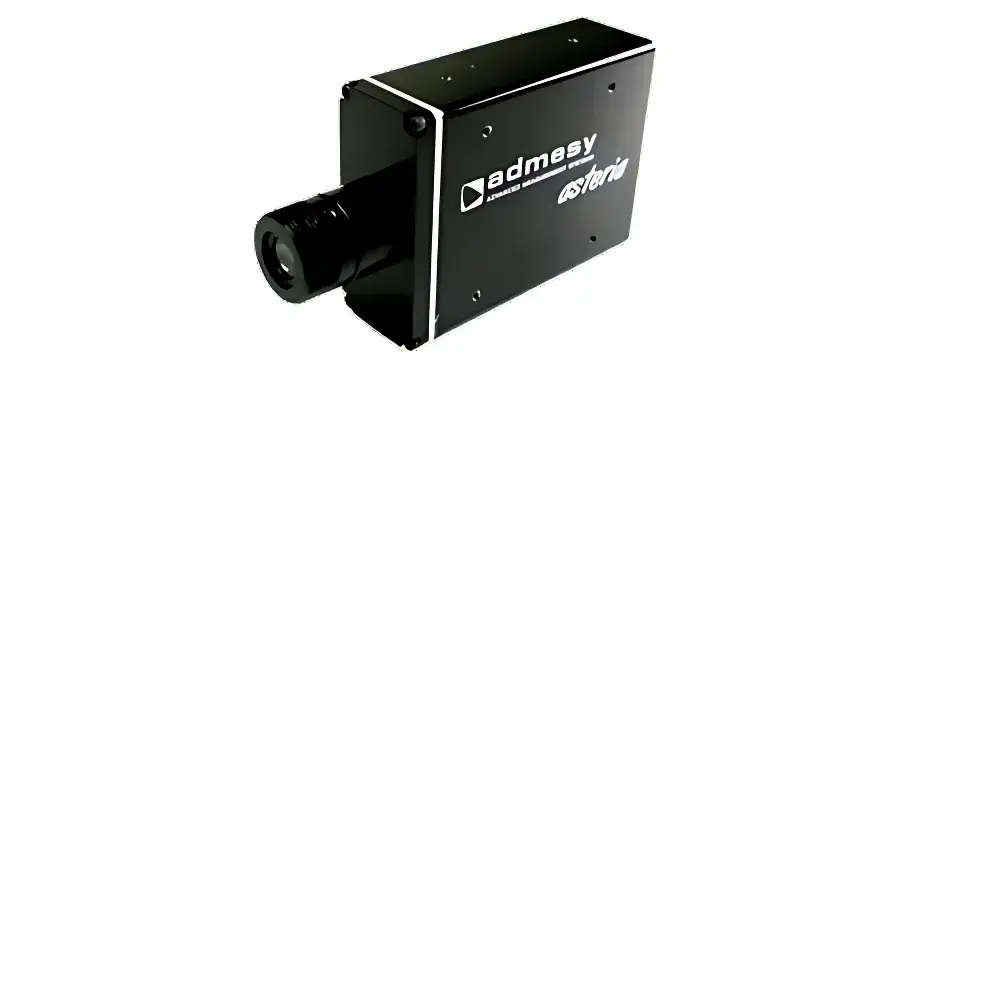
Admesy Asteria Colormeter – High-Speed Luminance, Illuminance & Flicker Measurement System
| Brand | Admesy |
|---|---|
| Origin | Netherlands |
| Model | Asteria-Colormeters |
| Instrument Type | Benchtop Spectrocolorimeter |
| Optical Geometry | 0/45° Integrating Sphere |
| Light Source | Steropes LED |
| Spectral Range | 200–1100 nm |
| Repeatability | <0.5% (ΔY), 0.0002 (ΔY at low luminance) |
| Detector | Silicon Photodiode with CIE 1931 Photopic Response Matching |
| Luminance Range | 0.002–15,000 cd/m² |
| Illuminance Range | 0.01–200,000 lux |
| Sampling Rate | Up to 180,000 samples/sec |
| Internal Memory | 250,000 measurements |
| Measurement Speed | 4–100 Hz (luminance/illuminance), real-time flicker analysis |
| Operating Temperature | 10–35 °C |
| Dimensions (L×W×H) | 69×31×93 mm (body only) |
| Weight | ~0.35 kg |
| Interface | USB 2.0, RS-232 |
| Trigger Support | External TTL trigger input |
| Software Compatibility | LabVIEW, LabWindows/CVI, Visual Studio (C++, C#, VB.NET) |
Overview
The Admesy Asteria Colormeter is a high-speed, benchtop optical measurement system engineered for precision photometric and flicker characterization in industrial R&D and production environments. Unlike conventional colorimeters or basic photometers, the Asteria implements a dual-path optical architecture—supporting interchangeable lens-based (luminance) and cosine-corrected diffuser (illuminance) configurations—within a single compact housing. Its core measurement principle relies on spectral-weighted photodetection aligned to the CIE 1931 photopic luminosity function (V(λ)), achieved via a silicon photodiode with optimized spectral responsivity and integrated temperature-stabilized electronics. The system captures time-resolved light signals at up to 180 kS/s, enabling simultaneous evaluation of steady-state photometric values (cd/m², lux) and dynamic flicker metrics—including temporal modulation depth, frequency spectrum, and industry-specific indices—without external data logging hardware. Designed for integration into automated test stations, the Asteria performs all flicker calculations internally (JEITA, IEEE 1789, VESA, Contrast Ratio, Percent Flicker, Flicker Index), eliminating post-processing latency and ensuring deterministic measurement timing.
Key Features
- Real-time, on-device computation of six standardized flicker metrics: JEITA MRT, IEEE 1789 Pst, VESA Flicker Metric, Contrast Method, Percent Flicker, and Flicker Index
- Dual optical configurations: 5° field-of-view lens (±2.5° acceptance angle) for luminance (cd/m²) with 12 mm spot size at 50 mm working distance; detachable cosine-corrected diffuser for illuminance (lux) with NIST-traceable angular response
- High dynamic range photometry: 0.002–15,000 cd/m² (luminance), 0.01–200,000 lux (illuminance), with calibrated repeatability better than ±0.03% ΔY at ≥150 cd/m²
- 15-bit ADC resolution across X, Y, Z tristimulus channels, delivering >78 dB signal-to-noise ratio and sub-millisecond integration time control (1 ms–5 s)
- Onboard memory stores 250,000 timestamped measurements with full metadata (integration time, gain, trigger status, computed flicker parameters)
- Industrial-grade I/O: isolated TTL trigger input for synchronization with display drivers or pulse-width-modulated LED sources; USB 2.0 and RS-232 interfaces with SCPI-compliant command set
- Software-agnostic API support: native drivers and example code for LabVIEW, LabWindows/CVI, and Visual Studio (C++, C#, VB.NET); no proprietary runtime dependencies
Sample Compatibility & Compliance
The Asteria is validated for use across display manufacturing (LCD, OLED, microLED), architectural lighting, automotive interior lighting, and medical device illumination systems. It meets the photometric traceability requirements of ISO/CIE standards for luminance and illuminance measurement (CIE S 014-2/E:2020, ISO 9241-305:2016). For flicker assessment, it complies with JEITA CP-3409, IEEE Std 1789-2015, VESA FPDM 2.0, and ENERGY STAR SSL Program Requirements v2.1. All factory calibrations are performed against NIST-traceable reference standards under controlled environmental conditions (23 ±1 °C, 50 ±5% RH), and calibration certificates include uncertainty budgets per ISO/IEC 17025:2017. The instrument’s mechanical design—featuring M3 threaded mounting points on all six faces—enables rigid, vibration-damped integration into AOI stations, robotic arms, or thermal chambers without optical misalignment.
Software & Data Management
Data acquisition and analysis are decoupled from vendor lock-in: the Asteria exposes a lightweight, stateless communication protocol over USB or RS-232, allowing direct integration into custom MES, SPC, or Lab Automation platforms. Each measurement packet includes raw sensor counts, computed Y (luminance/illuminance), chromaticity coordinates (x,y), flicker amplitude spectra (FFT up to 10 kHz), and pass/fail flags per selected metric. Audit trails—comprising operator ID, timestamp (UTC), firmware version, calibration ID, and environmental sensor readings (if equipped)—are embedded in every exported CSV or binary file. For regulated environments, optional firmware enables 21 CFR Part 11-compliant user authentication, electronic signatures, and immutable audit logs—fully compatible with GLP and GMP workflows. No cloud dependency: all processing occurs locally, satisfying data sovereignty requirements common in semiconductor and automotive Tier-1 supply chains.
Applications
- Display contrast verification per JEITA CP-3409 and VESA DisplayHDR testing protocols
- Flicker screening of backlight units (BLUs) and PWM-driven LED modules during incoming QC
- Temporal light artifact (TLA) assessment for human-centric lighting validation (CIE TN 006:2016)
- Automated optical inspection (AOI) of automotive HUDs, instrument clusters, and center displays
- Validation of dimming linearity and flicker suppression in smart lighting controllers
- Research-grade photobiological safety evaluation (IEC 62471) for UV-A and blue-light hazard weighting
FAQ
Does the Asteria support calibration traceability to national metrology institutes?
Yes. Each unit ships with a certificate of calibration traceable to NIST (USA) or NMi (Netherlands), including expanded uncertainty values at key luminance levels (0.1, 1, 10, 100 cd/m²) and flicker frequencies (30 Hz, 100 Hz, 1 kHz).
Can the Asteria measure both luminance and illuminance without hardware reconfiguration?
No—optical path selection requires physical attachment of either the 5° lens assembly or the cosine-corrected diffuser. However, switching takes less than 30 seconds and does not require recalibration.
Is external power required, or does it operate solely via USB bus power?
The Asteria operates exclusively on USB bus power (5 VDC, <500 mA); no external power adapter is needed.
What is the maximum flicker frequency the system can resolve?
With its 180 kS/s sampling rate and anti-aliasing filter, the Asteria supports unambiguous flicker analysis up to 45 kHz (Nyquist limit), though standard compliance modes target 0.1–3 kHz per IEEE 1789 and VESA specifications.
Are firmware updates and driver packages available publicly?
Yes. All firmware binaries, Windows/Linux/macOS drivers, SDKs, and API documentation are freely accessible via Admesy’s customer portal without registration or license keys.





