
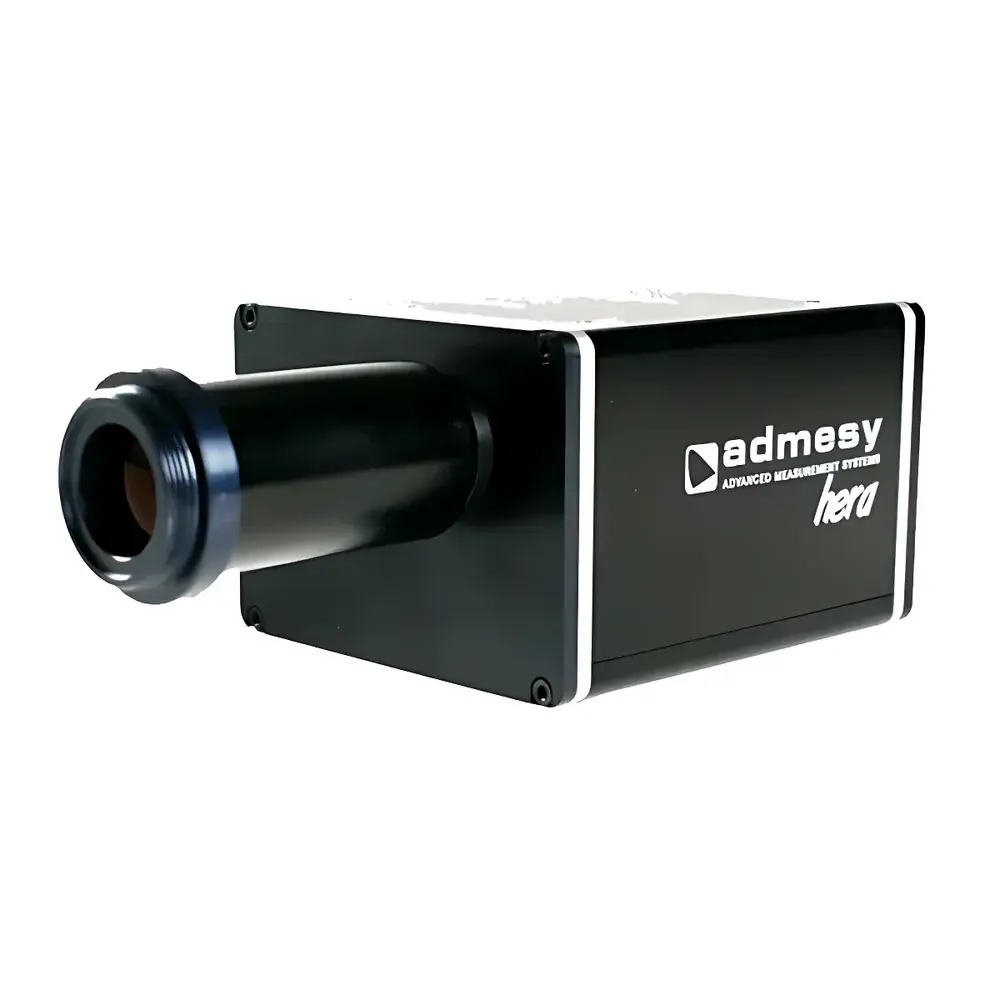
Admesy HERA High-Performance Spectroradiometer and Colorimeter
| Brand | Admesy |
|---|---|
| Origin | Netherlands |
| Model | HERA |
| Spectral Range (Lens Mode) | 380–780 nm |
| Spectral Resolution (FWHM) | 2.3 nm |
| Integration Time | 2.5 ms – 20 s |
| Stray Light | <0.03% |
| Nonlinearity | <1% |
| Luminance Range | 0.05–6000 cd/m² |
| Wavelength Accuracy | ±0.5 nm |
| Luminance Accuracy (CIE A) | ±4% |
| Chromaticity Accuracy (CIE x,y) | ±0.002 |
| Repeatability (2σ, 250 cd/m²) | <0.3% (luminance), ±0.0005 (x,y) |
| Measurement Spot Size (20 mm lens, 50 mm WD) | 20.5 mm |
| Field of View | ±0.3° |
| Interface | High-Speed USB (USBTMC/SCPI), RS232, Ethernet, External Trigger |
| Dimensions (L×W×H, body only) | 100 × 80 × 55 mm |
| Weight | 0.35 kg |
| Operating Temperature | 10–35 °C |
| Power | 1250 mW (USB-powered) |
| Optical Configurations | Fixed lens, cosine corrector, or fiber-coupled input (HERA01–HERA04 variants) |
Overview
The Admesy HERA is a high-precision spectroradiometer and colorimeter engineered for traceable photometric and colorimetric measurements in R&D laboratories, display manufacturing, LED quality control, and optical calibration facilities. Unlike conventional filter-based colorimeters, the HERA employs a calibrated CCD-based grating spectrometer architecture to acquire full spectral power distribution (SPD) across the visible and extended UV-NIR range—enabling fundamental CIE tristimulus calculations, chromaticity mapping, and radiometric validation with metrological rigor. Its core measurement principle relies on diffraction-grating dispersion coupled with thermally stabilized detector electronics and real-time dark-current compensation, ensuring high reproducibility under variable ambient conditions. Designed explicitly for integration into automated test benches and inline production monitoring systems, the HERA supports continuous spectral acquisition at millisecond-level integration times while maintaining NIST-traceable accuracy per CIE S 026/E:2015 and ISO/CIE 19476:2014 standards.
Key Features
- Modular optical input: interchangeable lens, cosine corrector, or SMA-905 fiber coupling—enabling flexible adaptation to collimated beams, diffuse surfaces, or remote probe configurations
- Four spectral variants (HERA01–HERA04) covering 190–1100 nm, with resolution options from 0.7 nm (UV) to 2.3 nm (VIS), all calibrated to ±0.5 nm wavelength accuracy
- Automatic exposure control with dynamic range optimization across six orders of magnitude in luminance (0.05–6000 cd/m²)
- Integrated thermal stabilization and real-time dark-signal subtraction, minimizing drift during long-duration measurements
- Full SCPI command set compliant with USBTMC 1.0, enabling seamless integration with LabVIEW, Python (PyVISA), MATLAB, and industrial PLCs
- Compact, fanless enclosure (100 × 80 × 55 mm, 0.35 kg) rated for continuous operation in controlled cleanroom and factory-floor environments (10–35 °C)
Sample Compatibility & Compliance
The HERA accommodates diverse sample geometries and emission characteristics—including OLED microdisplays, automotive HUDs, backlight units, laser projectors, and fluorescent materials—via configurable field-of-view (±0.3° with 20 mm lens) and adjustable working distance (50–150 mm). Its optical design conforms to CIE Publication 127:2007 for LED measurement geometry and supports compliance workflows aligned with IEC 62341-6-3 (OLED), JEITA CP-3502 (display uniformity), and MIL-STD-3009 (avionics lighting). All factory calibrations are performed against NIST-traceable reference lamps and reflectance standards; calibration certificates include uncertainty budgets per ISO/IEC 17025 requirements. The instrument meets CE, RoHS, and FCC Class B electromagnetic compatibility directives.
Software & Data Management
Admesy’s SpectraWin software provides a validated platform for spectral acquisition, CIE 1931/1976 chromaticity plotting, gamma curve analysis, CCT and Duv computation, and pass/fail binning against user-defined tolerances. Raw spectral data is exported in CSV, XML, or binary formats compatible with third-party analysis tools (e.g., OriginLab, JMP). For regulated environments, optional audit-trail-enabled firmware supports 21 CFR Part 11-compliant electronic records—including user authentication, immutable measurement logs, and version-controlled calibration history. Data synchronization over Ethernet enables centralized fleet management across multi-station test lines.
Applications
- Primary and secondary calibration of colorimeters, luminance meters, and imaging photometers
- Display Mura detection, white-point stability tracking, and viewing-angle-dependent chromaticity profiling
- LED phosphor characterization, binning consistency verification, and lifetime lumen maintenance studies
- Automotive interior lighting validation per UNECE R112 and SAE J1383
- Optical filter transmission/reflectance verification using relative spectral response correction
- Research-grade SPD acquisition for human-centric lighting (HCL) and circadian stimulus modeling
FAQ
Is the HERA suitable for ISO 13406-2 or ISO 9241-307 display ergonomics testing?
Yes—the HERA’s spatial uniformity performance, angular acceptance control, and CIE 1931 V(λ) spectral matching enable compliant luminance and chromaticity mapping per these standards when used with appropriate fixtures and alignment jigs.
Can the HERA perform flicker and temporal light modulation (TLM) analysis?
No—while its minimum integration time is 2.5 ms, the HERA is not designed for high-speed photometric waveform capture. For flicker metrics (Pst, SVM), Admesy recommends pairing it with the FlickerBox hardware module or using the dedicated FlickerSense spectroradiometer series.
Does the HERA support automatic recalibration in situ?
No—recalibration requires traceable reference sources and lab-grade environmental control. However, built-in dark-reference acquisition and gain-stability diagnostics allow users to verify system integrity between formal calibrations.
What is the typical calibration interval recommended for GMP environments?
Admesy recommends annual calibration with documented uncertainty assessment; interim verification using stable reference LEDs every 3 months is advised for critical QC applications.




