
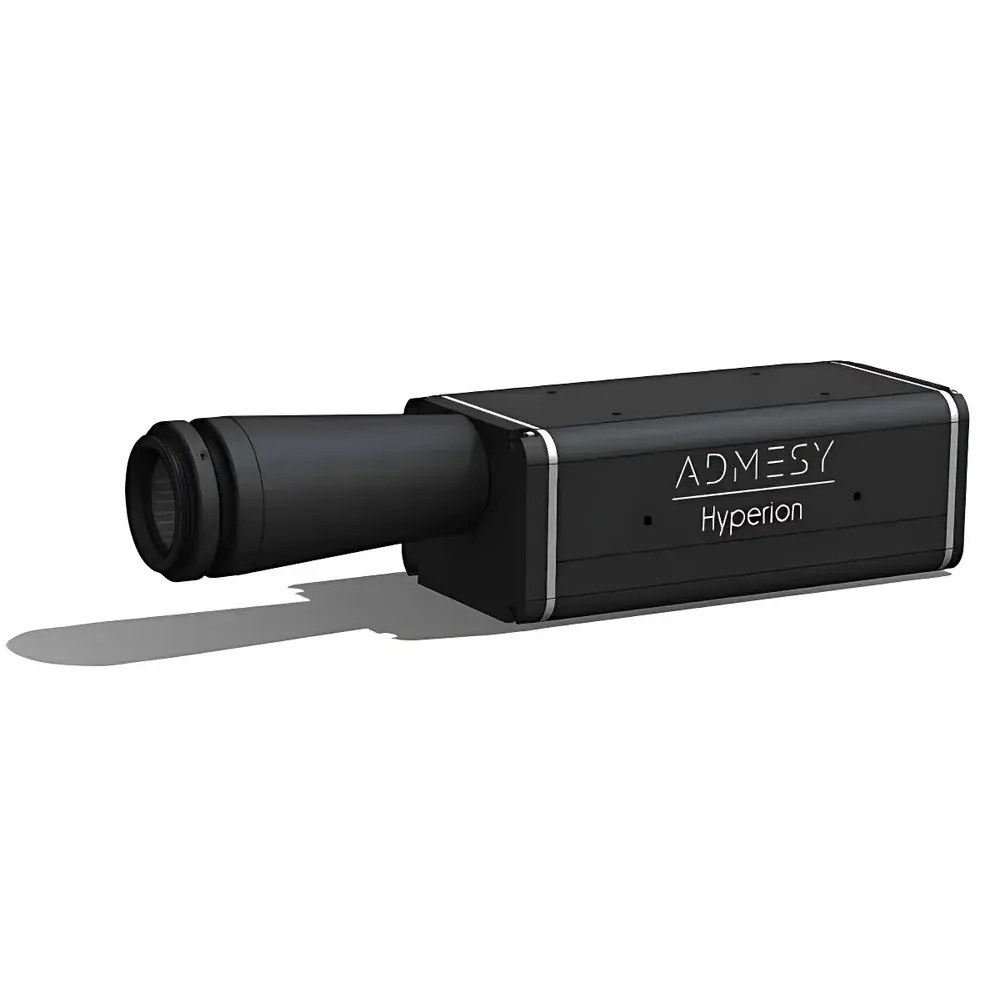
Admesy HYPERION 2.1 mm Focused-Lens Colorimeter
| Brand | Admesy |
|---|---|
| Origin | Netherlands |
| Model | HYPERION 2.1 mm |
| Optical Spot Size | 2.1 mm (focused lens configuration) |
| Measurement Principle | Tristimulus CIE 1931 XYZ colorimetry |
| Luminance Range | 0.001–200,000 cd/m² (typical, dependent on integration time and lens) |
| Sampling Rate | up to 2000 samples/s for Y (luminance) flicker measurement |
| Interface | USB-TMC compliant |
| Operating Systems | Windows, Linux (x86_64, i686, ARM), macOS |
| Software Integration | Native VISA support for LabVIEW, LabWindows/CVI, Visual Studio (.NET) |
| Compliance | USB-TMC 1.0, JEITA CP-3405 (flicker), CIE S 026/E:2015 (photopic luminous efficiency), ISO/CIE 11664-1:2019 (colorimetry fundamentals) |
| Mechanical Shutter | Integrated |
| Dynamic Range | >120 dB (typical, 24-bit ADC with auto-ranging) |
Overview
The Admesy HYPERION 2.1 mm Focused-Lens Colorimeter is a high-precision tristimulus color measurement instrument engineered for demanding optical metrology applications in display manufacturing, LED characterization, automotive lighting validation, and R&D laboratories. Based on the CIE 1931 standard observer model and calibrated against NIST-traceable standards, the HYPERION implements a three-channel silicon photodiode array with precision interference filters optimized for spectral responsivity matching the CIE XYZ color-matching functions. Its core innovation lies in the integrated 2.1 mm focal-length telecentric lens assembly, enabling sub-millimeter spatial resolution for measuring micro-displays, individual OLED subpixels, narrow-beam laser diodes, and miniature backlit components—where conventional 10–20 mm spot optics lack sufficient targeting fidelity. The device operates on a real-time MCU architecture with hardware-accelerated JEITA CP-3405 flicker analysis, delivering synchronized luminance (Y) sampling at up to 2000 Hz while maintaining full tristimulus (XYZ) acquisition integrity.
Key Features
- 2.1 mm focused optical spot size—enables precise targeting of micro-scale light sources without mechanical repositioning or image magnification artifacts
- High-dynamic-range analog front-end with 24-bit sigma-delta ADC and automatic gain ranging, achieving >120 dB effective dynamic range and sub-0.001 cd/m² low-luminance sensitivity
- Dedicated flicker measurement engine compliant with JEITA CP-3405, supporting simultaneous Y-channel sampling at 2000 Sa/s and FFT-based flicker index/percent depth calculation
- Integrated mechanical shutter for zero-reference dark calibration—eliminates thermal drift and ambient leakage errors during critical low-light measurements
- USB-TMC 1.0-compliant interface with native VISA driver support—ensures seamless integration into automated test systems using LabVIEW, LabWindows/CVI, or custom C#/C++ applications
- Cross-platform compatibility validated across Windows (x64), Linux (x86_64, i686, ARM64), and macOS (Intel & Apple Silicon)—with open-source USBTMC kernel modules available for embedded industrial controllers
Sample Compatibility & Compliance
The HYPERION 2.1 mm is designed for non-contact, point-source colorimetric evaluation of emissive devices under controlled ambient conditions. It supports direct coupling to optical fixtures—including collimators, integrating spheres (via fiber adapter), and custom tube assemblies—for repeatable alignment per ISO/CIE 11664-1:2019 geometry specifications. All factory calibrations are traceable to PTB/NPL primary standards and documented per ISO/IEC 17025 requirements. The instrument meets essential regulatory frameworks for quality-critical environments: USB-TMC compliance ensures interoperability in FDA 21 CFR Part 11–aligned validation workflows; JEITA CP-3405 conformance enables flicker reporting required by IEC TR 62778 and ENERGY STAR SSL program guidelines; and its spectral error margin (< ±0.5% Δu'v' over CIE 1976 UCS) satisfies ISO 13406-2 Annex B for display uniformity verification.
Software & Data Management
Admesy provides the open-architecture Hyperion Control Suite (v4.x), a Qt-based cross-platform application supporting real-time XY chromaticity plotting, flicker waveform visualization, pass/fail binning against user-defined tolerances (e.g., MacAdam ellipses, u’v’ boxes), and automated report generation (PDF/CSV/XLSX). Raw data export includes timestamped XYZ, Yxy, L*a*b*, CCT, Duv, and flicker metrics with metadata (integration time, gain setting, shutter state). For enterprise integration, the device exposes a complete SCPI command set over USB-TMC and supports NI-VISA session management—including transaction logging, audit trail capture, and electronic signature-ready calibration certificate embedding. All firmware updates are digitally signed and verified via ECDSA to maintain GLP/GMP data integrity.
Applications
- Micro-LED and Mini-LED pixel-level chromaticity mapping during wafer-level probe testing
- Automotive HUD and digital instrument cluster luminance uniformity verification at <1° viewing angle
- Flicker assessment of PWM-driven vehicle interior lighting per UNECE R128 and SAE J1383
- Color consistency screening of medical display panels (DICOM GSDF compliance support)
- Research-grade spectral stability monitoring of quantum dot backlight units under thermal stress cycling
- Calibration reference transfer between integrating sphere systems and production-line spot meters
FAQ
What is the minimum measurable source size supported by the 2.1 mm lens configuration?
The 2.1 mm spot diameter corresponds to the full-width-at-half-maximum (FWHM) intensity profile at the measurement plane; practical resolution for discrete emitters is ~0.8 mm when aligned under diffraction-limited conditions.
Does the HYPERION support spectral power distribution (SPD) output?
No—it is a tristimulus colorimeter, not a spectroradiometer; XYZ values are derived from filtered photodiode responses, not dispersed spectra.
Can the mechanical shutter be disabled for continuous acquisition?
Yes—shutter control is software-configurable; disabling it enables high-speed streaming mode, though dark offset stability must be managed externally.
Is calibration certificate included with shipment?
Yes—a NIST-traceable calibration certificate (including uncertainty budget per GUM) is provided with each unit, valid for 12 months from date of issue.
How is thermal drift compensated during extended measurements?
The internal temperature sensor feeds real-time correction coefficients to the XYZ gain matrix; additionally, periodic auto-zero cycles (triggered manually or on timer) engage the mechanical shutter for drift-free baseline recovery.




