
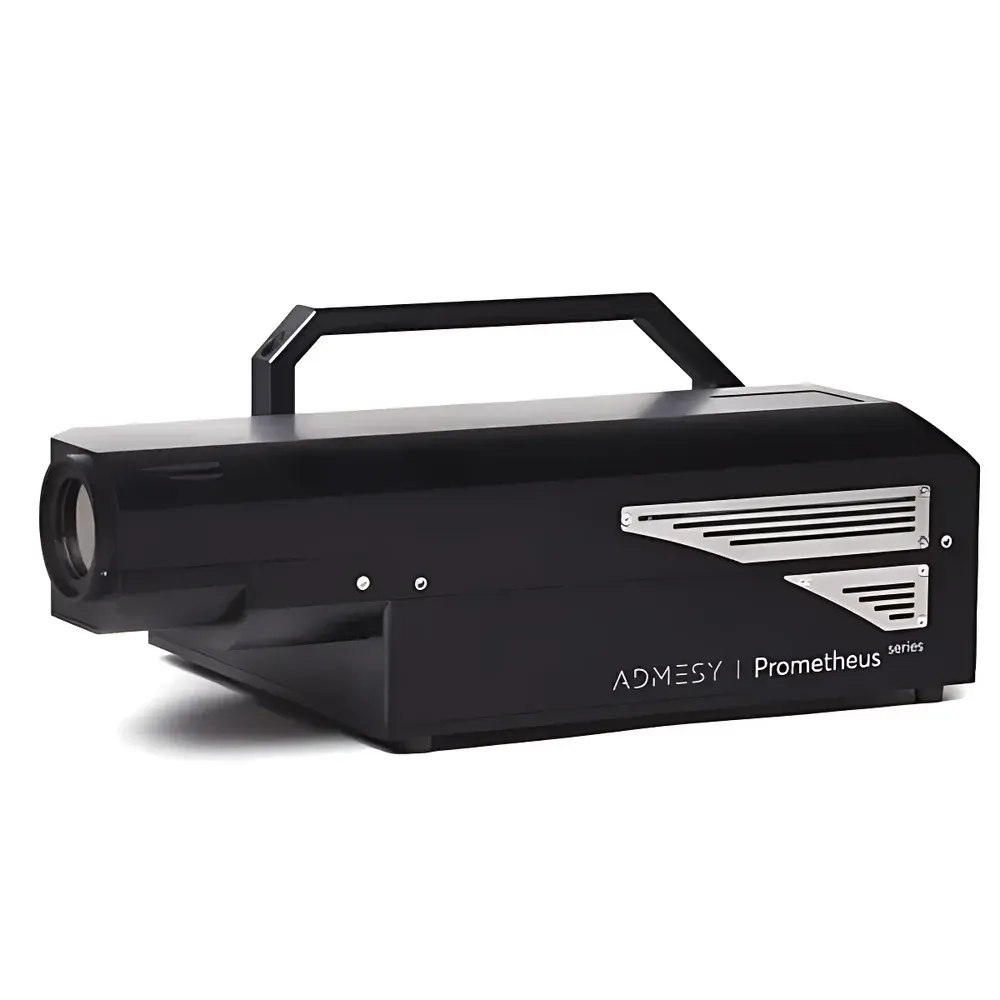
Admesy Prometheus Built-in Viewfinder Spectroradiometer
| Brand | Admesy |
|---|---|
| Origin | Netherlands |
| Model | Prometheus |
| Detector Type | Cooled CCD |
| Viewfinder Type | Pritchard Mirror-Based Camera Viewfinder |
| Interface | USB (USBTMC/SCPI), RS232, Ethernet |
| Dynamic Range | High (with内置 mechanical shutter & OD filter wheel) |
| Polarization Sensitivity | Very Low |
| Linearity Error | ±0.5% (internally compensated) |
| Dark Current Compensation | Full integration-range zero offset correction |
| Wavelength Monitoring | Integrated real-time wavelength drift correction |
| Calibration | Factory-calibrated for spectral radiance, luminance, chromaticity (CIE 1931 xy, u’v’) |
| Compliance | USBTMC, SCPI, ISO/CIE-compliant measurement architecture |
| Software Support | SDK for Python, C++, LabVIEW, MATLAB, .NET |
Overview
The Admesy Prometheus Built-in Viewfinder Spectroradiometer is a high-precision, production-grade optical measurement instrument engineered for absolute photometric and colorimetric characterization of light sources under real-world conditions. Unlike conventional colorimeters or basic spectroradiometers, the Prometheus integrates a Pritchard-type mirror-based optical viewfinder directly into its optical path—enabling unambiguous spatial registration of the measurement spot on target surfaces without parallax error. Its core measurement principle relies on cooled back-illuminated CCD detection coupled with high-fidelity grating dispersion, delivering spectral resolution sufficient for CIE 1931 tristimulus computation, luminance (cd/m²), chromaticity (x,y; u’v’), correlated color temperature (CCT), and dominant wavelength—all traceable to NIST-traceable calibration standards. Designed for in-line quality control and R&D validation, the Prometheus operates across a typical spectral range of 380–780 nm (extendable options available), with internal wavelength monitoring ensuring long-term stability against thermal drift or mechanical relaxation.
Key Features
- Pritchard mirror-based built-in camera viewfinder: Provides live, parallax-free visual confirmation of the exact measurement area—critical for small-emitter testing (e.g., micro-LEDs, OLED pixels, automotive lighting modules).
- Automated focus and factory-preset focal length: Eliminates manual focusing; focus position controlled via software command for repeatable setup across multiple instruments.
- Cooled CCD detector with ultra-low dark current: Enables stable integration times from 1 ms to 10 s while maintaining signal integrity and minimizing thermal noise.
- Integrated mechanical shutter and OD filter wheel: Supports high-dynamic-range measurements up to 10⁶:1 without saturation—essential for measuring both dim OLED blacks and bright LCD whites in a single acquisition.
- Real-time internal wavelength monitoring: Compensates for minor grating or thermal drift during operation, preserving spectral accuracy over extended runs and temperature fluctuations.
- Fully embedded photometric computation engine: Calculates luminance, CCT, Duv, CRI (Ra), TM-30 metrics, flicker (IEEE 1789), and stroboscopic effect visibility measure (SVM) onboard—reducing host PC load and enabling deterministic cycle times in automated test systems.
- Multi-interface connectivity: USB (USBTMC-compliant, SCPI command set), RS232, and Gigabit Ethernet support seamless integration into PLC-controlled lines, MES environments, or custom LabVIEW/C++ test platforms.
Sample Compatibility & Compliance
The Prometheus is optimized for planar and quasi-diffuse emitters including displays (LCD, OLED, MicroLED), backlight units, automotive headlamps, architectural lighting fixtures, and signage panels. Its compact form factor and ruggedized aluminum housing meet IP50-rated environmental robustness for factory-floor deployment. Measurement protocols align with CIE S 026/E:2015 (photobiological safety), ISO/CIE 11664 (colorimetry), and IEC 62341-6-3 (OLED display testing). Internal calibration adheres to ISO/IEC 17025 traceability requirements when used with Admesy’s certified calibration services. Data logging and configuration changes are audit-trail enabled—supporting GLP/GMP-aligned workflows where required.
Software & Data Management
Admesy’s SpectraWin software provides intuitive GUI-based operation, real-time spectral visualization, batch report generation (PDF/CSV/XLSX), and pass/fail limit mapping per parameter. The Prometheus SDK delivers full low-level access—including raw spectrum retrieval, asynchronous trigger control, and firmware update capability—compatible with Python (PyVISA), C/C++, MATLAB, LabVIEW, and .NET frameworks. All device firmware and calibration data are digitally signed and versioned. Data export conforms to ASTM E308-22 spectral data format, ensuring interoperability with third-party analysis tools such as ColorCAL, LightTools, or TracePro.
Applications
- Display manufacturing: Pixel-level uniformity mapping, Mura detection, grayscale tracking, and HDR tone-mapping verification.
- Automotive lighting: Headlamp beam pattern validation, DRL chromaticity compliance (ECE R149), and adaptive driving beam (ADB) dynamic output verification.
- AR/VR microdisplay testing: Luminance and color gamut evaluation at sub-millimeter apertures with precise spatial targeting.
- Lighting R&D: LED binning support, phosphor degradation analysis, and lifetime lumen maintenance studies under thermal stress.
- Regulatory testing labs: Pre-compliance screening for ENERGY STAR, DLC, and CE marking requirements related to photometric and color performance.
FAQ
Does the Prometheus require external calibration after initial setup?
No—factory calibration is valid for 12 months under normal operating conditions. Admesy recommends annual recalibration using NIST-traceable standards; optional on-site recalibration services are available.
Can the viewfinder be used for alignment during automated robotic integration?
Yes—the live video feed is accessible via SDK and supports ROI-based auto-alignment routines when paired with motion controllers or machine vision systems.
Is the instrument compliant with FDA 21 CFR Part 11 for regulated pharmaceutical or medical device applications?
While the hardware supports audit trail and electronic signature-ready configurations, full Part 11 compliance requires implementation of validated software controls and procedural SOPs—Admesy provides documentation packages to support such validation efforts.
What spectral bandwidth (FWHM) does the standard model achieve?
The base configuration delivers ≤2.5 nm FWHM at 550 nm; high-resolution variants (≤1.0 nm) are available upon request.
How is stray light performance quantified, and what mitigation strategies are implemented?
Stray light is suppressed to <0.01% via double-pass monochromator design, black-anodized internal baffling, and order-sorting filters—validated per CIE Publication 177:2006 methodology.





