
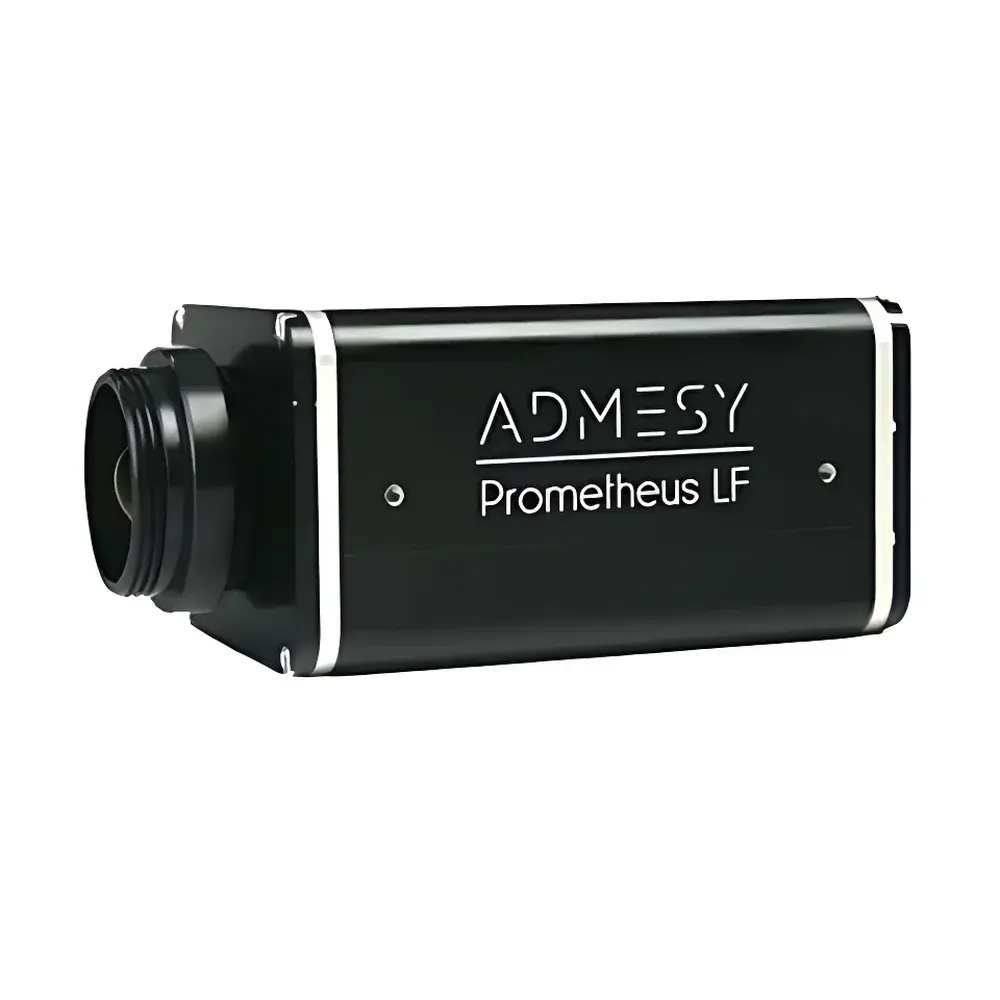
Admesy Prometheus LF High-Speed Luminance and Flicker Meter
| Brand | Admesy |
|---|---|
| Origin | Netherlands |
| Model | Prometheus LF |
| Sampling Rate | 800 kS/s |
| Photopic V(λ) Filter Compliance | CIE 1931 Standard Observer |
| Flicker Metrics | Contrast Ratio (Min/Max/RMS), JEITA, VESA |
| Operating Systems | Windows, macOS, Linux |
| API Support | VISA-compliant (LabVIEW, LabWindows/CVI, C++, C#, Python) |
| Trigger I/O | TTL-compatible input/output |
| Auto-ranging | Yes |
| User Calibration | Supported |
| Memory | High-capacity onboard buffer |
| Measurement Modes | Luminance (cd/m²), Flicker Waveform Capture, Temporal Analysis |
| Optical Aperture | 17 mm |
Overview
The Admesy Prometheus LF is a high-speed luminance and flicker meter engineered for precision photometric characterization of light-emitting devices under dynamic conditions. Based on calibrated silicon photodiode detection coupled with a spectrally optimized optical filter set, the instrument implements the CIE 1931 photopic luminosity function V(λ) with exceptional fidelity—achieving >99.5% spectral match to the standard observer curve. This ensures metrologically traceable luminance measurements (in cd/m²) across intensities ranging from sub-0.01 cd/m² to over 10⁶ cd/m², even during rapid temporal transients. Its core architecture leverages real-time analog signal conditioning and FPGA-accelerated digitization to sustain a continuous sampling rate of 800,000 samples per second—enabling full waveform capture of high-frequency flicker (up to 400 kHz) without aliasing or data gap. Unlike conventional integrating or slow-scan photometers, the Prometheus LF operates in true time-domain mode, making it suitable for evaluating OLED microdisplays, automotive HUDs, AR/VR near-eye displays, and LED lighting systems where temporal stability directly impacts visual perception and regulatory compliance.
Key Features
- Ultra-High Sampling Rate: 800 kS/s continuous acquisition enables Nyquist-compliant analysis of flicker components up to 400 kHz—critical for assessing PWM dimming artifacts and high-frequency driver instability.
- CIE-Compliant Photopic Filtering: Custom multi-layer interference filter achieves industry-leading V(λ) spectral match (f1′ < 1.5%), minimizing measurement uncertainty in luminance and flicker contrast calculations.
- Auto-Ranging & Wide Dynamic Range: Seamless switching between gain stages supports accurate measurement from 0.005 cd/m² to 1,000,000 cd/m² without manual attenuation or exposure adjustment.
- Onboard Temporal Buffer: High-throughput memory architecture stores up to 16 million consecutive samples—sufficient for capturing multiple full-period waveforms at maximum sampling rate.
- Hardware Trigger Synchronization: Dedicated TTL-compatible trigger input and output allow precise alignment with external stimuli (e.g., display frame sync, LED driver signals) for deterministic temporal correlation.
- Real-Time Flicker Metric Computation: On-device calculation of Contrast Ratio (min/max/rms), JEITA M1587, and VESA Flicker Index per IEC TR 62778—reducing post-processing latency and ensuring audit-ready results.
Sample Compatibility & Compliance
The Prometheus LF is designed for non-contact, collimated-field luminance measurement of planar and curved emissive surfaces—including OLED, microLED, LCD, and projection-based displays. Its 17 mm entrance aperture accommodates standard test geometries defined in ISO 9241-307 (Ergonomics of human-system interaction), IEC 62341-6-3 (OLED display testing), and ENERGY STAR Program Requirements for Displays (Version 8.0). All firmware and calibration certificates are traceable to NIST-recognized national metrology institutes via Admesy’s ISO/IEC 17025-accredited calibration laboratory. The device meets electromagnetic compatibility requirements per EN 61326-1 and carries CE marking for use in EU-based R&D and production environments. For regulated industries, raw data export includes timestamped metadata compliant with FDA 21 CFR Part 11 principles when used with validated software configurations.
Software & Data Management
Admesy provides the open-source Admesy SDK, a VISA-compliant driver suite supporting cross-platform integration with LabVIEW, LabWindows/CVI, MATLAB, Python (PyVISA), and native C/C++/C# applications. The included Quantum Console application offers real-time waveform visualization, flicker metric dashboards, batch report generation (PDF/CSV), and GLP-compliant audit trails—including user login tracking, parameter change logs, and calibration certificate embedding. Data files conform to HDF5 format with embedded SI units, measurement context, and instrument configuration—ensuring long-term readability and interoperability with third-party analysis tools such as OriginLab or Python-based SciPy workflows. Remote operation via TCP/IP or USB 2.0 is supported without proprietary middleware.
Applications
- Display manufacturing: In-line flicker screening of smartphone, tablet, and automotive infotainment panels
- R&D labs: Temporal characterization of novel emissive materials (e.g., perovskite LEDs, QD-OLEDs) under pulsed excitation
- Lighting design: Validation of IEEE 1789-2015 flicker mitigation strategies in smart LED drivers
- Medical device certification: Photobiological safety assessment per IEC 62471, including stroboscopic effect evaluation
- AR/VR hardware development: Latency-aware luminance profiling synchronized to head-tracking timestamps
- Standards laboratories: Reference-grade validation of flicker test equipment per CIE TN 006:2020
FAQ
What is the minimum measurable luminance level with the Prometheus LF?
The instrument maintains linearity down to 0.005 cd/m² under optimal signal-to-noise conditions; actual limit depends on integration time, aperture size, and ambient stray light control.
Does the Prometheus LF support calibration traceability to national standards?
Yes—each unit ships with a factory calibration certificate traceable to PTB (Physikalisch-Technische Bundesanstalt) or NPL, and optional on-site recalibration services are available through Admesy’s global partner network.
Can flicker metrics be computed in real time during acquisition?
Yes—Contrast Ratio (min/max/rms), JEITA, and VESA metrics are calculated onboard and streamed concurrently with raw waveform data.
Is Linux support fully featured, including GUI and CLI modes?
The Admesy SDK provides full API access on Linux; Quantum Console GUI is Windows/macOS only, but command-line utilities and Python examples enable complete headless operation.
How does the auto-ranging function handle sudden brightness transitions?
The FPGA-based control loop adjusts gain within <5 µs, preventing saturation during step changes typical in PWM-driven displays or strobed backlight systems.




