
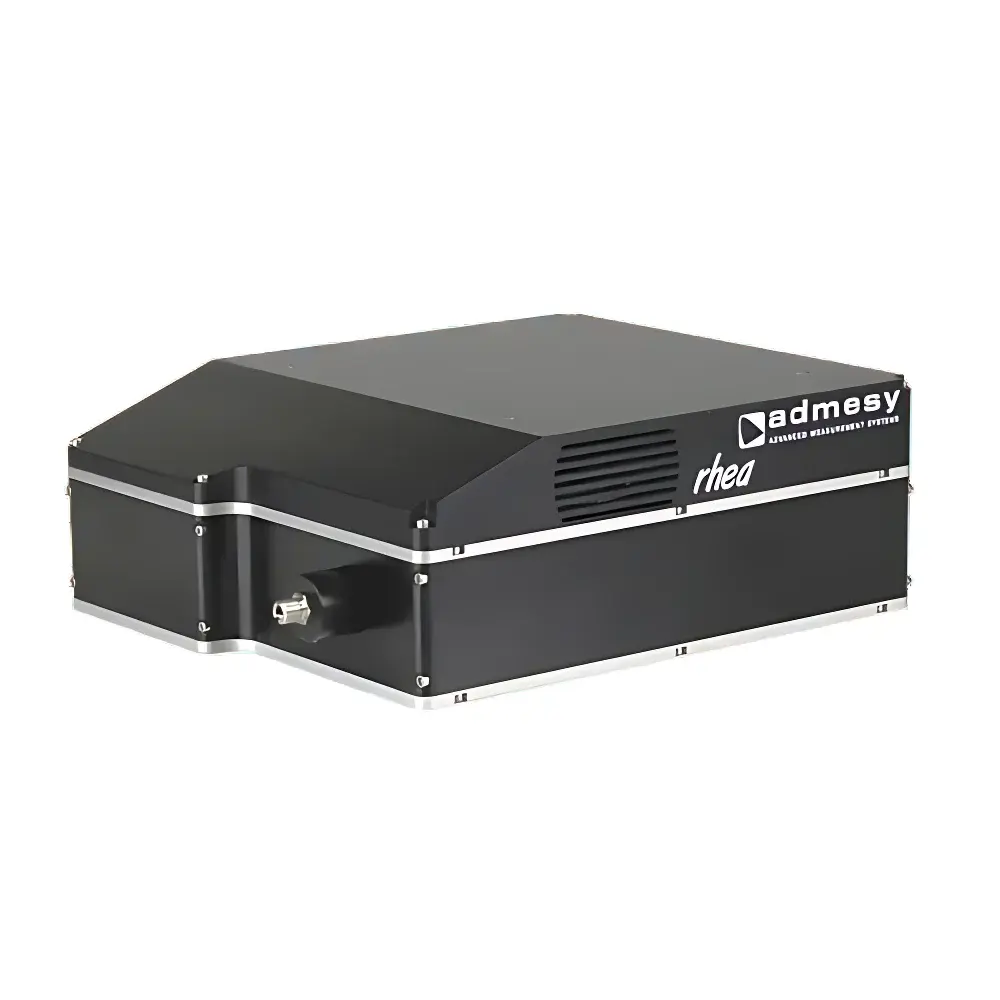
Admesy Rhea Spectrometer
| Brand | Admesy |
|---|---|
| Origin | Netherlands |
| Model | Rhea Spectrometers |
| Spectral Range | 200–1100 nm |
| Cooling | Thermoelectrically cooled CCD (operating at –10 °C) |
| Spectral Resolution (FWHM) | 2.3 nm |
| Integration Time | 4.8 ms – 60 min |
| Dark Noise (RMS) | ~3–5 counts (16-bit ADC) |
| Stray Light | <0.03% |
| Nonlinearity | <1% |
| Optical Input | Fixed or customizable fiber coupling |
| Interface | High-speed USB (USBTMC compliant), RS232, Ethernet, TTL trigger |
| Dimensions (L×W×H) | 230 × 195 × 82.5 mm (excl. lens) |
| Weight | 3.3 kg |
| Operating Temperature | 10–35 °C |
| Power Supply | 14.5–15.5 V DC |
| Spot Size (with 20 mm lens) | 20.5 mm @ 50 mm WD, 21 mm @ 100 mm WD, 21.5 mm @ 150 mm WD |
| Field of View | ±0.3° |
| Onboard Processing | Yes |
| Neutral Density Filter Wheel | Integrated |
| Dynamic Range Enhancement | Yes |
| Linearity | Engineered for <1% nonlinearity across full intensity range |
| Compliance | USBTMC, SCPI command set, suitable for GLP/GMP-aligned data acquisition workflows |
Overview
The Admesy Rhea Spectrometer is a high-performance, thermoelectrically cooled CCD-based optical spectrometer engineered for precision spectral radiometry, colorimetry, and photometric measurement in demanding industrial and laboratory environments. Operating on the principle of diffraction-grating-based spectral dispersion coupled with a deep-cooled silicon CCD detector, the Rhea delivers exceptional signal fidelity across the ultraviolet-to-near-infrared spectrum (200–1100 nm). Its core architecture centers on low-noise detection: the CCD is actively stabilized at –10 °C to suppress dark current, while an integrated neutral density (ND) filter wheel enables automatic dynamic range extension—critical for applications spanning high-intensity LED emission and low-flux fluorescence. All spectral processing—including dark current subtraction, wavelength calibration, and photometric unit conversion—is performed onboard, eliminating host-computer dependency and ensuring deterministic latency and reproducibility. Designed from inception for integration into automated test systems, OEM platforms, and inline process monitoring stations, the Rhea meets stringent requirements for stability, repeatability, and interoperability in regulated settings.
Key Features
- Thermoelectrically cooled CCD detector operating at –10 °C, reducing dark noise to ~3–5 counts RMS (16-bit ADC)
- Integrated motorized neutral density filter wheel enabling seamless high-dynamic-range (HDR) acquisition without manual intervention
- Onboard spectral processing engine: real-time dark compensation, nonlinearity correction (<1%), and absolute irradiance/color coordinate calculation
- Flexible optical input: factory-configured fixed-fiber interface with optional user-defined fiber coupling (SMA 905), supporting custom probe integration
- Multi-interface connectivity: USB 2.0 (USBTMC-compliant), RS232, Gigabit Ethernet, and hardware TTL trigger I/O for synchronized multi-device operation
- SCPI command set compliance ensures plug-and-play integration with LabVIEW, Python (PyVISA), MATLAB, and industrial PLC ecosystems
- Compact, robust aluminum chassis (230 × 195 × 82.5 mm; 3.3 kg) rated for continuous operation in ambient temperatures from 10 to 35 °C
Sample Compatibility & Compliance
The Rhea accommodates diverse sample geometries and illumination conditions via interchangeable optical attachments—including collimating lenses, integrating spheres (optional), and fiber-coupled probes. Its ±0.3° field-of-view and calibrated spot sizes (e.g., 20.5 mm at 50 mm working distance with 20 mm lens) support standardized reflectance, transmittance, and emission measurements per ISO/CIE geometry conventions. The instrument complies with USBTMC-USB488 standards for instrument-class communication and supports audit-trail-capable data logging when deployed with validated software environments. While not intrinsically certified for FDA 21 CFR Part 11, its deterministic firmware behavior, SCPI traceability, and onboard timestamping make it suitable for GxP-aligned validation protocols when embedded within qualified systems adhering to ISO/IEC 17025 or ASTM E308/E2159 guidelines.
Software & Data Management
Admesy provides the SpectraSuite-compatible SDK and native .NET/C++/Python APIs, enabling full control over integration time, ND filter selection, averaging, and output format (ASCII, CSV, binary). Raw spectra are exported with calibrated wavelength and intensity axes (µW/cm²/nm or cd/m²), alongside CIE 1931 xy, u’v’, and CCT values where applicable. All internal corrections—including pixel-wise dark frame subtraction, linearity mapping, and grating efficiency compensation—are applied prior to export. For enterprise deployment, the Rhea supports TCP/IP streaming mode for real-time spectral feed into MES or SCADA platforms, with configurable metadata tagging (sample ID, operator, timestamp, environmental sensor inputs).
Applications
- LED and OLED display manufacturing: binning, chromaticity shift monitoring, and aging studies under thermal stress
- Automotive lighting QA: headlamp spectral power distribution (SPD) verification against ECE R149 and SAE J1383
- Pharmaceutical packaging inspection: UV-Vis transmission analysis of blister foil and label inks
- Material science: thin-film interference characterization and optical coating reflectance profiling
- OEM integration: embedded spectral feedback in laser diode control loops, plasma process monitoring, and solar cell QE mapping systems
FAQ
Does the Rhea support NIST-traceable calibration?
Yes—Admesy offers factory-applied, NIST-traceable irradiance and wavelength calibration certificates (ISO/IEC 17025 accredited), with optional annual recalibration services.
Can the spectral resolution be customized beyond 2.3 nm FWHM?
Standard configuration delivers 2.3 nm FWHM across the full 200–1100 nm range. Higher resolution variants (e.g., 0.5 nm or 1.0 nm) are available upon request; contact Admesy engineering for slit width and grating options.
Is external triggering supported for synchronized multi-spectrometer setups?
Yes—the Rhea features TTL-compatible input and output trigger lines, enabling precise master-slave timing with sub-millisecond jitter for arrayed or hyperspectral configurations.
What power supply specifications must be observed?
The unit requires a stable 14.5–15.5 V DC supply delivering ≥2 A; ripple must remain below 50 mVpp to maintain CCD cooling stability and ADC accuracy.
How is thermal drift managed during extended integrations?
The thermoelectric cooler maintains detector temperature within ±0.1 °C of setpoint; onboard thermal sensors feed forward-compensated gain adjustments to preserve photometric linearity over 60-minute exposures.




