
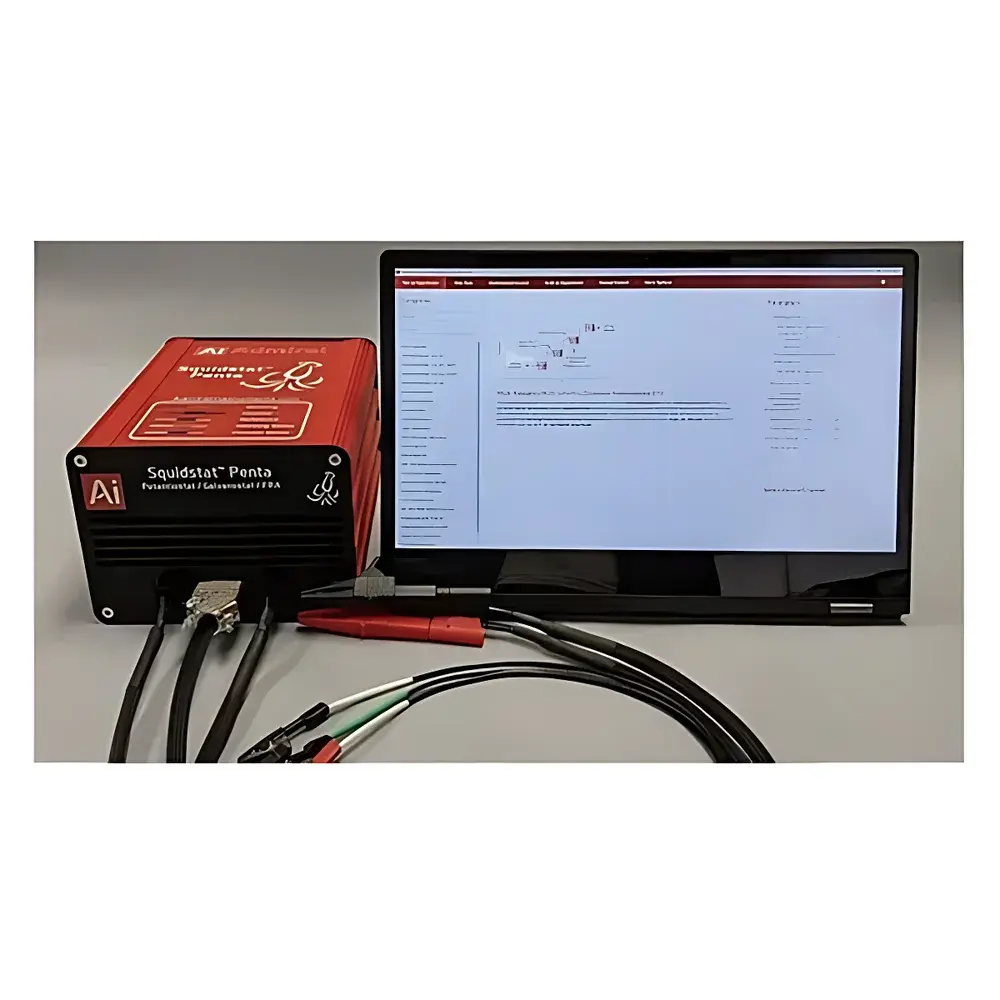
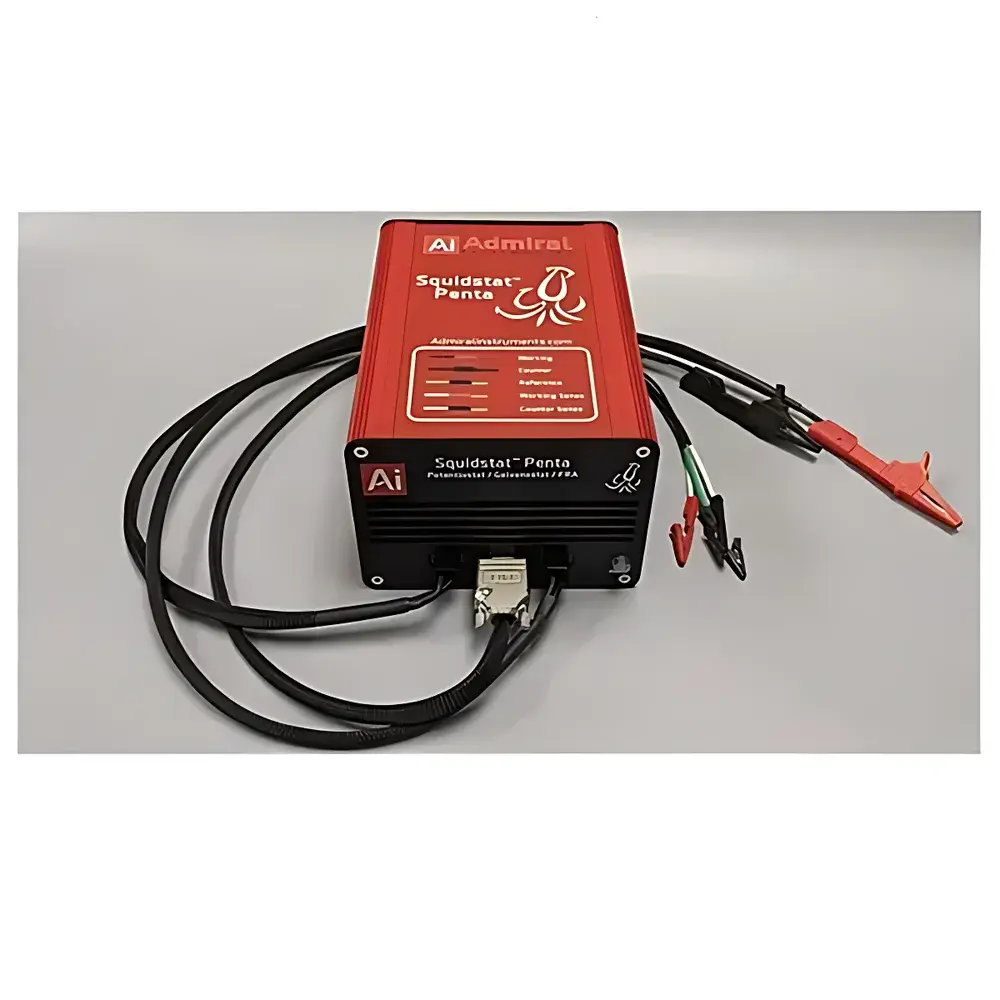
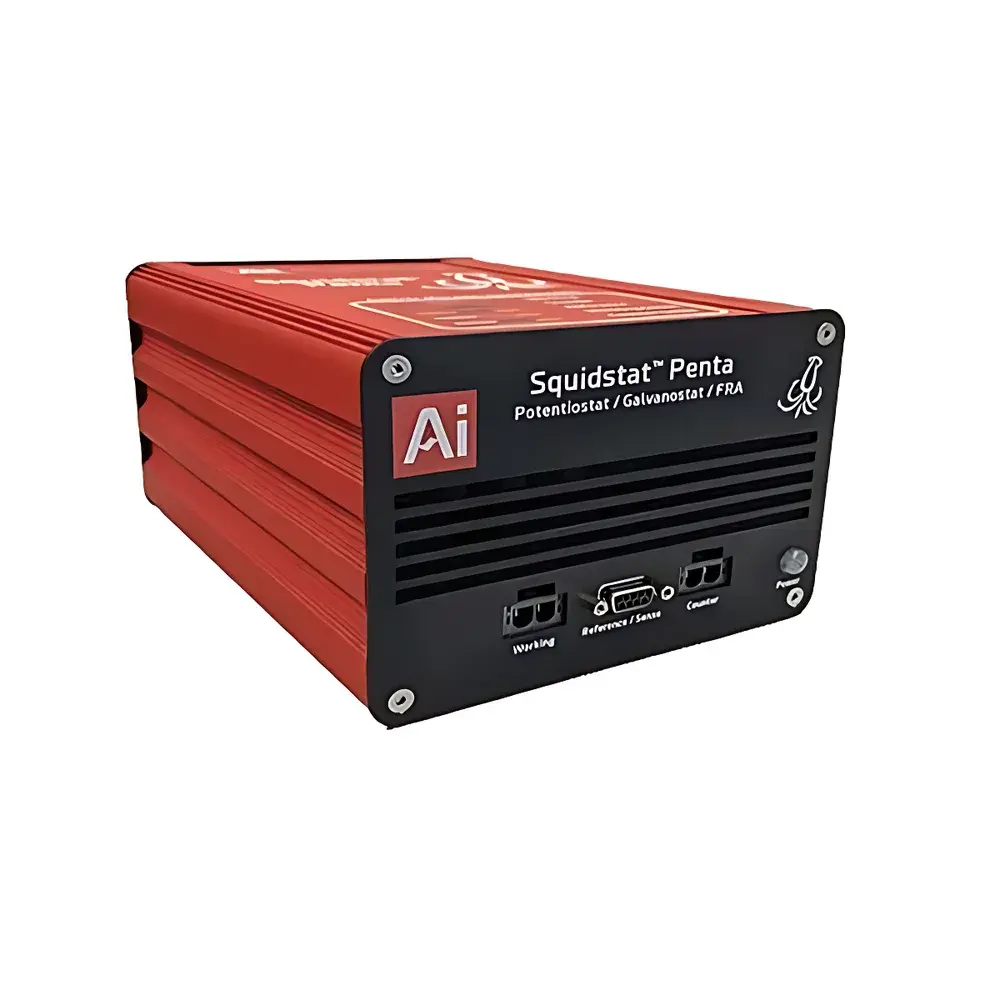
Admiral Squidstat Penta 5A High-Current Electrochemical Workstation
| Brand | Admiral |
|---|---|
| Origin | USA |
| Manufacturer Type | Authorized Distributor |
| Product Category | Imported Instrument |
| Model | Penta 5A |
| Instrument Type | Electrochemical Workstation |
| Current Range | ±5 A |
| Current Accuracy | 0.1% of range, minimum 1 nA |
| Potentiostatic Range | ±10 V |
| EIS Frequency Range | 10 µHz – 1 MHz |
| Current Resolution | down to 30 pA |
| Voltage Resolution | 15 µV |
| Voltage Accuracy | 0.1% of setpoint, minimum 1 mV |
| Input Impedance | 10 TΩ |
| Supported DC Techniques | CV, LSV, OCP, Tafel, CA, CP, DPV, NPV, SWV, Staircase Voltammetry, GITT, PITT |
| Supported AC Techniques | Potentiostatic EIS, Galvanostatic EIS, Mott-Schottky (1/C² vs. V) |
| Battery Testing Modes | CC-CV, CC-CV-EIS, CP/CR |
| Data Output | SOC, dQ/dV, Coulombic Efficiency, Energy Efficiency, Cycle Statistics, Capacity Statistics |
| Onboard Storage | 16 GB flash memory |
| Data Format | CSV (auto-saved, power-fail resilient) |
Overview
The Admiral Squidstat Penta 5A High-Current Electrochemical Workstation is a modular, precision-engineered potentiostat/galvanostat system designed for demanding electrochemical research and industrial battery development. Built upon a low-noise, high-bandwidth analog architecture, the Penta 5A implements true four-quadrant operation with ±5 A current capability and ±10 V compliance voltage—enabling characterization of high-power electrodes, large-format cells, flow batteries, and electrocatalytic systems where conventional benchtop instruments reach operational limits. Its core measurement engine supports both potentiostatic and galvanostatic control modes with synchronized data acquisition, and integrates broadband electrochemical impedance spectroscopy (EIS) from 10 µHz to 1 MHz—critical for resolving interfacial kinetics, solid-electrolyte interphase (SEI) evolution, and bulk transport phenomena across multiple time constants. The system complies with fundamental electrochemical instrumentation standards including ASTM E2421 (guidelines for EIS instrumentation), ISO 17025 traceability requirements for calibration documentation, and supports audit-ready workflows aligned with GLP and pre-GMP laboratory practices.
Key Features
- High-current capability: ±5 A maximum output with eight auto-ranging current scales (100 nA to 5 A), delivering <30 pA resolution and 0.1% full-scale accuracy (≥1 nA absolute minimum)
- Ultra-stable potentiostatic control: ±10 V compliance range, 15 µV voltage resolution, and 0.1% setpoint accuracy (≥1 mV absolute minimum)
- True dual-mode EIS: Potentiostatic and galvanostatic perturbation options with phase-resolved detection, supporting advanced analysis such as Mott-Schottky (1/C² vs. V) for semiconductor electrode characterization
- Integrated 16 GB non-volatile flash memory: All experiments are buffered and automatically saved in CSV format; data integrity is preserved during unexpected power loss or host disconnection
- Modular multi-channel expansion: Up to eight Penta 5A units can be synchronized via USB or Ethernet under single-software control, enabling parallel cell testing or multi-electrode array studies
- Drag-and-drop method builder: Enables rapid construction of custom test sequences combining DC techniques (CV, LSV, CA, CP, DPV, SWV, GITT/PITT) with EIS and dynamic load protocols
Sample Compatibility & Compliance
The Penta 5A interfaces seamlessly with standard three-electrode electrochemical cells, rotating disk electrodes (RDE), flow cells, and commercial battery test fixtures (e.g., 18650, pouch, and prismatic cell holders). Its high input impedance (>10 TΩ) ensures minimal loading error during open-circuit potential (OCP) monitoring and low-current measurements. For regulated environments, the system supports configuration logging, user-access controls, and electronic signature-capable experiment templates compliant with FDA 21 CFR Part 11 when used with validated software deployment. Calibration certificates are provided per ANSI/NCSL Z540-1 and traceable to NIST standards.
Software & Data Management
Squidstat Software v6.x provides native support for Windows-based instrument control, real-time visualization, and post-processing. All acquired datasets—including time-stamped voltage, current, impedance spectra, dQ/dV derivatives, state-of-charge (SOC) estimates, and coulombic/energy efficiency metrics—are exported in open CSV format without proprietary compression. The software includes built-in tools for Kramers-Kronig validation, equivalent circuit modeling (ECM), distribution of relaxation times (DRT), and differential capacity (dQ/dV) mapping. Audit trails record operator ID, timestamp, parameter settings, and hardware status—supporting internal QA reviews and external regulatory inspections.
Applications
- High-power lithium-ion and solid-state battery R&D: CC-CV cycling with in-situ EIS at defined SOC points, degradation mapping via GITT/PITT, and impedance growth tracking over hundreds of cycles
- Electrocatalysis and fuel cell catalyst screening: Tafel analysis, CO stripping, accelerated stress testing (AST), and multi-frequency EIS under controlled mass transport conditions
- Corrosion science: Polarization resistance (Rp), electrochemical noise analysis (ENA), and localized corrosion initiation studies on coated metals and alloys
- Supercapacitor characterization: Cyclic voltammetry at high scan rates (up to 10 V/s), galvanostatic charge/discharge with IR drop correction, and frequency-dependent capacitance profiling
- Electrodeposition and electrowinning process optimization: Chronoamperometric nucleation analysis, pulse-reverse plating control, and bath stability monitoring via OCP drift
FAQ
Can the Penta 5A perform simultaneous multi-channel EIS on different cells?
Yes—when configured in a synchronized multi-unit setup via Ethernet, each channel operates independently with precise timing alignment, enabling comparative EIS studies under identical environmental conditions.
Is the 16 GB onboard memory accessible as a removable storage device?
No—the memory is embedded and managed exclusively by the firmware; data export occurs automatically over USB or network connection upon completion or at user-defined intervals.
Does the system support third-party scripting (e.g., Python or MATLAB)?
Yes—Admiral provides a documented COM/ActiveX API and TCP/IP command interface for integration into automated test benches and custom analysis pipelines.
What is the recommended calibration interval for routine QC use?
Annual calibration is advised per ISO/IEC 17025 guidelines; field verification using certified reference resistors and voltage standards can be performed biweekly.
How does the Penta 5A handle current transients during fast-switching protocols like pulse plating?
Its 10 MHz analog bandwidth and adaptive digital filtering ensure sub-microsecond response fidelity, with slew-rate-limited output stages preventing overshoot while maintaining waveform fidelity up to 100 kHz.





