
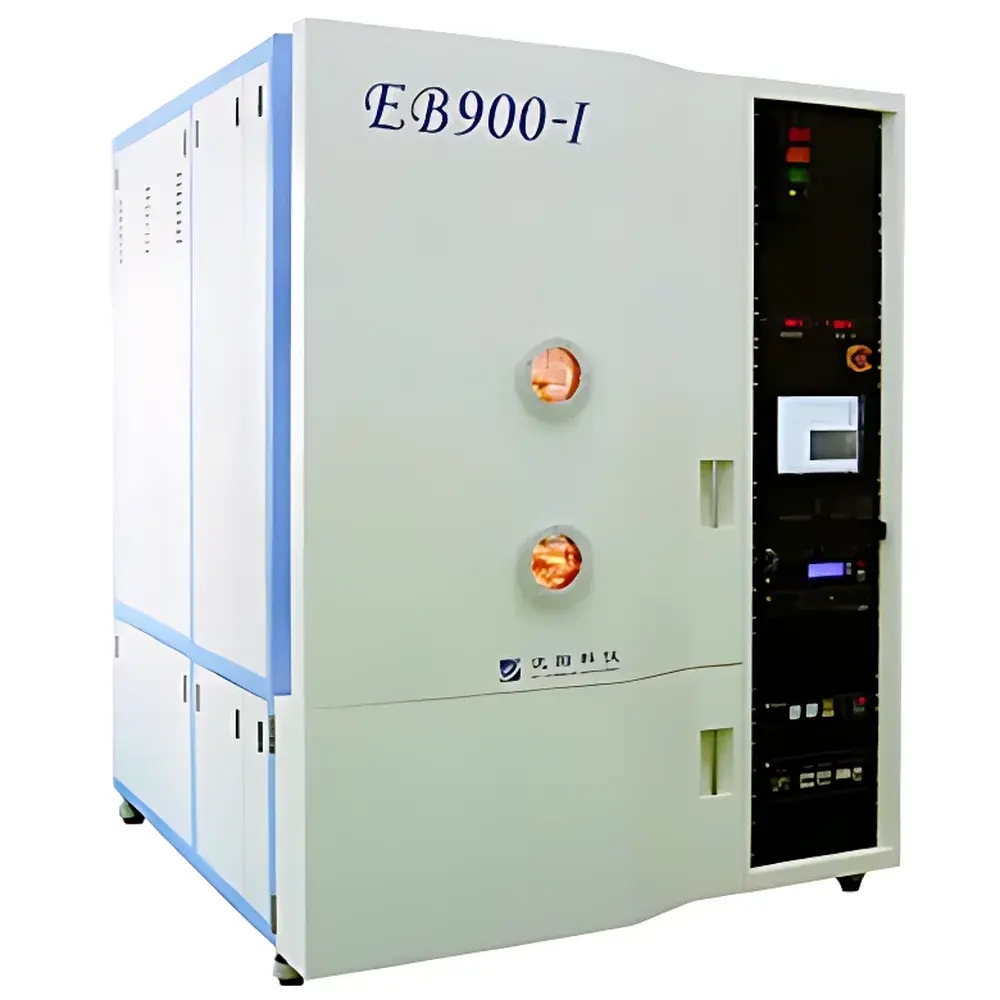
AdNaNo E-Beam Electron Beam Evaporation Coating System
| Brand | AdNaNo |
|---|---|
| Origin | USA |
| Manufacturer Type | Authorized Distributor |
| Import Status | Imported |
| Model | Customized-6 |
| Vacuum Chamber Dimensions | Custom |
| Base Pressure | ≤6.0 × 10⁻⁵ Pa |
| Evaporation Sources | 6 × 40 cm³ Crucibles |
| Substrate Heating Capability | Up to 300 °C |
| Intra-Wafer Thickness Uniformity | ≤ ±3% |
| Substrate Holder Configurations | Arch-type and Planetary-type Rotating Fixtures |
| Control System | Fully Automated Process Sequencing |
| Sample Size & Quantity | Fully Customizable |
Overview
The AdNaNo E-Beam Electron Beam Evaporation Coating System is a high-vacuum thin-film deposition platform engineered for precise, repeatable physical vapor deposition (PVD) of conductive, refractory, and dielectric materials onto semiconductor wafers, optical substrates, MEMS devices, and research-grade samples. Operating on the principle of electron beam-induced thermal evaporation, the system directs a focused, high-energy electron beam onto solid source material contained within water-cooled crucibles—generating localized temperatures exceeding 3000 °C—to induce controlled vaporization without crucible contamination. This non-contact heating mechanism enables high-purity film growth with minimal thermal load on the substrate stage, making it especially suitable for multilayer architectures requiring sharp interfacial definition and stoichiometric fidelity.
Key Features
- Modular ultra-high vacuum (UHV) chamber architecture with custom-dimensioned stainless steel construction and all-metal sealed flanges compliant with ISO-KF and CF standards;
- Six independently controllable 40 cm³ water-cooled crucibles, each equipped with real-time beam current regulation and shutter actuation for sequential or co-evaporation processes;
- Dual-mode substrate holder: configurable arch-type fixture for uniform angular coverage or planetary-type rotating stage enabling in-situ rotation, tilt, and orbital motion to achieve ≤±3% intra-wafer thickness uniformity across 4″–8″ substrates;
- Integrated quartz crystal microbalance (QCM) thickness monitor with dual-sensor capability (main + reference), calibrated for Al, Ni, Ag, Pt, Pd, Mo, Cr, Ti, SiO₂, and Al₂O₃ deposition rates;
- Programmable substrate heating system with PID-controlled resistive heating elements, capable of stable operation up to 300 °C under vacuum with ±1 °C thermal stability over 2-hour dwell periods;
- Full automation via industrial PLC-based control interface with recipe-driven process sequencing, event logging, and hardware interlock monitoring per SEMI E10 guidelines.
Sample Compatibility & Compliance
The system accommodates substrates ranging from 10 mm diameter discs to 200 mm wafers, with customizable fixturing for irregular geometries including curved optics, cantilever arrays, and ceramic packages. All wetted components—including chamber liners, crucible shields, and beam deflectors—are fabricated from oxygen-free high-conductivity (OFHC) copper or molybdenum to minimize outgassing and metal ion contamination. The vacuum architecture conforms to ASTM F2627–19 for residual gas analysis (RGA)-verified base pressure performance (≤6.0 × 10⁻⁵ Pa after 4-hour pump-down), and the entire system meets CE machinery directive (2006/42/EC) and electromagnetic compatibility (2014/30/EU) requirements. Optional integration with ISO/IEC 17025-compliant calibration protocols supports GLP/GMP environments where traceable thickness metrology is mandated.
Software & Data Management
Control firmware operates on a deterministic real-time OS with dual-channel data acquisition: analog inputs capture beam current, crucible thermocouple readings, QCM frequency shifts, and chamber pressure transducer outputs at 100 Hz sampling; digital I/O tracks shutter states, valve positions, and interlock conditions. Process recipes are stored in encrypted binary format with SHA-256 checksums and support version-controlled revision history. Audit trails record operator ID, timestamp, parameter setpoints, deviations, and manual overrides—fully compliant with FDA 21 CFR Part 11 requirements when paired with optional electronic signature modules. Export formats include CSV, HDF5, and XML for downstream integration with MES platforms such as Siemens Opcenter or Applied Materials EnduraConnect.
Applications
- Deposition of ohmic contacts (Ti/Pt/Au, Ni/Au) and diffusion barriers (TaN, TiN) in III–V and SiC power device fabrication;
- Growth of high-reflectivity multilayer stacks (e.g., Ta₂O₅/SiO₂, Nb₂O₅/SiO₂) for laser cavity mirrors and AR coatings;
- Preparation of superconducting thin films (Nb, NbN, MgB₂) for quantum circuit prototyping;
- Functional coating of AFM probes, SERS substrates, and plasmonic nanostructures requiring sub-nanometer thickness control;
- R&D-scale metallization of flexible electronics substrates (PI, PET) using low-thermal-budget evaporation cycles.
FAQ
What vacuum pumping configuration is standard on this system?
The base configuration includes a turbomolecular pump (≥1200 L/s for N₂) backed by a dry scroll pump (≥20 m³/h), with optional cryogenic or ion pump augmentation for UHV applications.
Can the system be upgraded to support reactive evaporation (e.g., oxide formation)?
Yes—integrated MFC-controlled O₂ or N₂ gas inlets with plasma-assisted oxidation modules (2.45 GHz microwave or RF ion source) are available as factory-installed options.
Is remote diagnostics and preventive maintenance scheduling supported?
The embedded controller supports secure TLS 1.3-enabled remote access via SSH and VNC; predictive maintenance algorithms analyze pump vibration spectra, heater resistance drift, and QCM crystal aging trends to generate service alerts.
Does the system meet cleanroom compatibility requirements (ISO Class 5 or better)?
All external surfaces are electropolished SS316L with passivated weld seams; particle shedding tests per ISO 14644-1 confirm ≤10 particles/m³ (≥0.5 µm) during idle and deposition modes.
What documentation is provided for IQ/OQ validation?
Factory-issued DQ/IQ/OQ protocols aligned with ASTM E2500–21 are included, with blank templates for URS, test scripts, acceptance criteria, and deviation reporting—all editable in PDF/A-2b format.



