
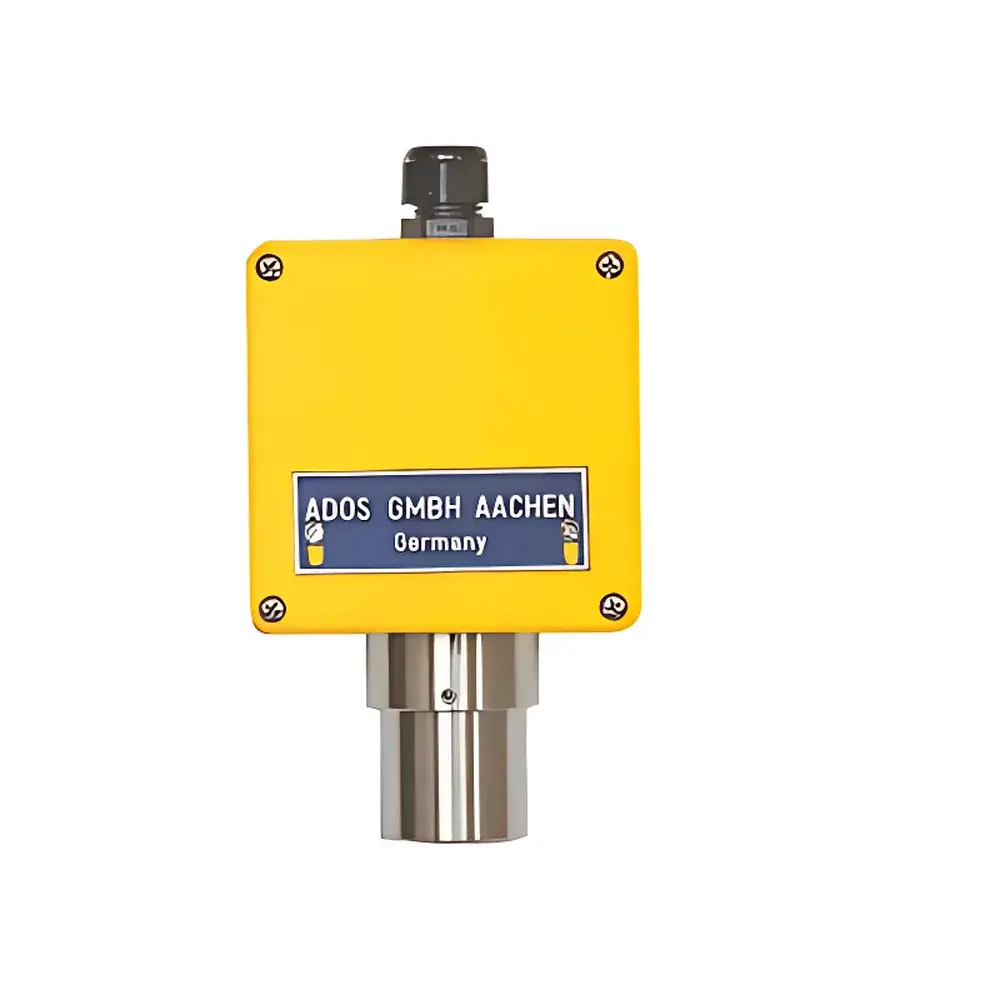
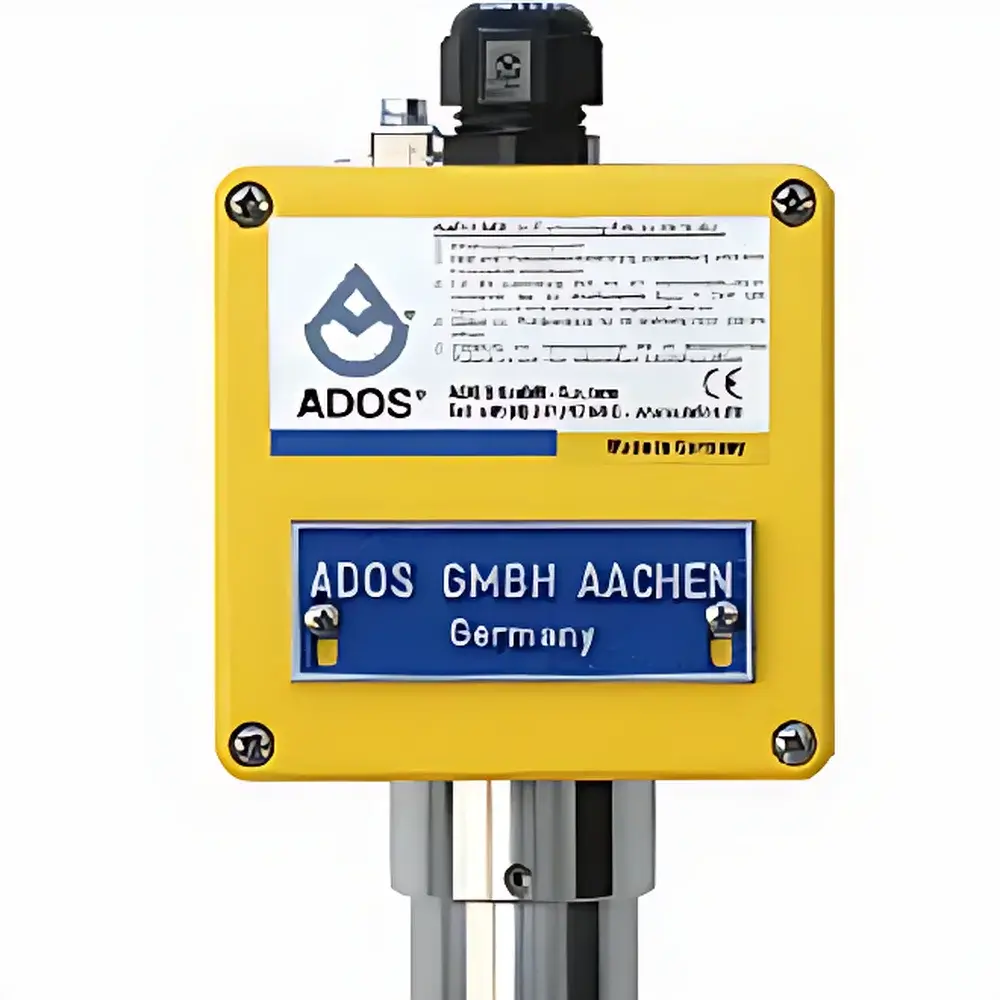
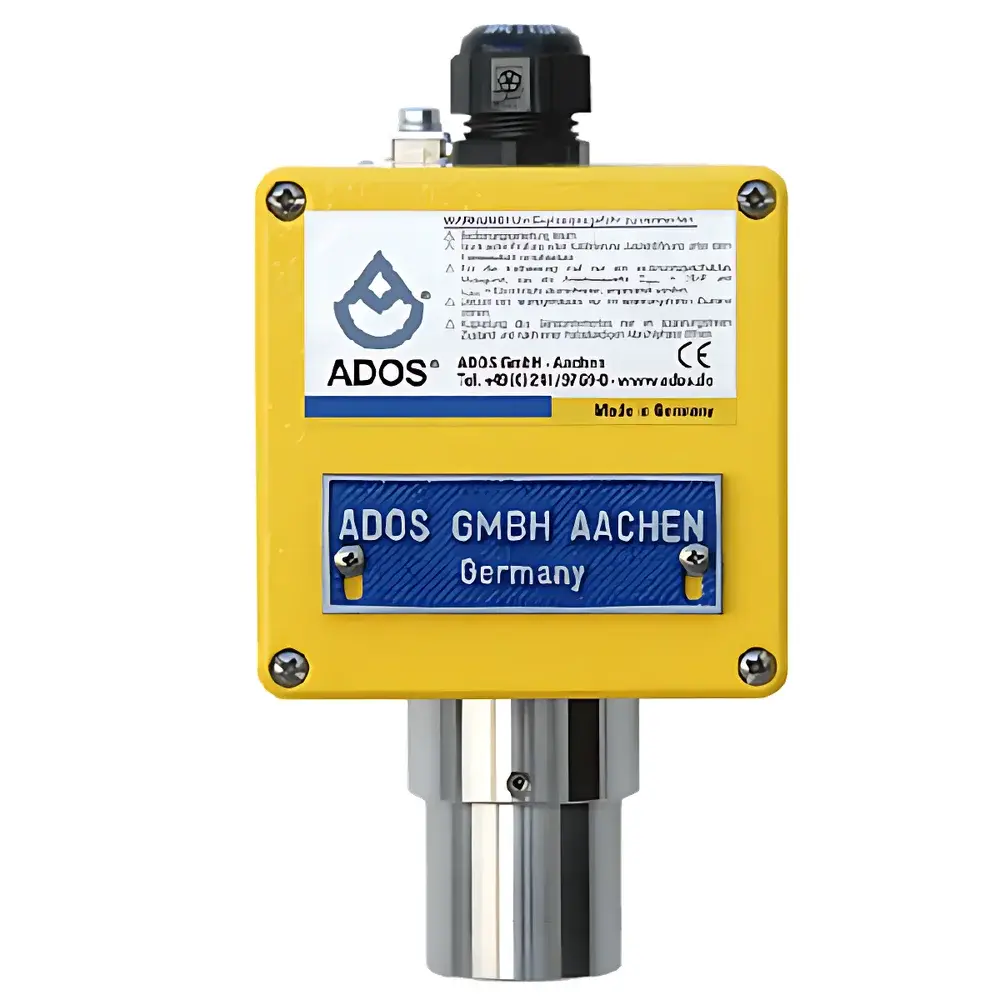
ADOS GTR196 Intrinsically Safe & Flameproof Gas Transmitter for Hazardous Areas
| Brand | ADOS |
|---|---|
| Origin | Germany |
| Model | GTR196 |
| Instrument Type | Single-Channel Fixed Gas Transmitter |
| Explosion Protection | II 2G Ex d e mb [ia] IIC T6 (KEMA 03 ATEX 2403 X) |
| Enclosure Rating | IP54 |
| Dimensions | 100 × 180 × 80 mm (O₂ version: 100 × 200 × 80 mm) |
| Weight | 1.1 kg |
| Power Supply | 15–30 V DC |
| Output Signal | 4–20 mA (3-wire) or galvanically isolated 4-wire interface |
| Data Transfer Rate | 78 kB/s |
| Operating Temperature | −20 °C to +45 °C |
| Sensor Principles | Metal Oxide Semiconductor (TGS), Catalytic Bead (VQ), Electrochemical (TOX), Non-Dispersive Infrared (NDIR), Photoionization Detection (PID) |
| Measurable Gases | O₂, CO, NH₃, NO₂, SO₂, H₂S, CH₄ (vol% & LEL), C₃H₈ (LEL), CO₂ (0–5 vol%), VOCs (e.g., C₇H₈, C₈H₁₀, CHCl₃), PH₃ |
| Full-Scale Accuracy | ±2–5% FS depending on sensor type |
| Response Time (T₉₀) | 45–120 s |
| Zero/Full-Scale Drift | <2% FS/year |
| Linearity | <2% FS |
| Temperature Influence | ≤2–5% of reading |
| Pressure Influence | ≤1% |
| Cross-Sensitivity | <2% with integrated particulate filter |
Overview
The ADOS GTR196 is a certified fixed gas transmitter engineered for continuous, real-time monitoring of toxic, combustible, and asphyxiant gases in both non-hazardous and Zone 1/Zone 2 explosive atmospheres (per ATEX Directive 2014/34/EU). Designed and manufactured in Germany, the GTR196 integrates up to five interchangeable detection modules—each based on a distinct physical or electrochemical principle—to deliver multi-gas capability within a single compact housing. Its core measurement architecture supports simultaneous operation of semiconductor (TGS), catalytic bead (VQ), electrochemical (TOX), non-dispersive infrared (NDIR), and photoionization detection (PID) sensors—enabling selective, cross-sensitive-free quantification across industrial gas classes: oxygen deficiency/enrichment, hydrocarbon vapors (CH₄, C₃H₈), acid gases (SO₂, NO₂, H₂S), carbon oxides (CO, CO₂), ammonia (NH₃), chlorine derivatives (CHCl₃), and low-ionization-potential VOCs (e.g., benzene, toluene, xylene, phosphine). The device outputs a linear 4–20 mA analog signal proportional to gas concentration, enabling direct integration with distributed control systems (DCS), programmable logic controllers (PLC), or centralized alarm panels located in safe areas. All electronics are housed in an explosion-proof enclosure rated II 2G Ex d e mb [ia] IIC T6 (certified by KEMA under report no. 03 ATEX 2403 X) and protected to IP54 against dust ingress and water splashing.
Key Features
- ATEX-certified dual-protection design: flameproof (Ex d) housing combined with intrinsically safe (Ex ia) sensor circuits for use in Zone 0/1/2 hazardous locations.
- Modular sensor architecture: hot-swap insertion of TGS, VQ, TOX, NDIR, or PID modules without recalibration—minimizing downtime during maintenance or reconfiguration.
- Multi-principle detection platform: eliminates reliance on a single technology, improving reliability and reducing false alarms in complex gas matrices.
- Integrated particulate filtration: reduces fouling and extends sensor service life, particularly critical in wastewater treatment or paint manufacturing environments.
- Temperature-compensated signal processing: embedded algorithms correct for ambient thermal drift (≤2–5% influence per °C) across all sensor types.
- Galvanically isolated 4-wire interface option: ensures noise immunity and data integrity in electrically noisy industrial settings (e.g., near variable-frequency drives or welding equipment).
- Robust mechanical construction: die-cast aluminum housing with stainless steel mounting hardware; compliant with EN 60079-0 and EN 60079-1 for explosive atmospheres.
Sample Compatibility & Compliance
The GTR196 is validated for deployment in process streams containing condensable vapors, particulates, and moderate humidity—common in petrochemical off-gas lines, biogas upgrading units, solvent recovery systems, and municipal wastewater headworks. It complies with key international standards including IEC 60079-29-1 (gas detector performance), EN 50104 (oxygen detectors), EN 45544-1 (toxic gas detectors), and EN 50104-2 (combustible gas detectors). For regulated industries, its 4–20 mA output and traceable calibration protocol support compliance with ISO 14001 environmental management systems, OSHA 1910.120 (HAZWOPER), and EU Seveso III Directive requirements for early warning of atmospheric release events. While not FDA 21 CFR Part 11–compliant out-of-the-box (as it lacks electronic audit trail functionality), its analog output is compatible with validated DCS platforms that maintain full GLP/GMP data integrity when configured per site-specific validation protocols.
Software & Data Management
The GTR196 operates as a field-level transducer and does not incorporate onboard firmware-based configuration or data logging. Configuration—including zero/span adjustment, alarm thresholds, and sensor type selection—is performed externally via handheld calibrators (e.g., ADOS CAL-01) or compatible HART communicators. All calibration events are recorded manually in facility-maintained logbooks per ISO/IEC 17025 requirements. Signal transmission follows standard 4–20 mA current loop conventions, supporting integration into third-party SCADA systems with native analog input modules. Optional flow adapters and vacuum flange kits enable direct in-line installation without bypass sampling—reducing lag time and adsorption losses in low-concentration VOC measurements. Sensor lifetime varies by chemistry: electrochemical cells require replacement every 1–5 years; NDIR and PID modules exhibit >5-year operational stability under controlled conditions; catalytic and semiconductor elements are rated for permanent service with periodic verification.
Applications
- Petrochemical refineries: continuous monitoring of H₂S in amine regenerator overheads, CH₄ leakage detection in compressor stations, and CO in furnace stack emissions.
- Wastewater treatment plants: real-time O₂ and H₂S tracking in anaerobic digesters, biogas pipelines, and sludge dewatering buildings.
- Paint and coating manufacturing: VOC (toluene, xylene) and solvent vapor monitoring in spray booths and mixing rooms per EN 14175.
- Plastics extrusion facilities: detection of PH₃ from phosphine-based stabilizers and CO from thermal degradation of polymer feedstocks.
- Natural gas boiler rooms: dual-range CH₄ (0–100% LEL and 0–100 vol%) monitoring for leak detection and combustion efficiency optimization.
- Chemical storage areas: multi-gas screening for NH₃, Cl₂ derivatives, and chlorinated solvents in tank farm bunds and loading docks.
FAQ
Is the GTR196 suitable for Zone 0 applications?
Yes—the Ex ia [ia] intrinsic safety rating certifies safe operation in Zone 0, where explosive gas atmospheres are continuously present.
Can multiple gas types be measured simultaneously with one unit?
No—the GTR196 is a single-channel transmitter; however, it accepts any one of five sensor modules at a time. Multi-gas capability requires parallel installation of multiple GTR196 units or integration with a central controller supporting multi-input analog acquisition.
What is the recommended calibration frequency?
Initial commissioning requires full span calibration. Subsequent verification is advised every 3–6 months in critical safety applications, or annually under stable ambient conditions—per EN 50104 and site-specific risk assessments.
Does the device support digital communication protocols such as Modbus or HART?
The standard model provides only 4–20 mA analog output. HART-enabled variants (GTR196-H) are available upon request but require separate ordering and configuration.
How is sensor drift compensated over time?
Drift compensation is achieved through scheduled zero and span adjustments using certified calibration gases; no automatic baseline correction algorithm is embedded in the transmitter firmware.
Related Products







