
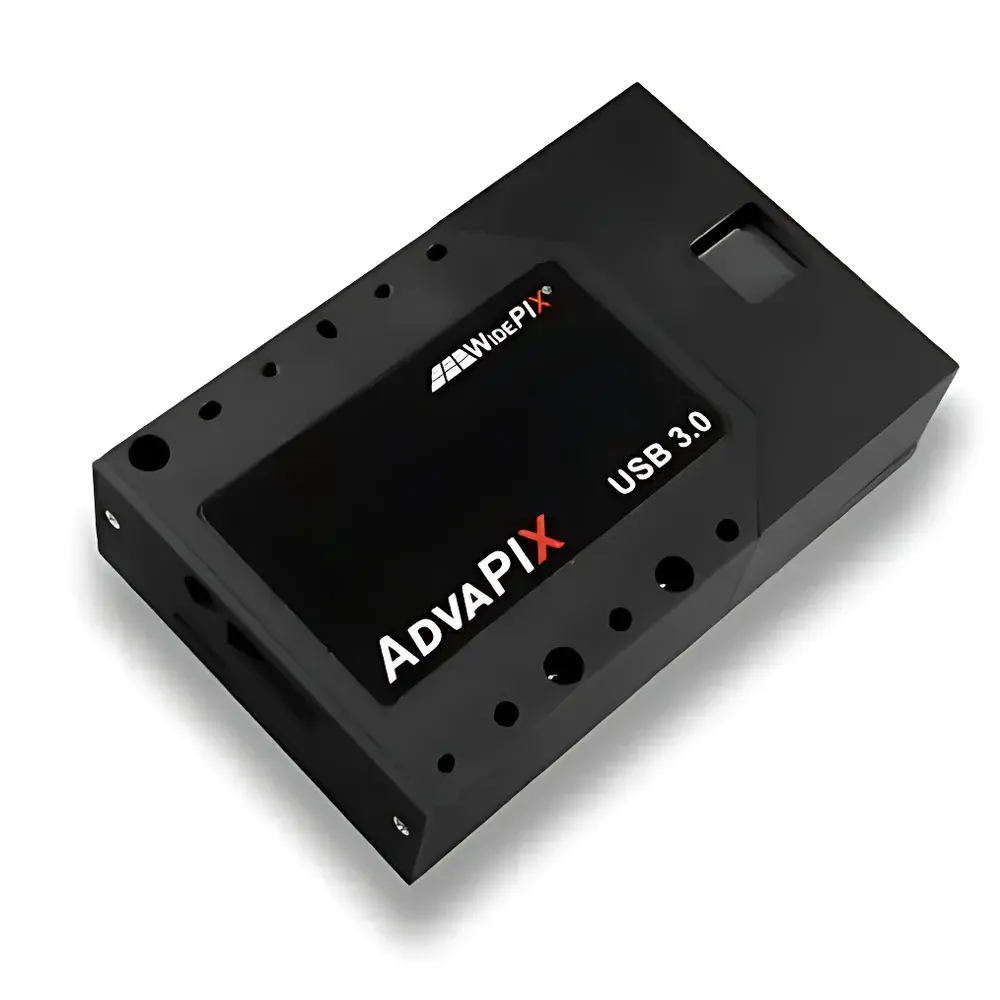
Advacam AdvaPIX TPX Laboratory-Grade Hybrid Pixel Detector with Timepix ASIC
| Brand | Advacam |
|---|---|
| Origin | Czech Republic |
| Model | ADVAPIX TPX |
| Sensor Options | Si or CdTe (custom thickness) |
| Frame Rate | Up to 1,700 fps sustained |
| Spatial Resolution | ≤200 nm (ion tracking), 2.5 µm σ (thermal neutron imaging, with 6LiF converter) |
| Field of View | 14 × 14 mm |
| Effective Pixel Count | 6.5 MPix |
| Readout Interface | Independent USB 3.0 per module |
| Trigger Mode | Synchronous or independent per module |
| Neutron Conversion Layer | Optional 6LiF deposition |
| Compliance | Designed for GLP-compliant research environments |
Overview
The Advacam AdvaPIX TPX is a laboratory-grade hybrid pixel detector engineered for high-precision, single-particle-resolved X-ray, neutron, ion, and gamma radiation imaging. Built around the CERN-developed Timepix application-specific integrated circuit (ASIC), it implements a direct-conversion detection architecture with pixel-level energy discrimination and time-over-threshold (ToT) or time-of-arrival (ToA) readout capabilities. Unlike conventional scintillator-based or charge-integrating detectors, the AdvaPIX TPX operates in photon-counting mode with zero inter-pixel gap—enabling continuous, distortion-free spatial sampling across its full active area. This architecture supports quantitative spectral imaging, particle trajectory reconstruction, and time-resolved event analysis without pile-up limitations at moderate flux levels. Its modular design allows scalable deployment—from single-sensor units for benchtop experiments to multi-module arrays for large-field synchrotron beamlines or neutron radiography stations.
Key Features
- Zero-gap hybrid pixel architecture based on the Timepix3/Timepix4-compatible ASIC platform, ensuring seamless spatial continuity and eliminating stitching artifacts.
- Sustained frame rates up to 1,700 frames per second with full-frame parallel readout—optimized for dynamic spectral imaging and time-of-flight applications.
- Configurable sensor material: high-resistivity silicon (Si) for X-rays and charged particles; cadmium telluride (CdTe) for higher-energy X-rays and gamma rays—both available in customizable thicknesses (e.g., 300 µm Si, 1 mm CdTe).
- Sub-micron spatial resolution capability: advanced centroiding algorithms achieve ≤200 nm resolution for heavy ion tracks; thermal neutron imaging reaches 2.5 µm σ (point spread function) when coupled with evaporated 6LiF conversion layers.
- Independent USB 3.0 interface per module ensures deterministic data throughput and eliminates bus contention in multi-camera configurations.
- Flexible triggering: modules support global synchronization via TTL/PECL signals or autonomous operation with programmable internal triggers—essential for pump-probe experiments and coincidence measurements.
Sample Compatibility & Compliance
The AdvaPIX TPX accommodates diverse radiation types without hardware modification: unmodified Si sensors detect X-rays (1–30 keV), electrons, protons, and alpha particles; addition of a 6LiF neutron conversion layer enables thermal neutron detection via 6Li(n,α)3H reaction products; CdTe variants extend sensitivity to hard X-rays (up to 200 keV) and low-flux gamma sources. All configurations maintain intrinsic energy calibration stability over time, supporting long-term quantitative studies. The system complies with ISO/IEC 17025 requirements for measurement uncertainty documentation and is routinely deployed in GLP-regulated environments—including nuclear materials characterization labs and medical physics research centers. While not FDA-cleared as a diagnostic device, its architecture meets foundational requirements for audit-ready data integrity (e.g., timestamped raw event lists, immutable metadata headers).
Software & Data Management
Acquisition and analysis are managed through the open-source, cross-platform Pixelman software suite—developed and maintained by Advacam. Pixelman provides real-time visualization, spectral histogramming, cluster analysis, and particle track reconstruction. Raw data is stored in HDF5 format with embedded detector geometry, bias voltage, temperature logs, and acquisition parameters—ensuring full experimental reproducibility. The API supports Python (via PyMca, NumPy, SciPy) and MATLAB integration for custom algorithm development. For regulated environments, optional audit-trail logging and user-access controls align with 21 CFR Part 11 principles—though formal validation remains the responsibility of the end-user institution.
Applications
- Energy-resolved radiography: Quantitative X-ray phase contrast, K-edge subtraction imaging, and multi-energy CT reconstruction.
- Neutron imaging: High-resolution thermal neutron radiography and tomography for fuel cell water distribution, cultural heritage object analysis, and boron neutron capture therapy (BNCT) dosimetry validation.
- Ion beam analysis: MeV ion microprobe mapping, Rutherford backscattering spectrometry (RBS), and elastic recoil detection (ERD) with sub-200 nm lateral resolution.
- Particle tracking & TOF imaging: Proton therapy beam monitoring, cosmic ray muon tomography, and compact Compton camera implementations.
- Space instrumentation: Flight-qualified heritage demonstrated in ESA and NASA missions—including radiation environment monitoring on CubeSats and planetary landers.
FAQ
What radiation types can the AdvaPIX TPX detect?
It detects X-rays (1–30 keV with Si; up to 200 keV with CdTe), thermal neutrons (with 6LiF), charged particles (electrons, protons, alphas, heavy ions), and gamma photons—depending on sensor choice and converter layer configuration.
Is calibration required before each experiment?
No. The detector features factory-calibrated gain and offset per pixel, with temperature-compensated operation. Energy calibration drift is typically <0.5% over 24 h at stable ambient conditions.
Can multiple AdvaPIX TPX modules be synchronized?
Yes. Modules support hardware-level synchronization via external trigger lines (TTL/PECL) with jitter <100 ns, enabling precise coincidence timing for Compton imaging or multi-angle tomography.
Does the system support real-time processing?
Pixelman provides real-time centroiding and spectral binning. Full event-by-event analysis (e.g., track fitting) is performed offline but benefits from GPU-accelerated libraries included in the SDK.
Are firmware and software updates provided?
Yes. Advacam releases quarterly firmware and software updates via its customer portal, including bug fixes, new acquisition modes, and compatibility patches for newer OS versions.




