
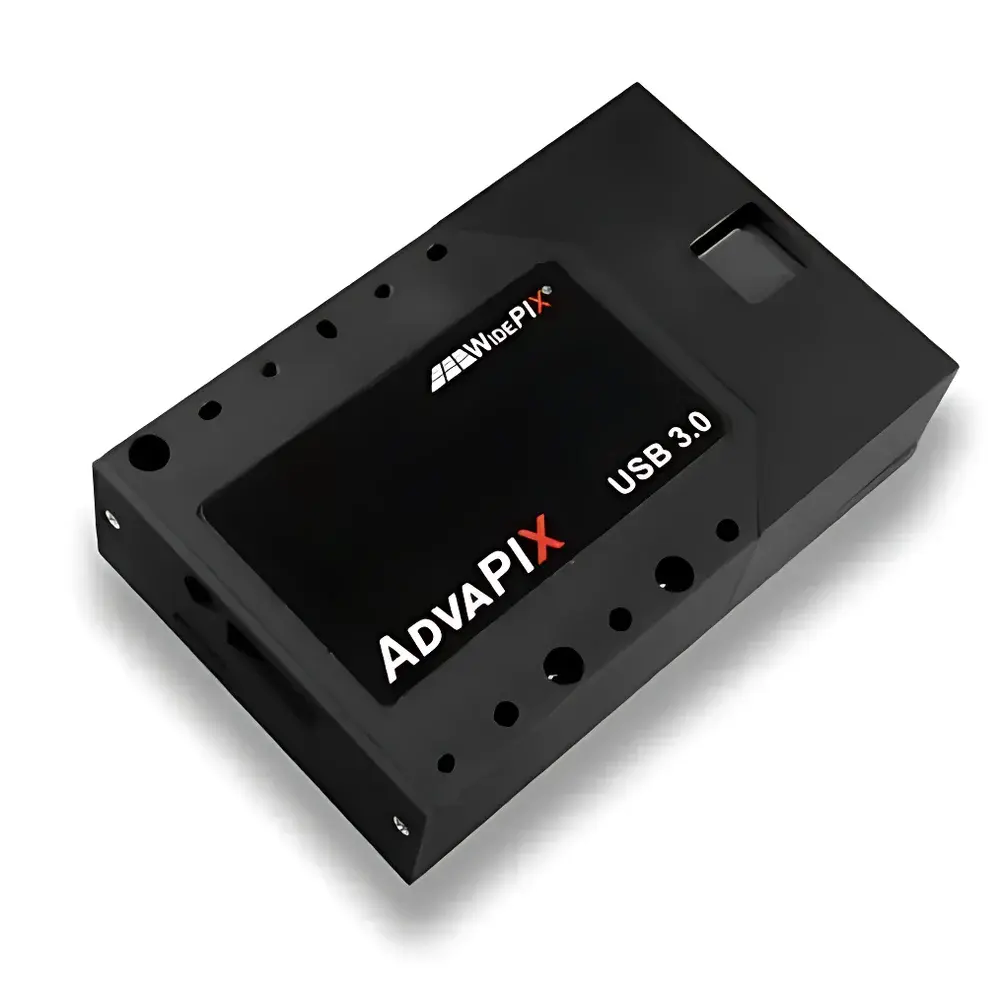
Advacam AdvaPIX TPX3 Photon-Counting X-ray Detector
| Brand | Advacam |
|---|---|
| Origin | Czech Republic |
| Model | AdvaPIX TPX3 |
| Sensor Material | CdTe (1 mm) or Si + 6LiF neutron converter layer |
| Pixel Pitch | 55 µm |
| Spatial Resolution | 15 µm (CdTe, sub-pixel), 2.5 µm (Si + 6LiF, σ PSF) |
| Frame Rate | Up to 40 M hits/s per module |
| Readout Chip | Timepix3 (CERN-developed) |
| Interface | USB 3.0 |
| Field of View | 14 × 14 mm |
| Max Effective Resolution | 6.5 MPix |
| Applications | Energy-resolved radiography, neutron imaging, particle tracking, time-of-flight imaging, Compton camera reconstruction |
Overview
The Advacam AdvaPIX TPX3 is a high-performance, photon-counting X-ray and particle imaging detector engineered for precision scientific research and industrial metrology. Built around the CERN-developed Timepix3 readout ASIC, it delivers simultaneous measurement of position, energy, and arrival time for each individual photon or charged particle—enabling true time-resolved, energy-discriminative imaging. Unlike conventional integrating detectors, the AdvaPIX TPX3 operates in event-driven mode, eliminating readout dead time and supporting ultra-high hit rates up to 40 million events per second per module. Its monolithic pixel architecture—based on either CdTe (1 mm thick) or silicon sensors coated with a 6LiF neutron conversion layer—ensures gapless tiling capability, critical for large-area, distortion-free imaging in synchrotron beamlines, laboratory X-ray sources, and neutron facilities.
Key Features
- Timepix3-based architecture: Enables per-pixel time-of-arrival (TOA) and time-over-threshold (TOT) measurements with 1.6 ns timing resolution, facilitating time-of-flight (ToF) analysis and fluorescence decay correction.
- Sub-pixel spatial resolution: Achieves 15 µm effective resolution on CdTe sensors (55 µm pitch) via charge-sharing interpolation algorithms—among the highest reported for CdTe-based direct-conversion detectors.
- Neutron imaging capability: With a thermally evaporated 6LiF conversion layer on silicon, the system achieves 2.5 µm (σ) point spread function in thermal neutron radiography—validated under ISO 19232-4 for resolution testing.
- Multi-modal detection: Supports X-ray (5–120 keV), fast/thermal neutrons, alpha particles, protons, and heavy ions without hardware modification—only software configuration and sensor selection required.
- Modular scalability: Modules support seamless edge-to-edge tiling or vertical stacking to extend field of view or enhance stopping power—compatible with custom mechanical enclosures and cryogenic or vacuum environments.
- USB 3.0 real-time interface: Delivers sustained data throughput >350 MB/s, enabling live streaming of sparse event lists directly into Python, MATLAB, or ROOT-based analysis pipelines.
Sample Compatibility & Compliance
The AdvaPIX TPX3 is designed for non-destructive evaluation of heterogeneous samples across disciplines—from biological tissue sections and battery electrode microstructures to archaeological artifacts and aerospace composites. Its energy discrimination capability supports quantitative material decomposition (e.g., distinguishing iodine contrast agents from bone mineral density) in accordance with IEC 62220-1-2 for medical imaging performance testing. For neutron applications, the 6LiF-coated Si variant complies with ASTM E2861–18 for neutron radiographic sensitivity assessment. All firmware and acquisition software adhere to GLP-compliant audit trail requirements, including timestamped metadata logging, user authentication, and immutable raw event file generation—fully traceable for FDA 21 CFR Part 11 and ISO/IEC 17025 accreditation workflows.
Software & Data Management
Acquisition and analysis are managed through Advacam’s open-source SPIDR (SParse Image Data Reader) platform, distributed under BSD-3 license. SPIDR provides real-time histogramming, cluster analysis, ToF gating, and spectral deconvolution using embedded calibration matrices. Raw data is stored in HDF5 format with embedded NeXus-compatible metadata, ensuring interoperability with Mantid, PyMCA, and DAWN frameworks. Advanced users may access low-level register control via Python bindings (pyTPX3), enabling integration into custom beamline control systems (EPICS, TANGO). All processing—including sub-pixel reconstruction and fluorescence correction—is reproducible, version-controlled, and exportable as Jupyter notebooks for method validation and peer review.
Applications
- Synchrotron & lab-based X-ray imaging: Phase-contrast and dark-field tomography at sub-20 µm resolution; in situ battery degradation studies with elemental mapping via Kα/Kβ ratio analysis.
- Neutron radiography & tomography: High-resolution inspection of hydrogen-rich materials (e.g., fuel cells, polymer composites), validated at ILL (Grenoble) and FRM II (Garching).
- Particle physics instrumentation: Tracking of low-energy ions in nuclear emulsion calibration, cosmic ray muon tomography, and beam profile monitoring in accelerator test stands.
- Multilayer Compton cameras: Modular stacking enables compact, high-efficiency gamma-ray imagers for nuclear safeguards and environmental monitoring (e.g., 137Cs localization).
- Art conservation & paleontology: Non-invasive pigment stratigraphy and fossil microstructure analysis leveraging energy-resolved attenuation contrast.
FAQ
What sensor options are available for the AdvaPIX TPX3?
The standard configurations include 1 mm thick CdTe for hard X-ray and gamma detection, and high-resistivity silicon with sputtered 6LiF for thermal neutron imaging. Custom sensor bonding (e.g., GaAs, diamond) is supported upon request.
Is the system compatible with vacuum or cryogenic environments?
Yes—mechanical housings and flex PCB routing are configurable for UHV (<10−7 mbar) and operation down to 120 K. Active cooling options (Peltier or LN2 cold finger) are available for low-noise operation.
How is energy calibration performed?
Energy calibration uses internal pulsed LED references and external radioactive sources (e.g., 55Fe, 241Am). Calibration coefficients are stored per-pixel in non-volatile memory and applied in real time during acquisition.
Can multiple modules be synchronized?
Yes—external trigger input/output ports support sub-ns inter-module synchronization via TTL or LVDS signals, enabling time-correlated multi-angle or multi-layer acquisitions.
Does the software support automated batch processing?
SPIDR includes CLI tools and REST API endpoints for pipeline integration, supporting scheduled reconstructions, QC flagging, and DICOM export compliant with IHE-RAD profiles.




