
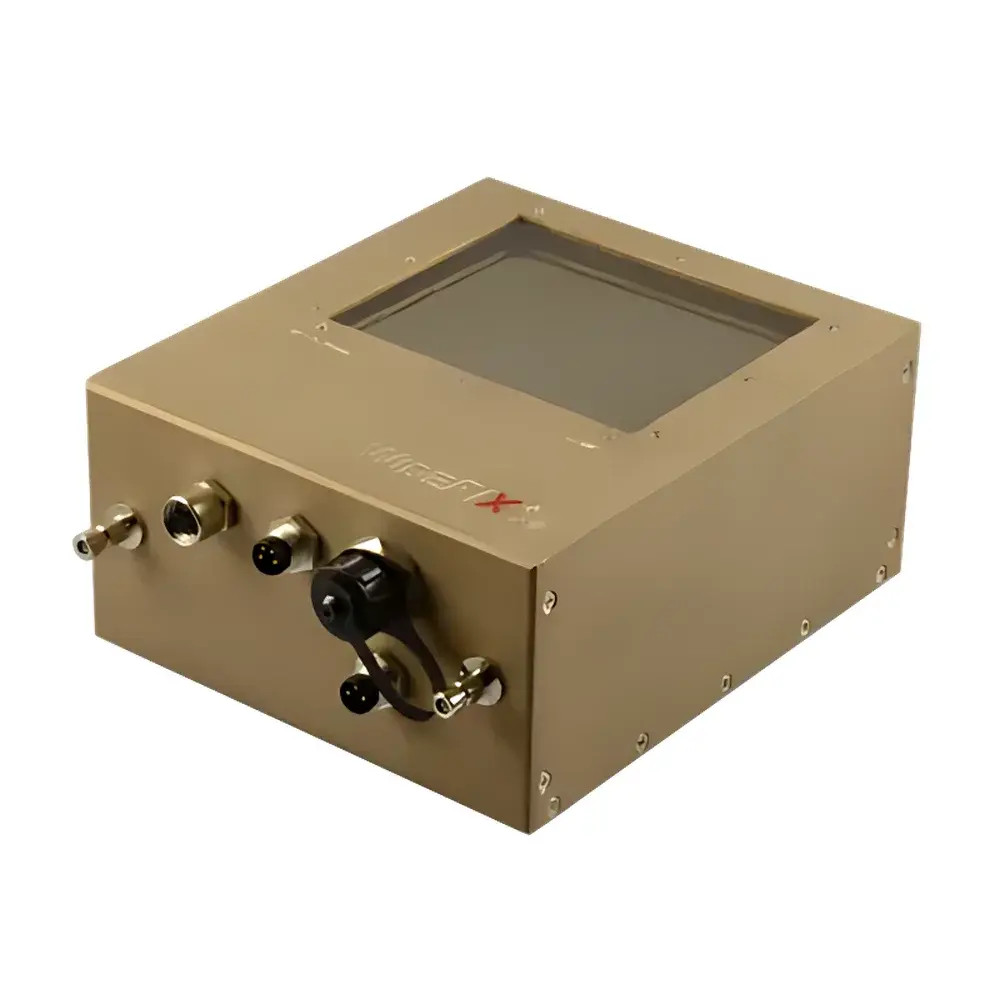
Advacam WidePIX 5×5 Photon-Counting X-ray Detector
| Brand | Advacam |
|---|---|
| Origin | Czech Republic |
| Model | WidePIX 5×5 |
| Detector Architecture | Tiled 5×5 array of Timepix3 hybrid pixel detectors |
| Sensor Material | Edgeless Si or CdTe |
| Total Active Area | ~14.1 × 14.1 cm² |
| Pixel Count | 1280 × 1280 (1.63 MP) |
| Pixel Pitch | 55 µm |
| Energy Threshold Range | Adjustable from ~3 keV (Si) or ~10 keV (CdTe) |
| Counting Mode | Per-pixel digital photon counting with time-over-threshold (ToT) energy estimation |
| Frame Rate | Up to 100 fps (full frame, depending on readout configuration) |
| Readout Interface | USB 3.0 or PCIe (optional) |
| Compliance | CE, RoHS, compatible with ISO 17025-accredited lab environments |
Overview
The Advacam WidePIX 5×5 is a high-resolution, large-area photon-counting X-ray detector engineered for quantitative, noise-free imaging across scientific, industrial, and biomedical domains. Built upon the Timepix3 hybrid pixel ASIC—developed at CERN and optimized for single-photon detection—the WidePIX 5×5 integrates 25 edgeless silicon (Si) or cadmium telluride (CdTe) sensor tiles into a seamless 5×5 mosaic. Unlike conventional scintillator-based or charge-integrating detectors, this architecture eliminates inter-tile dead zones, delivering true gapless detection over a continuous active area of approximately 14.1 × 14.1 cm². Each of its 1.63 million pixels operates as an independent digital counter with time-over-threshold (ToT) capability, enabling simultaneous spatial localization, energy discrimination, and time-stamping of individual X-ray photons (or other ionizing particles). This intrinsic photon-counting principle ensures zero readout noise, infinite dynamic range per frame, and exceptional contrast sensitivity—particularly critical for low-attenuation materials such as polymers, soft tissue, carbon fiber composites, and biological specimens.
Key Features
- Gapless 5×5 tiling architecture with edgeless Si or CdTe sensors, eliminating blind regions between modules
- True photon-counting operation at the pixel level—no integration noise, no dark current contribution
- Energy-resolved imaging via per-pixel ToT measurement, supporting spectral radiography and material decomposition
- Adjustable energy thresholds (starting from ~3 keV in Si, ~10 keV in CdTe), enabling selective detection across broad X-ray and particle spectra
- Sub-55 µm effective spatial resolution achievable via centroiding algorithms and advanced reconstruction pipelines
- Support for neutron imaging through optional 6LiF conversion layer deposition on sensor surface
- Real-time data streaming via USB 3.0 interface; PCIe variant available for high-throughput synchrotron or CT applications
- Firmware-upgradable architecture with configurable acquisition modes: counting, ToT, time-of-arrival (ToA), and tracking
Sample Compatibility & Compliance
The WidePIX 5×5 is designed for direct interaction with low-to-medium energy X-rays (3–60 keV), thermal/epithermal neutrons (with converter), alpha/beta particles, and light ions. Its high quantum efficiency and low electronic noise make it suitable for imaging low-Z materials—including CFRP, epoxy resins, polymeric foams, and murine soft tissue—without beam hardening artifacts or dose escalation. The system complies with CE marking requirements and RoHS directives. When deployed in regulated environments (e.g., preclinical imaging labs or aerospace NDT facilities), raw data output supports audit-ready metadata logging—including exposure timestamp, threshold settings, sensor temperature, and frame synchronization signals—enabling alignment with GLP and ISO/IEC 17025 documentation workflows. While not FDA-cleared as a medical device, its performance characteristics align with ASTM E2737 (standard practice for digital detector arrays in radiographic testing) and IEC 62494-1 (X-ray imaging detectors).
Software & Data Management
Acquisition and analysis are managed through the open-source, cross-platform software suite Pixelman, developed and maintained by Advacam. Pixelman provides real-time visualization, energy windowing, frame averaging, spectral binning, and basic tomographic reconstruction (FBP, iterative SART). Raw data is stored in HDF5 format—structured to include detector geometry, calibration coefficients, and acquisition parameters—ensuring full traceability and interoperability with third-party tools (e.g., Python-based SciPy/NumPy pipelines, MATLAB, or commercial CT reconstruction platforms like Octopus or Dragonfly). For GxP-compliant deployments, optional audit trail modules log user actions, parameter changes, and data export events—supporting 21 CFR Part 11 readiness when integrated with validated laboratory information management systems (LIMS).
Applications
- Non-Destructive Testing (NDT): Detection of micro-defects—including kissing bonds, delamination, porosity, and foreign inclusions—in aerospace-grade composites at ≤55 µm resolution
- Preclinical Spectral Imaging: Multi-energy small-animal radiography and spectral CT for tissue differentiation, contrast agent quantification, and longitudinal tumor response monitoring
- Neutron Radiography: High-contrast imaging of hydrogen-rich structures (e.g., lubricants, adhesives, water distribution in fuel cells) using thermal neutron conversion
- Particle Tracking & Time-of-Flight Imaging: Reconstruction of charged particle trajectories in nuclear physics experiments and space radiation monitoring
- Multi-layer Compton Cameras: Directional gamma-ray imaging for nuclear safeguards and astrophysical source localization
- Cultural Heritage Analysis: Layer-by-layer pigment mapping and underdrawing revelation in paintings without sample contact
FAQ
What sensor materials are supported, and how do they affect energy response?
The WidePIX 5×5 is available with either edgeless high-resistivity silicon (Si) or cadmium telluride (CdTe). Si offers superior spatial resolution and lower noise below 30 keV, while CdTe provides higher stopping power for energies above 20 keV—ideal for industrial inspection and medium-energy X-ray applications.
Can the detector be used for neutron imaging?
Yes—when coated with a 6LiF neutron converter layer, the Si version becomes sensitive to thermal neutrons, enabling high-contrast imaging of hydrogenous materials in engineering and geological samples.
Is energy calibration required for quantitative spectral imaging?
Yes—per-pixel energy calibration using monochromatic X-ray sources or radioactive standards is recommended before spectral analysis. Pixelman includes built-in tools for gain/offset correction and spectral line fitting.
How is spatial resolution enhanced beyond the native 55 µm pitch?
Sub-pixel resolution down to ~10 µm can be achieved via centroiding algorithms applied to charge-sharing events, particularly in low-flux, high-SNR conditions—common in synchrotron or micro-CT setups.
Does the system support synchronized multi-detector acquisition?
Yes—via external trigger input (TTL) and programmable gate signals, enabling precise temporal coordination with X-ray sources, robotic stages, or other detectors in modular imaging systems.





