
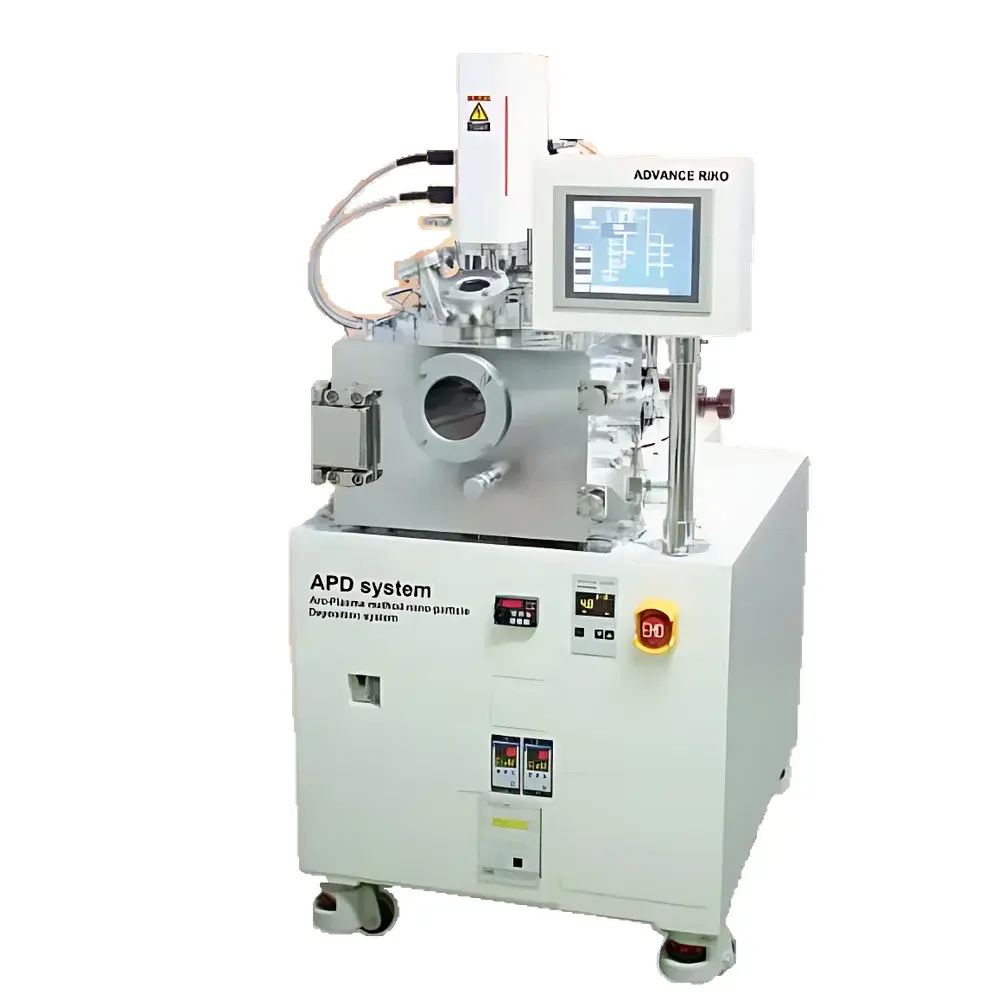
Advance Riko APD Series Arc Plasma Deposition System
| Brand | ADVANCE RIKO |
|---|---|
| Origin | Japan |
| Manufacturer Type | Authorized Distributor |
| Origin Category | Imported |
| Model | APD |
| Pricing | Upon Request |
| Vacuum Chamber Dimensions | 400 × 400 × 300 mm (L×W×H) |
| Pumping System | 450 L/s Turbo-Molecular Pump |
| Plasma Source | 1 Standard, Up to 3 Optional |
| Operating Pressure | High Vacuum to Low-Pressure Reactive Gases (N₂, O₂, H₂, Ar) |
| Target Geometry | Cylindrical or Tubular, Ø10 mm × 17 mm |
| Target Resistivity | < 0.01 Ω·cm |
| Capacitance Bank | 360 µF × 5 (Optional Configurations Available) |
| Pulse Frequency | 1–5 Hz |
| Discharge Voltage Range | 70–400 V (Max 150 V at 1800 µF) |
| Human-Machine Interface | Industrial Touchscreen Control Panel |
| APD-P Powder Collector | Ø95 mm × 30 mm |
| Collection Rate | 13–20 cm³/h (Dependent on Particle Size & Density) |
| Rotation Speed | 1–50 rpm |
| APD-S Substrate Holder | Compatible with 2-inch (50.8 mm) Wafers/Foils |
Overview
The Advance Riko APD Series Arc Plasma Deposition System is an engineered platform for high-energy, pulsed arc plasma synthesis of nanoscale thin films and free-standing nanoparticles. Based on controlled vacuum arc discharge physics, the system ionizes conductive target materials via transient high-current, low-voltage pulses—generating dense, highly ionized plasma plumes (>90% ionization fraction) with kinetic energies exceeding 50 eV per ion. Unlike sputtering or thermal evaporation, arc plasma deposition operates in a non-equilibrium regime where localized cathode spot temperatures exceed 10,000 K, enabling direct vaporization and ionization of refractory and high-melting-point elements without substrate heating. This principle supports stoichiometric transfer from target to deposit—even for multi-component alloys—and permits in-situ reactive synthesis under precisely regulated gas environments (O₂, N₂, H₂, Ar). The APD is designed for laboratory-scale development of functional nanomaterials requiring atomic-level compositional fidelity, crystallinity control, and high surface reactivity—particularly relevant to catalysis, thermoelectrics, and advanced carbon allotropes.
Key Features
- Adjustable nanoparticle diameter control between 1.5 nm and 6 nm via programmable capacitance bank (360 µF × 5 standard; optional expansion up to 1800 µF) and pulse frequency tuning (1–5 Hz).
- Dual-mode operation: APD-S configuration enables uniform thin-film deposition on 2-inch substrates; APD-P configuration integrates a rotating powder collector (Ø95 mm × 30 mm) for scalable nanopowder harvesting at rates of 13–20 cm³/h.
- Multi-target capability: Up to three independent arc plasma sources can be installed for sequential or co-deposition—enabling combinatorial synthesis of intermetallics, oxides, nitrides, and heterostructured catalysts.
- Reactive atmosphere integration: Mass-flow-controlled gas inlets support dynamic pressure regulation from ≤10⁻⁶ Pa (high vacuum) up to 100 Pa (low-pressure reactive gas), facilitating oxide, nitride, carbide, and diamond-like carbon (DLC) formation.
- Industrial-grade touchscreen HMI with real-time waveform monitoring (voltage, current, pulse timing), recipe storage, and event-logged operational history compliant with GLP documentation requirements.
Sample Compatibility & Compliance
The APD system accommodates cylindrical or tubular targets (Ø10 mm × 17 mm) fabricated from electrically conductive materials with bulk resistivity < 0.01 Ω·cm—covering most transition metals (Fe, Co, Ni, Cu, Pt, Pd), refractory metals (W, Mo, Ta), semiconductors (Si, Ge, GaAs), and selected intermetallic alloys. Graphite targets yield nano-diamond, amorphous carbon, and carbon nanotube precursors under H₂ or CH₄ atmospheres. All process parameters—including discharge energy, pulse repetition rate, background gas composition, and substrate bias—are fully traceable and reproducible across runs. The system meets mechanical and electrical safety standards per IEC 61000-6-2/6-4 and is compatible with ISO/IEC 17025-compliant QA workflows. Optional audit-trail logging satisfies FDA 21 CFR Part 11 requirements for electronic records in regulated R&D environments.
Software & Data Management
Control firmware includes embedded data acquisition synchronized to each plasma pulse (voltage, current, rise time, peak power), enabling post-hoc correlation between discharge characteristics and resulting particle size distribution (PSD) or film stoichiometry. Export formats include CSV and HDF5 for integration with third-party analysis tools (e.g., MATLAB, Python-based PSD fitting, EDS quantification pipelines). Process recipes are encrypted and version-controlled; user access levels support role-based permissions (operator, engineer, administrator). Raw sensor logs and metadata are timestamped and stored locally on an industrial SSD with automatic backup to network-attached storage (NAS) upon cycle completion.
Applications
- Synthesis of bimetallic and trimetallic nanoparticle catalysts (e.g., Fe-Co, Pt-Ni-Cu) for low-temperature CO oxidation, VOC abatement, photocatalytic water splitting, and PEM fuel cell electrodes—exhibiting superior mass activity and durability compared to colloidal or impregnation-derived analogues.
- Growth of thermoelectric thin films (e.g., Bi₂Te₃, Sb₂Te₃, Mg₂Si) with preserved crystallographic orientation and minimized interfacial defects, critical for cross-plane ZT optimization.
- Production of nitrogen-doped carbon nanotubes and oxygen-functionalized graphene quantum dots for electrochemical sensing and battery anode applications.
- In-situ formation of metal oxide (e.g., TiO₂, CeO₂, Fe₃O₄) and nitride (e.g., TiN, VN) coatings on temperature-sensitive polymer substrates via low-heat-load plasma delivery.
FAQ
What vacuum level is required for stable arc initiation?
Stable cathode spot formation requires base pressure ≤5 × 10⁻⁵ Pa, achievable using the integrated 450 L/s turbo-molecular pump backed by a dry scroll forepump.
Can insulating materials be deposited directly?
No—targets must exhibit bulk conductivity < 0.01 Ω·cm. However, insulating compounds (e.g., Al₂O₃, SiO₂) may be synthesized reactively using conductive metallic precursors (Al, Si) under controlled O₂ partial pressure.
Is substrate heating necessary during deposition?
Not required—the APD delivers energetic ions capable of room-temperature film growth with high adhesion and density; optional substrate heating (up to 600 °C) is available for epitaxial strain engineering.
How is nanoparticle size distribution verified?
Collected powders are routinely characterized by TEM, XRD, and DLS; in-line laser diffraction (optional add-on) provides real-time PSD feedback during APD-P operation.
Does the system support automated long-duration runs?
Yes—fully unattended operation up to 72 hours is supported via watchdog timers, interlock monitoring, and auto-recovery protocols following minor vacuum excursions or power fluctuations.



