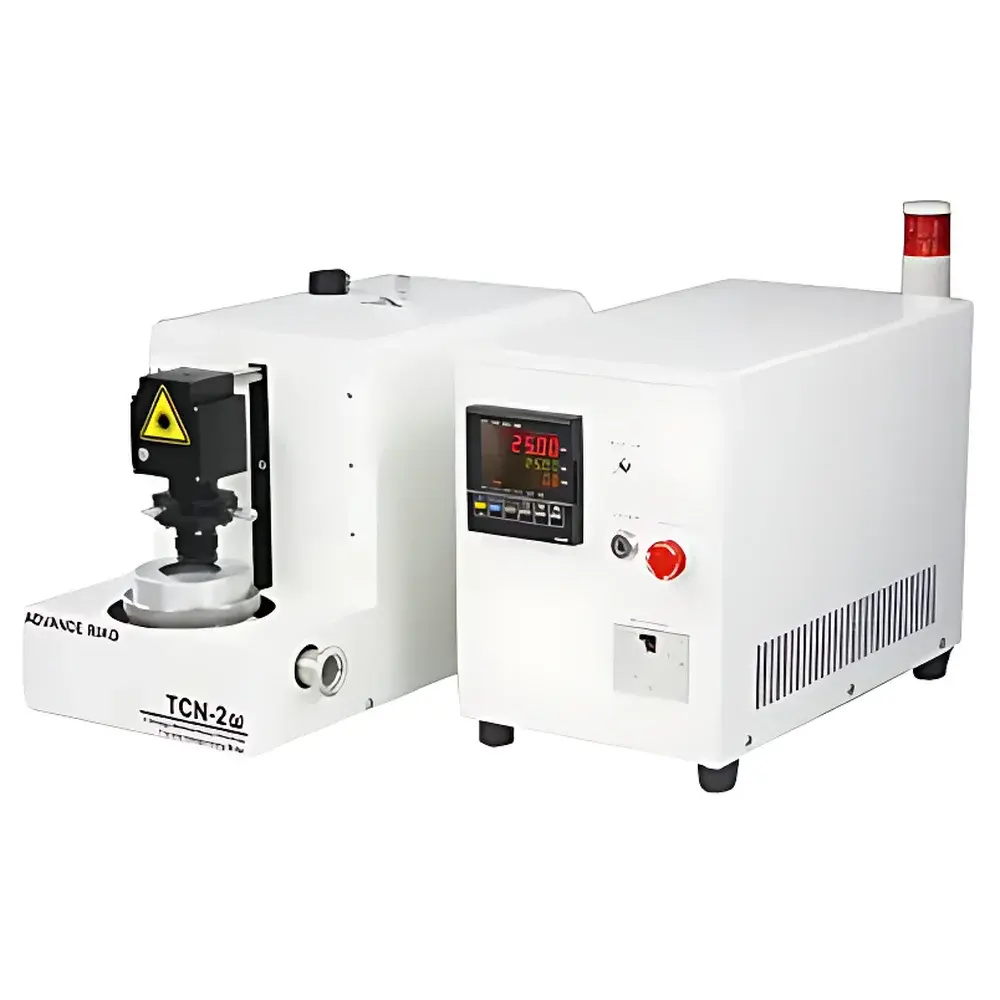
ADVANCE RIKO TCN-2ω Nanoscale Thin-Film Thermal Conductivity Measurement System
| Brand | ADVANCE RIKO |
|---|---|
| Origin | Japan |
| Model | TCN-2ω |
| Measurement Principle | 2ω Lock-in Thermography (Cross-Plane Thermal Conductivity) |
| Temperature Range | Ambient (23 ± 2 °C) |
| Sample Dimensions | 10–20 mm (L) × 10 mm (W) × 0.3–1 mm (total thickness, including substrate) |
| Substrate Options | Si (recommended), Ge, Al₂O₃ |
| Metal Transducer Film | Au, 100 nm thick, 1.7 mm × 15 mm |
| Thermal Conductivity Range | 0.1–10 W·m⁻¹·K⁻¹ |
| Atmosphere | Ambient air |
| Compliance | ISO/IEC 17025-aligned methodology, compatible with GLP documentation workflows |
Overview
The ADVANCE RIKO TCN-2ω Nanoscale Thin-Film Thermal Conductivity Measurement System is a purpose-built instrument for quantifying cross-plane (through-thickness) thermal conductivity (λ⊥) of nanoscale thin films—ranging from ~20 nm to ~100 nm—on rigid substrates. It implements the well-established 2ω (second-harmonic) lock-in thermographic technique, grounded in one-dimensional heat diffusion theory under periodic Joule heating. When an alternating current at frequency f passes through a metallic transducer layer (e.g., 100 nm Au), resistive heating occurs at 2f, generating a temperature oscillation at the metal/film interface. The amplitude and phase of the resulting surface temperature modulation—detected via high-sensitivity infrared thermoreflectance—are directly governed by the thermal diffusivity and conductivity of the underlying film. By fitting the measured in-phase (real) component of the 2ω signal against analytical solutions of the 1D heat conduction equation across the trilayer stack (metal transducer / sample film / substrate), λ1 is extracted without requiring absolute calibration or reference standards. This method eliminates dependence on contact resistance assumptions and avoids complex microfabrication—making it especially suitable for rapid screening of low-κ dielectrics, organic semiconductors, thermoelectric thin films, and emerging 2D material heterostructures.
Key Features
- Non-contact, non-destructive measurement of cross-plane thermal conductivity with nanoscale film sensitivity (20–100 nm)
- Integrated gold transducer deposition protocol: no photolithography required; uniform 100 nm Au film sputtered directly onto sample surface (1.7 mm × 15 mm footprint)
- Engineered for high reproducibility: ambient-temperature operation minimizes thermal drift; real-time lock-in detection suppresses 1/f noise and environmental fluctuations
- Validated analytical model incorporating substrate thermal boundary resistance (TBR) effects—enabling accurate λ1 extraction even for films on high-conductivity substrates (Si, Al₂O₃, Ge)
- Modular design supports rapid sample exchange; alignment-free optical path optimized for consistent thermoreflectance signal acquisition
- Compliant with metrological traceability frameworks: raw 2ω voltage data export enables post-processing per ISO 18434-1 (condition monitoring — thermography) and ASTM E1933 (standard test methods for measuring and compensating for emissivity)
Sample Compatibility & Compliance
The TCN-2ω accepts planar, freestanding or substrate-supported thin films with total thickness between 0.3 mm and 1 mm—including native oxide layers or engineered buffer stacks. Recommended substrates include single-crystal silicon (standard), germanium, and sapphire (Al₂O₃); all must exhibit thermal conductivity ≥ 100 W·m⁻¹·K⁻¹ to ensure dominant vertical heat flow. Films under evaluation may be dielectric (e.g., SiO₂, SiCN, porous organosilicates), polymeric (PI, PMMA), chalcogenide (Bi₂Te₃, Sb₂Te₃), or van der Waals heterostructures. Sample preparation requires only vacuum deposition of the Au transducer—no etching, patterning, or suspended-membrane fabrication. The system’s operational envelope (ambient atmosphere, no vacuum or inert gas requirement) aligns with ISO 14644-1 Class 8 cleanroom compatibility and supports routine QC integration in semiconductor front-end process labs. Data handling protocols support audit-ready documentation per FDA 21 CFR Part 11 when paired with compliant LIMS environments.
Software & Data Management
TCN-2ω is controlled via ADVANCE RIKO’s proprietary Windows-based acquisition suite, which implements real-time lock-in demodulation at user-selectable harmonics (fundamental, 2ω, 3ω). All raw voltages, phase angles, and lock-in parameters are logged in HDF5 format with embedded metadata (timestamp, sample ID, operator, ambient T/RH). The software includes built-in curve-fitting modules using Levenberg–Marquardt optimization to extract λ1 from the analytical 2ω amplitude vs. √ω relationship. Export options include CSV, MATLAB .mat, and PDF reports conforming to GLP Annex 11 requirements—featuring electronic signatures, version-controlled analysis scripts, and full audit trails. Raw datasets retain full spectral resolution for reprocessing under updated models or inter-laboratory comparison studies.
Applications
- Low-κ interlayer dielectric (ILD) qualification for advanced node BEOL integration (e.g., SiCOH, nanoporous silica)
- Thermal property mapping of thermoelectric thin films (Bi₂Te₃, SnSe, Cu₂Se) for power generation and solid-state cooling
- Process development feedback for ALD/CVD-grown barrier layers (TiN, TaN) and encapsulation films
- Structure–property correlation in organic electronic films (PEDOT:PSS, PTB7-Th) where thermal management dictates device lifetime
- Validation of molecular dynamics (MD) simulations predicting interfacial thermal resistance in multilayer stacks
FAQ
What substrate materials are compatible with the TCN-2ω?
Silicon is the default and most widely validated substrate. Germanium and single-crystal Al₂O₃ (sapphire) are also supported—provided their bulk thermal conductivity exceeds 100 W·m⁻¹·K⁻¹ to ensure one-dimensional heat flow dominance.
Can the system measure films thicker than 100 nm?
Yes—though sensitivity diminishes above ~200 nm due to reduced thermal contrast; for films >300 nm, alternative techniques such as time-domain thermoreflectance (TDTR) or steady-state microbridge methods are recommended.
Is vacuum or controlled atmosphere required during measurement?
No. All measurements are performed in ambient air. Convective losses are negligible at the 2ω frequency range used (typically 10–100 kHz) and are accounted for in the thermal model.
How is the Au transducer film deposited?
By DC magnetron sputtering or e-beam evaporation; ADVANCE RIKO provides detailed process guidelines (base pressure ≤ 5×10⁻⁶ Torr, deposition rate 0.1–0.3 nm/s) to ensure optimal adhesion, continuity, and electrical homogeneity.
Does the system comply with ISO/IEC 17025 for accredited testing?
While the TCN-2ω itself is not a certified reference instrument, its measurement methodology, uncertainty budgeting framework (±8% k=2 for λ1 in the 0.5–5 W·m⁻¹·K⁻¹ range), and data traceability features fully support implementation within ISO/IEC 17025-accredited laboratories.
Related Products