
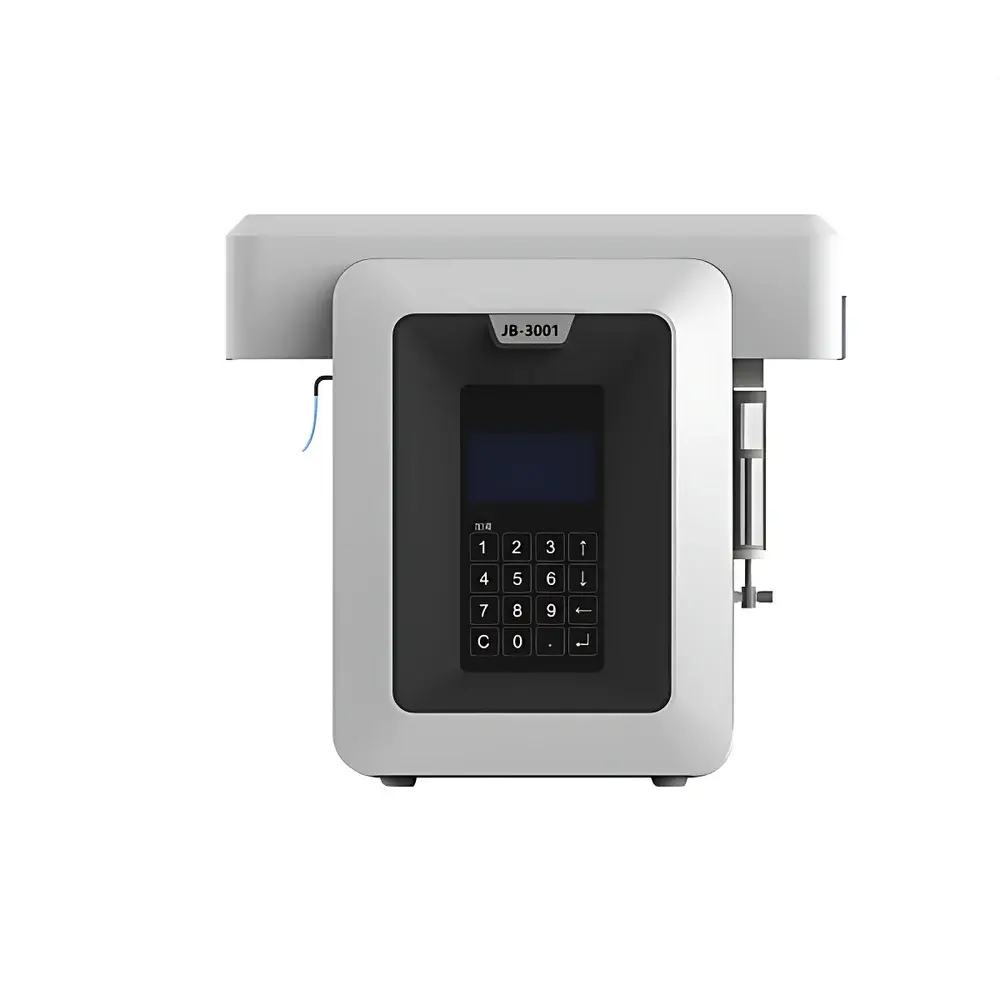
AECC JB-3010 Microscale Automated Spiking System
| Brand | AECC (Aviation Engine Corporation of China) |
|---|---|
| Origin | Beijing, China |
| Manufacturer Type | Authorized Distributor |
| Country of Origin | China |
| Model | JB-3010 |
| Instrument Type | Single-Channel Electric Pipette |
| Automation Level | Motorized Precision Spiking System |
| Channel Count | 1 |
| Volume Range | Customizable (250–1000 µL) |
| Minimum Dispense Volume | 25 µL (at 250 µL range) |
| Dispensing Accuracy (Relative Error) | ≤ ±0.22% (typical, per JJG 646) |
| Dispensing Precision (CV) | ≤ 0.04% (typical, per JJG 646) |
| Syringe Material | Borosilicate Glass |
| Fluidic Path Material | PTFE |
| Priming Modes | Full-Range Aspiration / Volume-Specific Aspiration |
| Cleaning Modes | Multi-cycle Standard Wash / Low-Volume Sequential Wash |
| Compliance | Fully compliant with JJG 646–2018 “Verification Regulation for Pipettes” (China National Metrology Verification Regulation) |
Overview
The AECC JB-3010 Microscale Automated Spiking System is a motor-driven, single-channel precision liquid handling instrument engineered for trace-level standard addition in quantitative analytical workflows. Unlike conventional manual pipettes or generic electronic pipettors, the JB-3010 implements closed-loop stepper motor control of a borosilicate glass piston syringe to achieve repeatable microscale dispensing with metrological traceability to national standards. Its core function—automated spiking—is optimized for applications requiring strict adherence to calibration protocol integrity: internal standard addition in chromatographic analysis (GC, HPLC, IC), matrix-matched calibration curve construction, and certified reference material (CRM) dilution series preparation. The system operates on volumetric displacement principle, eliminating air-cushion variability inherent in positive-displacement pipettes with disposable tips. Designed for integration into regulated laboratory environments, it supports audit-ready operation through deterministic motion control, programmable aspiration/dispense sequences, and non-volatile parameter retention.
Key Features
- Precision piston-driven dispensing with ≤0.04% coefficient of variation (CV) at 1000 µL and ≤0.09% CV at 25 µL—validated against JJG 646–2018 metrological requirements
- Dual aspiration modes: full-range fill (for maximum reproducibility across entire volume span) and volume-specific fill (to minimize reagent consumption during low-volume spiking)
- Two-stage cleaning protocol: configurable multi-cycle wash for cross-contamination mitigation and low-volume sequential rinse for precious stock solution conservation
- Chemically inert fluid path constructed from borosilicate glass (syringe barrel) and PTFE (tubing, valves, and fittings)—compatible with organic solvents, strong acids (e.g., 6 M HCl), and basic aqueous media (pH 1–13)
- On-device parameter memory retains user-defined spiking volumes, dwell times, and rinse cycles—no external PC required for routine operation
- Ergonomic, low-force actuation interface with tactile feedback and visual LED status indicators for error-free workflow execution
Sample Compatibility & Compliance
The JB-3010 is validated for use with aqueous buffers, ethanol/water mixtures, acetonitrile, methanol, dilute mineral acids (HNO₃, HCl ≤2 M), and sodium hydroxide solutions (≤1 M). It meets mechanical and metrological requirements defined in JJG 646–2018 and aligns with ISO 8655–1:2022 (Piston-operated volumetric apparatus — Part 1: Terminology, general requirements and user recommendations). While not pre-certified for FDA 21 CFR Part 11, its deterministic firmware architecture—featuring immutable dispense logs, timestamped cycle records, and non-editable calibration history—enables straightforward validation for GLP/GMP-compliant laboratories. All calibration data are exportable via USB-C as CSV files for inclusion in instrument qualification (IQ/OQ/PQ) documentation packages.
Software & Data Management
The JB-3010 operates autonomously without proprietary software dependency. All operational parameters—including target volume, number of spikes per sample, rinse cycles, and aspiration mode—are configured directly via intuitive rotary encoder and OLED display. For advanced deployment, optional Windows-compatible configuration utility (JB-Config v2.1) enables batch programming of spiking protocols, firmware updates, and export of audit trails with ISO 8601 timestamps. Exported logs include: cycle ID, date/time stamp, aspirated volume, dispensed volume, error flags (e.g., air bubble detection, pressure timeout), and operator ID field (user-definable). Data integrity is ensured via cyclic redundancy check (CRC-32) embedded in each log entry.
Applications
- Internal standard addition in ICP-MS, GC-MS, and LC-MS/MS quantitation of trace metals, pesticides, pharmaceutical residues, and environmental contaminants
- Preparation of multi-point calibration standards for EPA Method 525.3 (drinking water), ISO 17025-accredited environmental testing labs
- Spiking of biological matrices (serum, urine, tissue homogenates) prior to extraction to assess method recovery and matrix effects
- Automated dilution of CRMs (e.g., NIST SRM 1643e, ERM-CA101) for laboratory control sample generation
- Reproducible delivery of enzyme inhibitors or co-factors in kinetic assay development under ISO/IEC 17025 quality systems
FAQ
Is the JB-3010 compatible with corrosive solvents such as concentrated HF or fuming nitric acid?
No. While PTFE and borosilicate glass resist many aggressive reagents, the JB-3010 is not rated for hydrofluoric acid, aqua regia, or >6 M HNO₃. Refer to the Chemical Compatibility Matrix in Section 4.2 of the User Manual.
Can the instrument be integrated into a robotic liquid handler platform?
Yes. The JB-3010 features TTL-level digital I/O ports (trigger in/out, status signal) and Modbus RTU over RS-485 for synchronization with third-party automation controllers (e.g., Hamilton Vantage, Tecan Fluent). API documentation is available under NDA.
What calibration frequency is recommended for GLP-regulated use?
Per JJG 646–2018 and ISO/IEC 17025:2017, full verification at three points (10%, 50%, and 100% of selected range) is required before first use, after repair, and at least every 6 months—or per daily performance checks using gravimetric verification if used for critical assays.
Does the system support variable dispense speeds?
Yes. Four preset flow rates (slow, medium, fast, turbo) are selectable per dispense step to optimize delivery into viscous matrices (e.g., glycerol-based standards) or low-volume vials without splashing or wall adhesion.
Is firmware update capability available in the field?
Yes. Updates are delivered via signed .bin files loaded from USB flash drive. Each update includes cryptographic signature verification and automatic rollback on checksum failure.



