
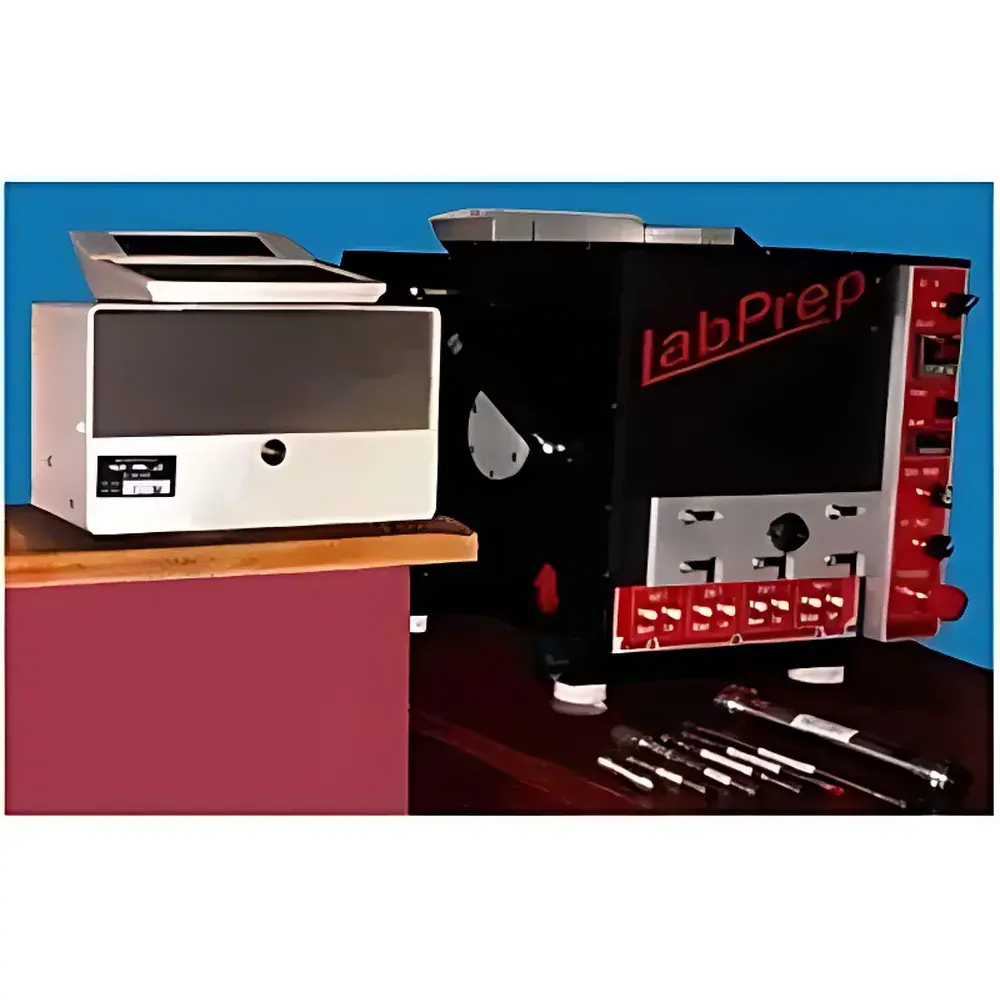
AECS LabPrep High-Speed Counter-Current Chromatography System
| Brand | AECS |
|---|---|
| Origin | United Kingdom |
| Manufacturer Type | Authorized Distributor |
| Origin Category | Imported |
| Model | LabPrep |
| Pricing | Upon Request |
Overview
The AECS LabPrep High-Speed Counter-Current Chromatography (HSCCC) System is a precision-engineered, solvent-based liquid–liquid partition chromatography platform that operates without a solid stationary phase. Unlike conventional HPLC or flash chromatography, HSCCC relies on the differential partitioning of analytes between two immiscible liquid phases under high centrifugal force—generated via a planetary motion mechanism—where the stationary phase is retained by centripetal acceleration while the mobile phase percolates through it. This principle eliminates irreversible adsorption, sample degradation, and column fouling, delivering quantitative recovery, high reproducibility, and exceptional resolution for natural products, polar metabolites, peptides, and unstable compounds. The LabPrep system implements AECS’s proprietary Quattro CCC™ architecture—a dual-axis, multi-coil planetary rotor design—enabling simultaneous operation of up to four independent coil assemblies with variable diameters (1.0–6.0 mm), materials (PTFE, stainless steel, titanium alloy), and volumes (26–1400 mL). Its optimized β-value (coil radius / rotor radius) and rotational dynamics (0–860 rpm standard; optional 0–2500 rpm) ensure maximum G-force generation (>100 g), critical for stable stationary-phase retention and efficient mass transfer.
Key Features
- Modular multi-coil configuration: Supports 1-, 2-, or 4-coil setups on single or dual spindles—functionally equivalent to multiple independent instruments in one chassis.
- Material-flexible coil construction: PTFE (chemically inert, low-pressure), stainless steel (high-pressure, broad pH compatibility), and titanium alloy (corrosion-resistant, extreme pH/temperature stability).
- Wide coil diameter range: 1.0, 1.6, 2.0, 2.2, 3.0, 3.7, and 6.0 mm—enabling seamless scaling from analytical-scale CCC–MS coupling (1.0 mm PTFE) to preparative purification (6.0 mm SS).
- Aerospace-grade sealing: High-temperature, solvent-resistant aviation adhesive used for all fluidic connections, ensuring >10,000 operational hours and minimal maintenance.
- Integrated safety architecture: Interlocked safety door, power-fail brake engagement, anti-drop door chain, rear-mounted containment housing, emergency stop button, and key-switch startup.
- CE-certified electrical isolation: Chromatographic solvent pathways are physically and electrically segregated from control electronics per IEC 61010-1.
- Air-purged rotor chamber: Prevents solvent vapor accumulation and ensures thermal stability during extended runs.
- Digital instrumentation suite: Optional real-time displays for temperature, rotational speed, and automated parameter logging compliant with GLP audit trails.
Sample Compatibility & Compliance
The LabPrep system accommodates a broad spectrum of sample classes—including glycosides, alkaloids, flavonoids, saponins, organic acids, and chiral intermediates—without derivatization or immobilization artifacts. Its pressure-independent separation mechanism allows direct analysis of thermolabile or strongly adsorbing compounds incompatible with silica-based columns. All configurations meet CE marking requirements (2014/30/EU EMC Directive, 2014/35/EU LVD Directive) and support compliance with ISO/IEC 17025 method validation frameworks. When equipped with auto-injection, fraction collection, and timestamped data logging modules, the system satisfies FDA 21 CFR Part 11 electronic record integrity criteria—including user authentication, audit trail generation, and non-erasable event logs—making it suitable for regulated QC/QA environments in pharmaceutical, nutraceutical, and botanical extract manufacturing.
Software & Data Management
The LabPrep platform integrates with AECS’s CCCControl™ software (Windows-based, USB/RS-485 interface), providing synchronized control of pump flow rates, rotational speed, temperature setpoints, valve switching, UV/Vis detection signals, and fraction collector triggers. All parameters are logged at ≤1 Hz resolution with embedded metadata (operator ID, method name, timestamp, coil ID, solvent batch). Raw chromatograms and fraction maps are exportable in CSV, ASCII, and .CDF formats for downstream processing in third-party tools (e.g., Chromeleon, MassHunter, MATLAB). Optional automation packages support method sequencing, unattended overnight operation, and integration into LIMS via OPC UA or RESTful API endpoints. Data integrity safeguards include write-protected storage, encrypted backups, and configurable retention policies aligned with ALCOA+ principles.
Applications
- Natural product isolation: Scalable purification of bioactive constituents from plant, marine, or microbial extracts—e.g., paclitaxel analogs, curcuminoids, or marine polyphenols—with >95% recovery and no column carryover.
- Metabolomics profiling: High-fidelity fractionation of polar and ionic metabolites (e.g., amino acids, nucleotides, organic acids) prior to LC–MS or NMR analysis.
- Chiral separations: Enantioselective partitioning using chiral solvents (e.g., D-limonene/water systems) without chiral stationary phases.
- Process development & tech transfer: Seamless transition from lab-scale (26 mL coil) to pilot-scale (1400 mL coil) using identical chemistry and retention mechanisms—eliminating method revalidation.
- Reference standard preparation: Certified purity grade isolation (≥99.5%) for pharmacopeial standards (USP, EP, JP) under GMP-aligned workflows.
FAQ
What coil diameter should I select for coupling with mass spectrometry?
For direct CCC–MS interfacing, use 1.0 mm PTFE coils (minimum volume 30 mL); their low dead volume and chemical inertness minimize ion suppression and enable nanoflow-compatible elution profiles.
Can I upgrade my LabPrep to PilotPrep throughput?
Yes—the LabPrep chassis supports mechanical and firmware upgrades to accommodate up to 3000 mL coil capacity (via PrepPlus conversion kit), maintaining full backward compatibility with existing coils, controllers, and software.
How does the planetary motion improve separation efficiency compared to traditional CCC?
The Quattro CCC™ planetary drive generates higher and more uniform G-force across the entire coil length, improving stationary-phase retention stability and reducing band broadening—resulting in 20–35% higher peak capacity versus single-axis systems.
Is titanium alloy coil material necessary for routine use?
Titanium is recommended only for highly corrosive solvent systems (e.g., concentrated HF, hot aqua regia) or long-term operation above 80 °C; PTFE and stainless steel cover >95% of standard natural product and pharmaceutical applications.
Does the system support gradient elution?
No—HSCCC is inherently isocratic due to its liquid–liquid partition equilibrium foundation; however, stepwise solvent system switching (via optional multi-port valves) enables pseudo-gradient protocols for complex mixtures.





