
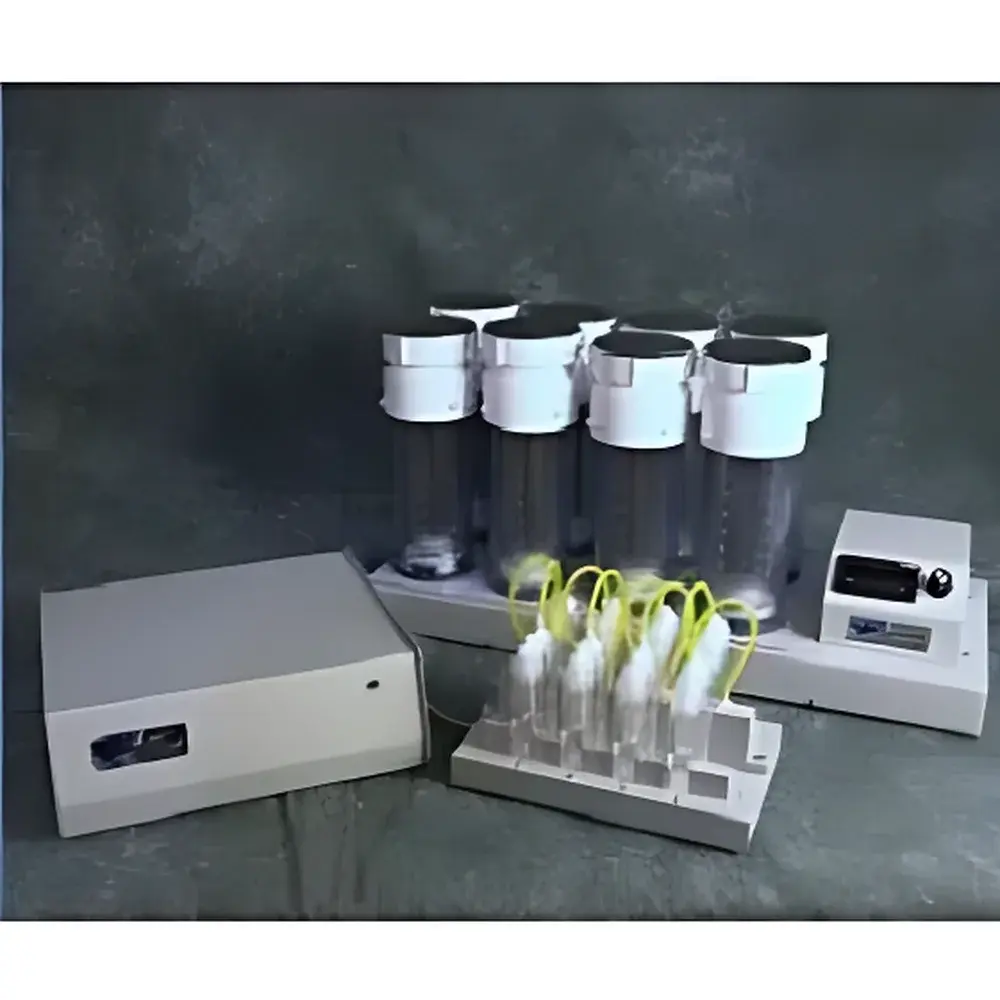
AER-208S Organic Solid Waste Composting System
| Origin | USA |
|---|---|
| Manufacturer Type | Authorized Distributor |
| Origin Category | Imported |
| Model | 208S |
| Instrument Type | Fertilizer/Nutrient Analyzer |
Overview
The AER-208S Organic Solid Waste Composting System is a bench-scale, controlled-environment aerobic composting reactor designed for reproducible laboratory evaluation of biodegradation kinetics, microbial respiration dynamics, and stabilization behavior of organic solid wastes. Engineered for precision in soil health and bioremediation research, the system operates on the principle of dynamic oxygen consumption monitoring coupled with real-time CO₂ evolution measurement—enabling quantification of microbial metabolic activity during thermophilic and mesophilic composting phases. Unlike open-pile or static-bin methods, the AER-208S integrates regulated aeration, temperature feedback control, moisture management, and headspace gas sampling ports to simulate field-relevant aerobic decomposition under standardized conditions. It serves as a critical tool for assessing compost maturity, evaluating phytotoxicity reduction, and generating data compliant with OECD 301/310 guidelines and ISO 14855-1 for aerobic biodegradability testing.
Key Features
- Programmable dual-channel aeration system with mass flow controllers (0–5 L/min range) for precise O₂ supply and exhaust gas routing
- Integrated PT100 temperature sensors with ±0.2 °C accuracy, positioned in both compost matrix and exhaust line for thermal profile mapping
- Real-time respirometry via non-dispersive infrared (NDIR) CO₂ sensor (0–5% v/v range, ±2% FS accuracy) and paramagnetic O₂ analyzer (0–25% v/v, ±0.1% FS)
- Automated moisture adjustment capability through periodic misting cycles and gravimetric feedback (optional load cell integration)
- Stainless-steel reaction vessel (8 L working volume) with removable sampling ports, corrosion-resistant gasket seals, and pressure-relief safety valve
- Modular design supporting parallel operation of up to four units under synchronized protocol control via central software interface
Sample Compatibility & Compliance
The AER-208S accommodates heterogeneous feedstocks including municipal solid waste fractions, food waste, agricultural residues, sewage sludge, green compost amendments, and contaminated soils spiked with organic pollutants (e.g., PAHs, petroleum hydrocarbons, pesticides). Sample mass loading ranges from 1.5–6.0 kg (wet weight), with adjustable C/N ratio calibration and bulking agent integration. The system supports method validation per ASTM D5338 (Standard Test Method for Determining Aerobic Biodegradation of Plastic Materials in Soil), ISO 21729-1 (Soil quality — Assessment of compost maturity), and EPA SW-846 Method 9045D (Respirometric screening for biodegradation potential). All data acquisition and parameter logging comply with GLP audit requirements, including electronic signature support and 21 CFR Part 11–ready metadata tagging.
Software & Data Management
The proprietary CompostLog™ software provides intuitive protocol setup, live multichannel visualization (O₂ uptake rate, CO₂ evolution rate, cumulative mineralization, temperature gradient), and automated calculation of key indices: DT₅₀ (time to 50% theoretical CO₂ release), respiration quotient (RQ), and stability/maturity thresholds (e.g., <0.3 mg CO₂-C/g VS·h for mature compost). Raw sensor data are exported in CSV/Excel format with timestamped metadata; batch reports include statistical summaries (mean, SD, CV%) across replicates. Audit trails record all user actions, parameter modifications, and calibration events—fully traceable for regulatory submissions or peer-reviewed publication.
Applications
- Evaluation of composting efficiency for novel feedstock blends (e.g., lignocellulosic co-digestion with food waste)
- Toxicity screening of compost leachates using standardized bioassays (e.g., lettuce seed germination, earthworm avoidance tests)
- Optimization of operational parameters (aeration frequency, turning intervals, moisture setpoints) for process scale-up
- Assessment of contaminant fate during composting—tracking degradation half-lives of emerging pollutants under defined redox conditions
- Soil amendment efficacy trials: correlating compost physicochemical properties (C/N, EC, humic substances) with microbial functional diversity (via PLFA or qPCR follow-up)
- Regulatory compliance testing for landfill diversion credits or organic recycling certification (e.g., USCC STA, EU Ecolabel)
FAQ
What sample preparation is required prior to loading into the AER-208S?
Samples must be homogenized, moisture-adjusted to 55–65% w/w, and screened to ≤10 mm particle size. Representative subsampling and initial characterization (pH, TOC, TN, C/N) are recommended.
Can the system operate under mesophilic conditions only, without reaching thermophilic temperatures?
Yes—temperature setpoints are fully programmable between 20–70 °C; users may enforce isothermal mesophilic regimes (e.g., 35 °C) to isolate low-temperature microbial consortia effects.
Is the AER-208S suitable for anaerobic digestion studies?
No—it is explicitly engineered for aerobic respirometry. For anaerobic applications, refer to the companion AER-300 series with sealed biogas capture and CH₄/H₂S monitoring modules.
How frequently does the NDIR CO₂ sensor require recalibration?
Factory-calibrated sensors maintain accuracy for ≥12 months under normal use; annual zero/span verification with certified gas standards (N₂ and 2% CO₂ in air) is recommended.
Does the system meet international shipping and electrical safety standards?
Yes—CE-marked, compliant with IEC 61000-6-3 (EMC) and IEC 61010-1 (safety); configured for 100–240 VAC, 50/60 Hz operation with universal power supply.







