
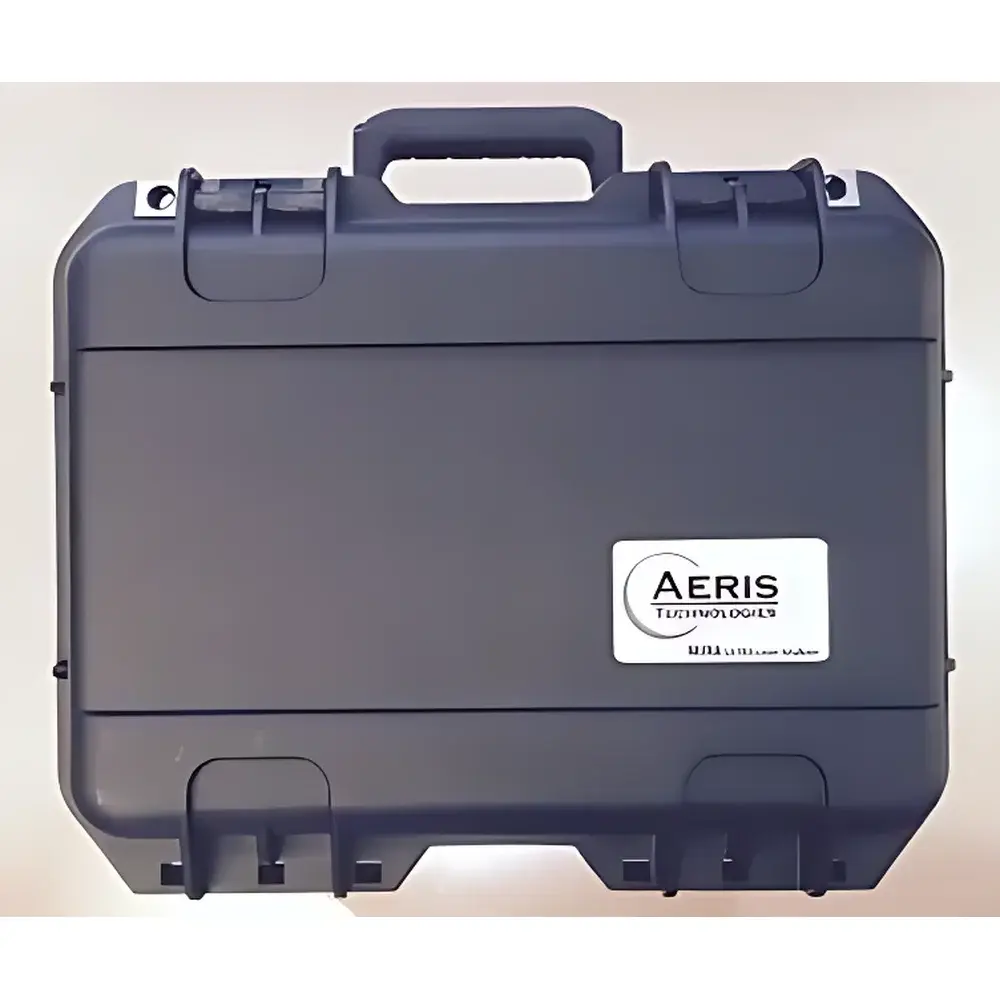
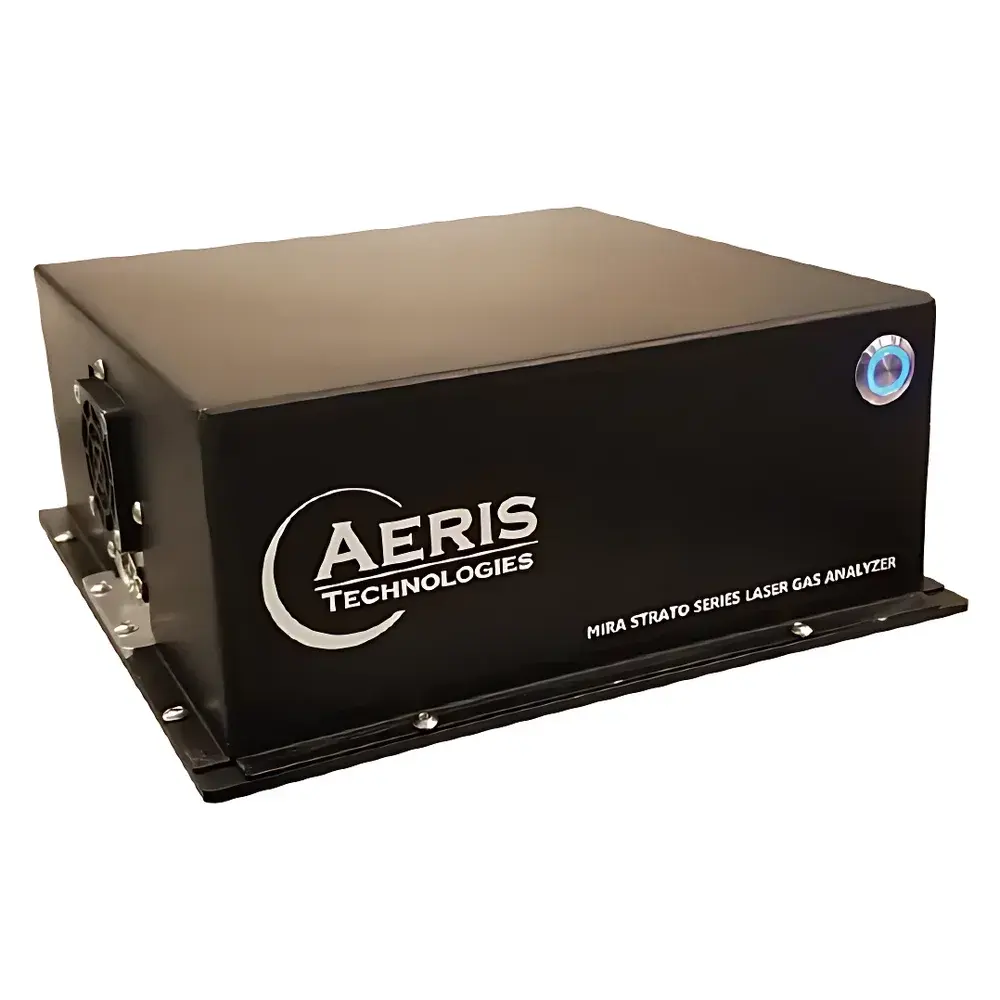
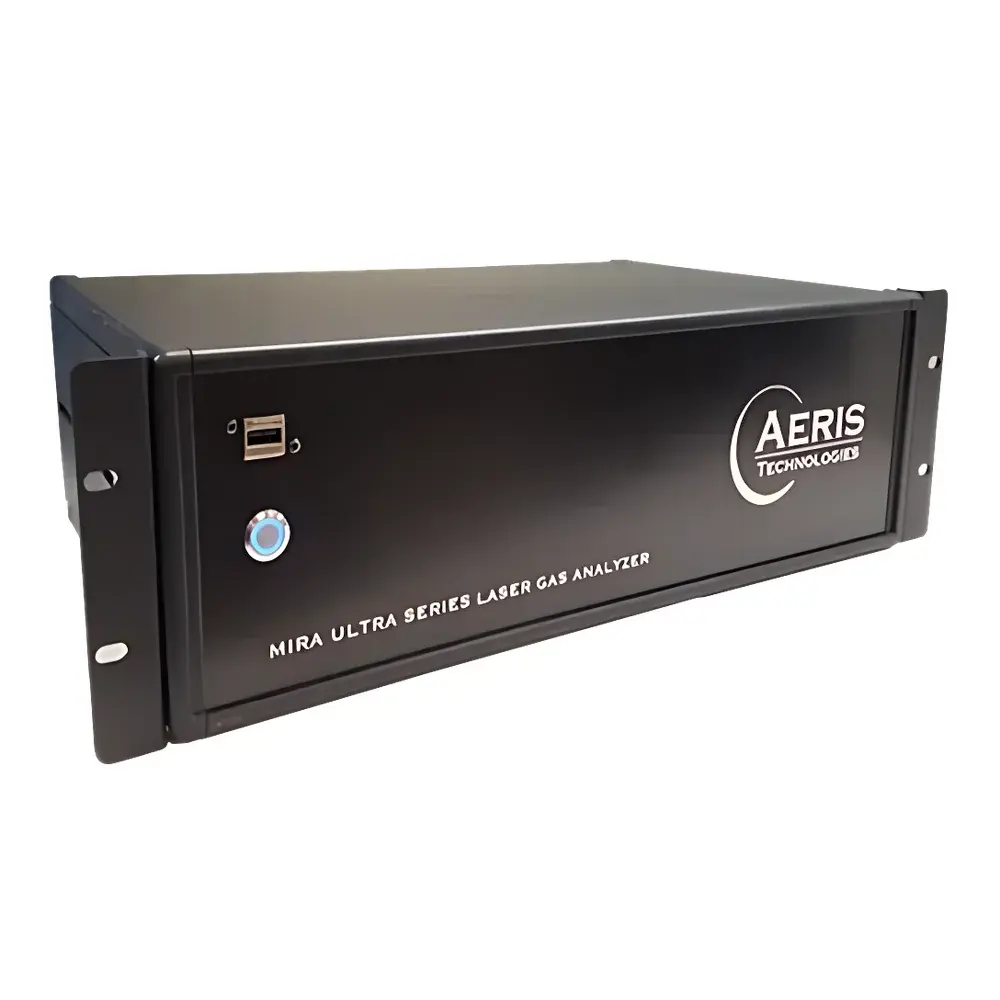
Aeris Technologies MIRA LDS Portable Methane and Ethane Leak Detection System
| Brand | Aeris Technologies |
|---|---|
| Origin | USA |
| Manufacturer Type | Authorized Distributor |
| Origin Category | Imported |
| Model | MIRA LDS |
| Instrument Type | Portable |
| Sensitivity | CH₄ < 1 ppb/s, C₂H₆ < 500 ppt/s |
| Measurement Principle | Mid-Infrared Laser Absorption Spectroscopy |
| Path Length | 13 m in 60 mL sample cell |
| Detection Targets | CH₄, C₂H₆, H₂O (dry mole fraction reported) |
| Ethane/Methane Ratio Accuracy | ±0.02% (e.g., 4.42% ± 0.02%) |
| Drift (Ultra) | ≤2 ppb or 0.1% of reading across full temperature range |
| Operating Environment | 10–40 °C, 10–95% RH (non-condensing) |
| Data Output Rate | 1–2 Hz standard, up to 10 Hz optional |
| GPS Accuracy | High-precision embedded GNSS with magnetic-mount antenna |
| Power Consumption | 15–25 W depending on configuration |
| Dimensions & Weight | Pico (2.75 kg), Ultra Portable (6.5 kg), Strato (2.0 kg) |
| Data Storage | 32 GB internal (expandable) |
| Communication Interfaces | Wi-Fi, RS-232, USB, analog output (optional) |
Overview
The Aeris Technologies MIRA LDS Portable Methane and Ethane Leak Detection System is an advanced, field-deployable gas analyzer engineered for high-fidelity detection and source attribution of methane emissions. It employs tunable mid-infrared (MIR) laser absorption spectroscopy—a technique offering >200× stronger CH₄ and >6000× stronger C₂H₆ absorption cross-sections compared to near-infrared (NIR) methods—enabling sub-part-per-trillion-per-second sensitivity without optical mirrors or complex multipass cavities. Its patented solid-state MIR laser and monolithic absorption cell (60 mL volume, 13 m effective path length) deliver exceptional signal-to-noise ratio, rapid response (<1 s T90), and intrinsic immunity to vibration and thermal drift. Unlike conventional single-gas analyzers, the MIRA LDS simultaneously quantifies CH₄, C₂H₆, and H₂O in real time, computing dry-mole-fraction-corrected concentration ratios with metrological traceability. This dual-species capability forms the physical basis for distinguishing thermogenic natural gas leaks (CH₄:C₂H₆ ≈ 10:1 to 100:1) from biogenic sources such as landfills (CH₄:C₂H₆ > 1000:1) or livestock (near-zero C₂H₆), thereby eliminating false positives endemic to CH₄-only detection platforms.
Key Features
- Sub-ppb/s detection limits: CH₄ < 1 ppb/s, C₂H₆ < 500 ppt/s — validated per ASTM D6584 and ISO 13864 protocols
- Integrated high-accuracy GNSS receiver with magnetic-mount antenna for georeferenced mapping at ≤2 m horizontal uncertainty
- Thermally stabilized measurement cell (Ultra variant): maintained at 42 °C ± 1 mK, reducing long-term drift to ≤2 ppb or 0.1% of reading over full operating temperature range
- Zero-maintenance optical architecture: no consumables, no reflective optics, no periodic alignment required
- Real-time data streaming at up to 10 Hz via RS-232 (standard), with optional Wi-Fi and analog voltage outputs for SCADA integration
- Onboard data logging: 32 GB internal flash memory (FAT32-formatted), exportable as .kml for Google Earth visualization and .csv for post-processing
- Low-power operation: 15 W (Pico), 17 W (Strato), 25 W (Ultra); compatible with 12–15 V DC (2 A) or 110–220 V AC (0.5 A)
- Ruggedized aluminum chassis rated IP54; operational in ambient conditions from 10–40 °C and 10–95% RH (non-condensing)
Sample Compatibility & Compliance
The MIRA LDS is designed for direct analysis of ambient air, stack effluents, and fugitive emission plumes without pre-concentration, drying, or chemical derivatization—eliminating bias introduced by sorbent tubes or catalytic scrubbers. Its simultaneous H₂O measurement enables real-time correction to dry mole fraction, ensuring compliance with EPA Method 21 reporting conventions and aligning with ISO 14064-3 verification requirements for GHG inventories. The system meets electromagnetic compatibility standards per FCC Part 15 Class B and CE EN 61326-1. For regulated environments, its firmware supports audit-ready data integrity features including timestamped metadata, immutable file logging, and configurable user access levels—facilitating adherence to GLP and 21 CFR Part 11 principles when deployed in utility compliance monitoring programs.
Software & Data Management
Aeris’ proprietary FieldView™ software provides real-time spectral visualization, leak localization heatmaps, and automated C₂H₆/CH₄ correlation analytics. Raw spectra are stored alongside environmental metadata (GPS coordinates, pressure, temperature, humidity) in a structured binary format (.aer), convertible to netCDF or HDF5 for third-party modeling (e.g., inverse dispersion modeling with WindTrax or OpenGHG). The system supports remote firmware updates over secure TLS channels and integrates with cloud platforms via MQTT or RESTful API endpoints. All data files include cryptographic hash signatures for chain-of-custody validation, satisfying data integrity requirements under ISO/IEC 17025 accredited laboratory workflows.
Applications
- Natural gas transmission and distribution infrastructure leak surveys (pipeline corridors, compressor stations, city gate meters)
- Oil and gas upstream facility emissions quantification (well pads, tank batteries, flares) per OGI and LDAR program requirements
- Landfill and wastewater treatment plant methane flux characterization using dual-isotope proxy inference
- Urban atmospheric methane source apportionment studies in support of municipal climate action plans
- Drone-based aerial survey campaigns: Strato variant certified for integration with DJI Matrice 600 and Autel EVO Max series UAVs
- Mobile lab deployments aboard service vehicles for rapid-response leak verification and repair prioritization
FAQ
Does the MIRA LDS require daily calibration?
No. The Ultra variant’s thermally stabilized cell and built-in automatic zero tracking eliminate routine calibration; field verification against NIST-traceable span gases is recommended every 90 days for regulatory reporting.
Can it distinguish landfill methane from natural gas leaks?
Yes. By measuring the ethane/methane molar ratio in real time, the system identifies thermogenic signatures (typically 0.5–5% C₂H₆/CH₄) versus biogenic sources (<0.05%).
Is GPS data synchronized with concentration readings?
Yes. Each concentration timestamp includes synchronized GNSS position, altitude, and velocity vectors, enabling precise plume mapping at sub-meter spatial resolution.
What data formats are supported for export?
Native .aer binary, plus export to .kml (Google Earth), .csv (Excel-compatible), and netCDF/HDF5 (modeling-ready).
Is the system suitable for use in explosive atmospheres?
The MIRA LDS is not intrinsically safe rated; it is intended for use in non-hazardous locations per NEC Class I, Division 2 guidelines. Optional ATEX-certified enclosures are available upon request.







