
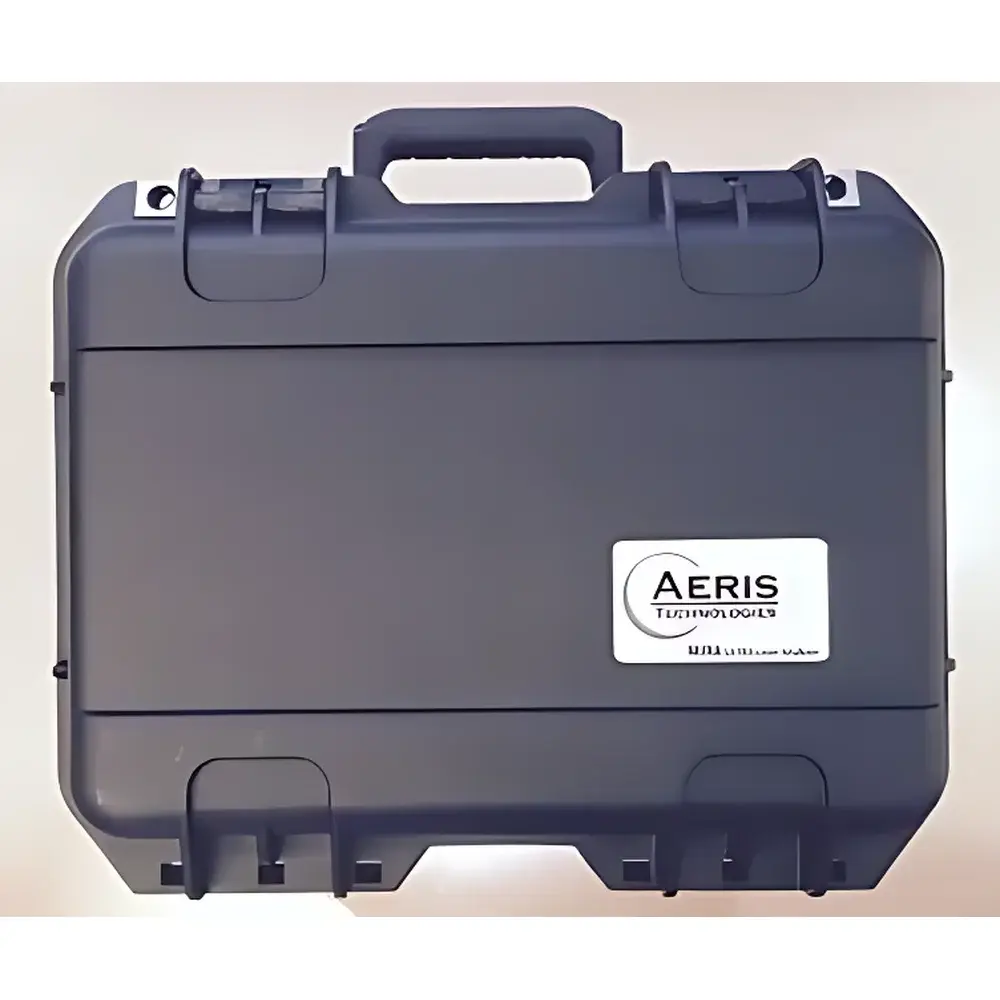
Aeris Technologies MIRA Ultra Portable Greenhouse Gas Analyzer (CH₄ / N₂O / CO₂ / H₂O)
| Brand | Aeris Technologies |
|---|---|
| Origin | USA |
| Model | MIRA Ultra |
| Detection Principle | Multi-pass Absorption Cell Coupled with Solid-State Mid-Infrared Laser Spectroscopy |
| Precision | CH₄: <1 ppb/s, N₂O: <200 ppt/s, CO₂: <200 ppb/s |
| Measurement Ranges | CH₄: 10 ppb – 10,000 ppm |
| N₂O | <2 ppb – 500 ppm |
| CO₂ | <10 ppm – 10% |
| H₂O | Full-range humidity compensation |
| Optical Path Length | 15 m in 60 mL cell volume |
| Data Output Rate | 1–10 Hz (configurable) |
| Dimensions | 45.7 × 38.1 × 17.8 cm (W×D×H) |
| Weight | 8.5 kg |
| Power Consumption | 25 W |
| Operating Temperature | 10–40 °C |
| Relative Humidity | 10–95% RH (non-condensing) |
| Internal Battery Life | 6 hours |
| Communication Interfaces | Wi-Fi, USB, RS-232, Analog Output (optional) |
| Onboard Storage | 32 GB (expandable) |
Overview
The Aeris Technologies MIRA Ultra Portable Greenhouse Gas Analyzer is an engineered field-deployable instrument that implements direct absorption spectroscopy in the mid-infrared (MIR) spectral region—where fundamental vibrational-rotational transitions of CH₄, N₂O, CO₂, and H₂O exhibit orders-of-magnitude stronger absorption than in the near-infrared. Unlike conventional NDIR or tunable diode laser (TDLAS) systems operating in weaker overtone bands, the MIRA Ultra leverages proprietary solid-state quantum cascade lasers (QCLs) tuned to the molecular “fingerprint” region (typically 5–12 µm), enabling sub-part-per-trillion sensitivity without cryogenic cooling or optical cavities. Its dual-channel multi-pass absorption cell—mirrorless, monolithic, and thermally stabilized at 42 °C with milli-Kelvin stability—achieves an effective optical path length of 15 meters within a compact 60 mL volume. This architecture eliminates alignment drift, minimizes condensation risk, and ensures long-term baseline stability critical for unattended environmental monitoring.
Key Features
- Simultaneous, real-time quantification of CH₄, N₂O, CO₂, and H₂O at 1–10 Hz update rates
- Sub-ppb per second precision: CH₄ <1 ppb/s, N₂O <200 ppt/s, CO₂ <200 ppb/s (1σ, 1-s integration)
- Proprietary differential measurement method compensating for thermal and pressure-induced baseline drift
- Integrated zero-gas calibration pathway—user-configurable for periodic auto-zero or differential synchronous sampling
- Onboard water vapor correction yielding dry-mole-fraction concentrations without external drying or post-processing
- Thermally regulated detection chamber (42 °C ± 0.005 K) ensuring consistent line shape, minimal condensation, and reduced calibration frequency
- Ultra-low power consumption (25 W) with internal rechargeable Li-ion battery supporting 6 hours of continuous operation
- Modular GPS add-on enabling georeferenced .kml export compatible with Google Earth visualization
- Communication via Wi-Fi, USB, RS-232, and optional analog voltage outputs for SCADA integration
Sample Compatibility & Compliance
The MIRA Ultra accepts ambient air, stack emissions, soil flux chambers, and headspace samples without pre-concentration or chemical derivatization. Its robust inlet design accommodates particulate-laden or high-humidity streams; integrated hydrophobic filtration protects the optical path while preserving quantitative H₂O response. The analyzer meets core requirements for environmental data integrity under EPA Method TO-15 adjunct protocols and aligns with ISO 14064-3 verification guidance for GHG emission inventories. While not certified as a reference method per EPA 40 CFR Part 60, its demonstrated stability (<100 ppt Allan deviation over 8 h for N₂O) and traceability to NIST-traceable gas standards support use in Tier 2/3 inventory reporting, flux tower validation, and mobile source characterization. Firmware includes audit-trail logging compliant with GLP principles, and data files embed timestamp, GPS coordinates (if enabled), temperature/pressure metadata, and diagnostic flags.
Software & Data Management
The MIRA Ultra ships with Aeris’ proprietary FieldView™ software suite, providing real-time spectral visualization, automated baseline fitting, and configurable alarm thresholds. All raw absorbance spectra and processed concentration time series are stored onboard (32 GB eMMC, expandable via microSD) with file-level encryption and cyclic overwrite protection. Data export supports CSV, NetCDF, and KML formats; timestamps are synchronized to UTC via NTP or GPS PPS. Remote access is supported over secure Wi-Fi or Ethernet using TLS 1.2–encrypted API endpoints. For regulatory workflows, optional 21 CFR Part 11-compliant user authentication, electronic signatures, and immutable audit logs are available through the Enterprise Edition firmware package.
Applications
- Atmospheric boundary layer studies and eddy covariance flux validation
- Mobile monitoring of landfill, dairy, and wastewater treatment facility emissions
- In-vehicle exhaust plume characterization for light- and heavy-duty vehicles
- Indoor air quality assessment in agricultural buildings and urban microenvironments
- Combustion efficiency optimization in industrial burners and gas turbines
- Soil-atmosphere exchange measurements using dynamic closed-chamber systems
- Calibration transfer and intercomparison campaigns among CRDS, OA-ICOS, and GC-based networks
FAQ
Does the MIRA Ultra require external calibration gases during routine operation?
No—its dual-path differential architecture and thermally stabilized optics enable stable operation for weeks between zero/span checks. However, periodic verification (e.g., monthly) with NIST-traceable standards is recommended for regulatory-grade reporting.
Can the instrument operate in freezing or high-humidity conditions?
It is rated for 10–40 °C and up to 95% RH non-condensing. Optional heated inlet kits extend low-temperature usability; internal thermal regulation prevents condensation inside the cell even at high ambient humidity.
Is H₂O measurement used only for correction, or is it a quantified output?
H₂O is fully quantified as a primary analyte, reported in ppmv with ±2% accuracy. Its signal enables real-time dry-mole-fraction conversion for CH₄/N₂O/CO₂ without external drying.
What is the minimum detectable concentration for N₂O at 10-second averaging?
Based on Allan variance analysis, the effective detection limit is <12 ppt (1σ) at 10 s integration time, assuming optimal flow and stable thermal conditions.
How is data security ensured during remote transmission?
All wireless communication uses WPA2-Enterprise or TLS 1.2 encryption; firmware updates are cryptographically signed and verified prior to installation.
Related Products







