
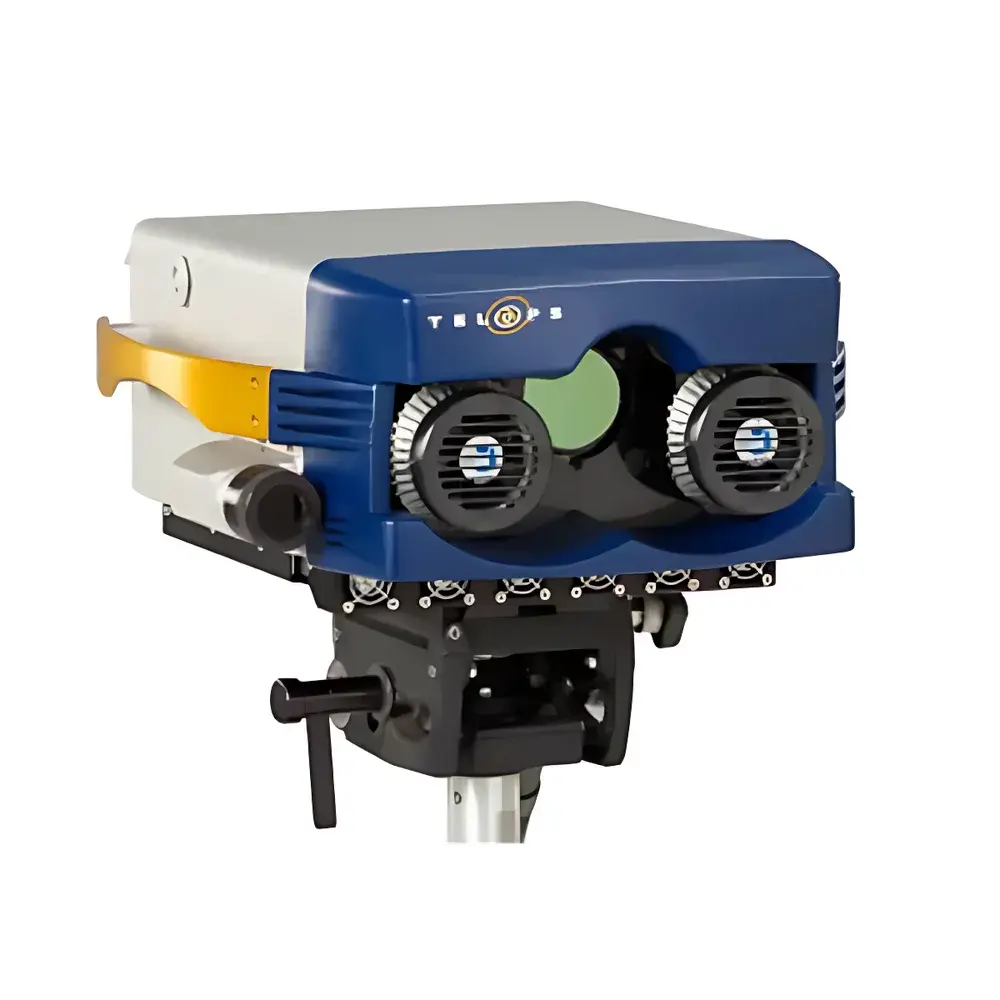
AERO Hyper-Cam Infrared Hyperspectral Imaging System
| Brand | AERO |
|---|---|
| Origin | Beijing, China |
| Manufacturer Type | Authorized Distributor |
| Product Origin | Domestic (China) |
| Model | Hyper-Cam |
| Pricing | Available Upon Request |
| Operating Principle | Fourier Transform Infrared (FTIR) Spectroscopy |
| Imaging Architecture | Dispersive (Grating-Based) |
| Deployment Mode | Ground-Based & Airborne Compatible |
| Spectral Range | 7.7–12.5 µm (MWIR) |
| Spectral Resolution | Up to 0.25 cm⁻¹ |
| Spatial Resolution (IFOV) | 0.45 mrad (typical, lens-dependent) |
| Detector Format | 320 × 256 HgCdTe FPA |
| Field of View (TFOV) | 6.4° × 5.1° |
| Frame Rate | Up to 60 Hz (full-frame, binning-dependent) |
| Calibration | Onboard Blackbody + Ambient Reference |
| Compliance | ISO/IEC 17025-aligned calibration traceability, GLP-compliant data acquisition workflow |
Overview
The AERO Hyper-Cam Infrared Hyperspectral Imaging System is a field-deployable, Fourier Transform Infrared (FTIR)-based hyperspectral imager engineered for quantitative molecular identification and spatially resolved thermal emission analysis in the mid-wave infrared (MWIR) spectral region (7.7–12.5 µm). Unlike filter-wheel or push-broom architectures, the Hyper-Cam employs a robust interferometric core coupled with a high-stability scanning mirror and a liquid-nitrogen-cooled HgCdTe focal plane array (320 × 256 pixels), enabling simultaneous acquisition of spatial and spectral information across thousands of contiguous wavenumber channels. Its design adheres to fundamental radiometric principles defined in ASTM E1933 and ISO 18434-1 for infrared thermography and spectral emissivity measurement. The system supports both ground-based tripod operation and integration into stabilized airborne gimbals—making it suitable for environmental monitoring, industrial process surveillance, defense-related standoff detection, and academic research requiring trace gas mapping, material discrimination, or combustion dynamics characterization.
Key Features
- High-fidelity MWIR spectral acquisition with configurable resolution down to 0.25 cm⁻¹—enabling precise separation of narrow absorption features from volatile organic compounds (VOCs), greenhouse gases (e.g., CH₄, N₂O), and energetic materials.
- 320 × 256 pixel HgCdTe detector with <15 mK noise-equivalent spectral radiance (NESR) at 300 K blackbody temperature—ensuring high signal-to-noise ratio for low-emissivity or low-contrast targets.
- Modular optical interface supporting interchangeable f/# 2.0–4.0 lenses (e.g., 12 mm, 25 mm, 50 mm) to adapt instantaneous field-of-view (IFOV) from 0.28 mrad to 1.15 mrad without recalibration.
- Real-time interferogram acquisition at up to 60 Hz full-frame rate; hardware-triggered synchronization with external sensors (e.g., GPS, IMU, laser rangefinders) for georeferenced spectral cube generation.
- Integrated dual-point blackbody calibration source (±0.1°C stability) and ambient reference shutter—supporting non-uniformity correction (NUC) and radiometric calibration before, during, and after data collection.
- Ruggedized aluminum chassis rated IP54 for dust and water resistance; operational temperature range: −10 °C to +50 °C ambient.
Sample Compatibility & Compliance
The Hyper-Cam is optimized for passive remote sensing of naturally emitting or thermally excited targets—including plumes, smoke, heated surfaces, vegetation canopies, and uncooperative objects at standoff distances ranging from 1 m to >5 km (lens- and atmospheric transmission dependent). It does not require external illumination. All radiometric outputs conform to SI-traceable calibration protocols aligned with ISO/IEC 17025 requirements. Data acquisition workflows support audit trails, user authentication, and electronic signatures per FDA 21 CFR Part 11 when deployed in regulated environments (e.g., emissions verification under EPA Method 320). Spectral libraries are compatible with commercial chemometric platforms (e.g., ENVI, MATLAB, Python scikit-learn) and support custom algorithm development under NIST SP 800-145 guidelines.
Software & Data Management
The system ships with AERO SpectraSuite v4.x—a cross-platform application (Windows/Linux) providing real-time interferogram visualization, spectral cube reconstruction (via fast Fourier transform), radiometric calibration, and basic spectral unmixing. Raw data is stored in IEEE 754-compliant binary format (.hsi) with embedded metadata (wavenumber axis, IFOV, integration time, calibration timestamps). Export options include ENVI-compatible BIL/BIP, HDF5, and CSV. Advanced users may access low-level APIs (C/C++, Python bindings) for integration into automated QA/QC pipelines or machine learning inference engines. All software modules undergo annual regression testing against NIST-traceable spectral reference standards.
Applications
- Environmental science: Quantitative mapping of methane leakage from landfills, oil/gas infrastructure, and agricultural sources using spectral fitting algorithms (e.g., SFIT, MCR-ALS).
- Industrial maintenance: Detection of insulation failure, refractory degradation, and overheated electrical contacts via emissivity-corrected temperature profiling across spectral bands.
- Defense & security: Standoff identification of chemical warfare agent simulants (e.g., DMMP, sarin analogs) and explosives precursors based on characteristic vibrational fingerprints.
- Fire research: Time-resolved analysis of flame chemistry, soot formation, and CO/CO₂ ratio evolution during combustion events.
- Materials science: Non-contact characterization of thin-film coatings, polymer degradation, and semiconductor wafer uniformity through spectral reflectance/emissivity analysis.
FAQ
What spectral calibration standards are used for factory certification?
Factory calibration is performed using NIST-traceable blackbodies (SRM 2000 series) and validated against ASTM E1933 reference spectra; certificate includes uncertainty budgets per ISO/IEC 17025 Annex A.
Is airborne vibration compensation supported?
Yes—the system accepts external IMU data streams (RS-422 or Ethernet) for motion-compensated spectral cube registration; integration kits available for common UAV gimbals (e.g., FLIR Vue Pro R, Zenmuse XT2).
Can the Hyper-Cam operate in real time without post-processing?
Basic radiometric imaging and threshold-based alarm triggering (e.g., gas presence detection) are executed onboard; full spectral unmixing and quantification require post-acquisition processing.
Does the system comply with export control regulations?
The Hyper-Cam falls under EAR99 classification; no ITAR restrictions apply, but end-user screening and license exception eligibility must be verified prior to international shipment.
How frequently must radiometric recalibration be performed in field use?
Daily NUC is recommended for critical applications; full two-point blackbody calibration is required every 72 hours or after ambient temperature shifts exceeding ±5 °C.
Related Products






