
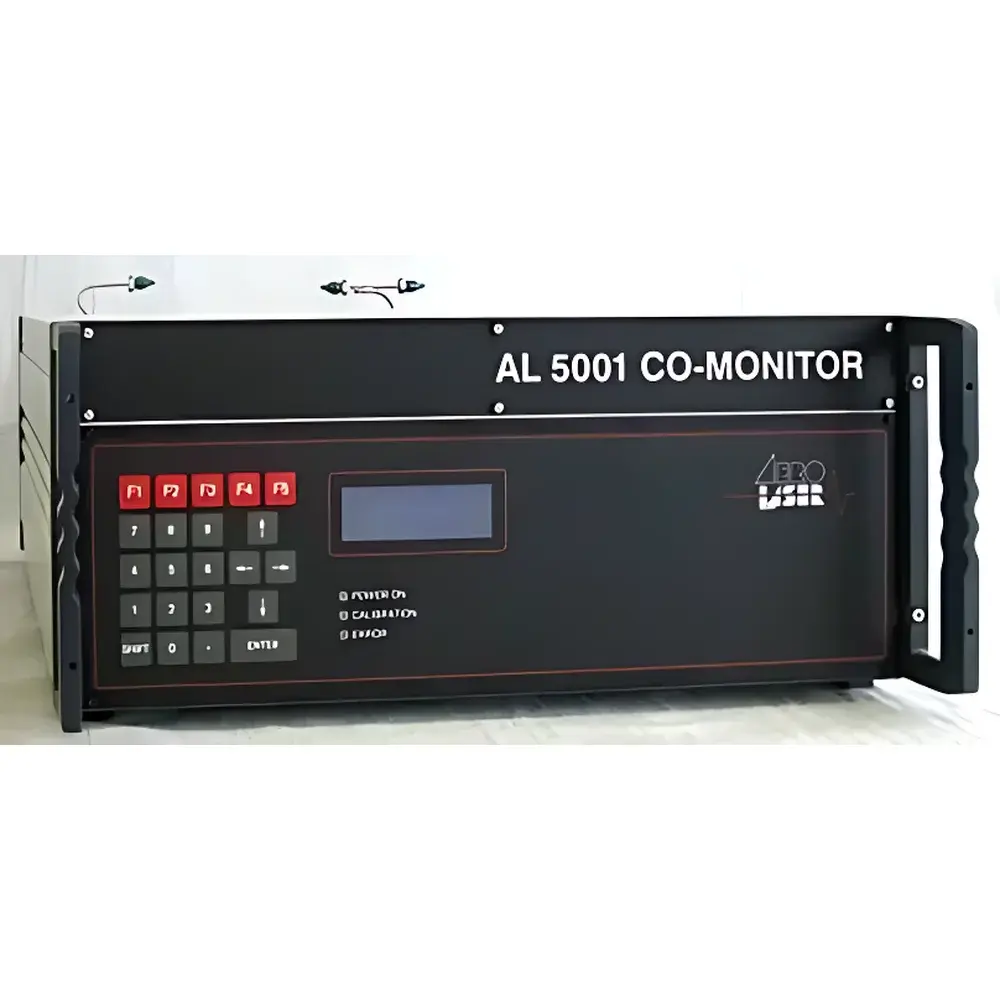
Aero Laser AL5001 Fast Carbon Monoxide Analyzer
| Brand | Aero Laser |
|---|---|
| Origin | Germany |
| Model | AL5001 |
| Detection Principle | Vacuum Ultraviolet Fluorescence (VUV) at 150 nm |
| Detection Limit | <2.0 ppb (1 s integration), <0.8 ppb (10 s integration) |
| Response Time (10–90%) | 2 s |
| Linear Range | 0–100 ppm (pulse counting mode) |
| Pump Type | Diaphragm vacuum pump |
| Interface | RS232 |
| Power Supply | 110/220 VAC or 24 VDC |
| Weight | 22 kg |
| Automation | Fully automated measurement and calibration |
Overview
The Aero Laser AL5001 Fast Carbon Monoxide Analyzer is a high-performance, laboratory- and field-deployable instrument engineered for trace-level CO quantification in ambient air, stack emissions, and controlled environmental chambers. It employs vacuum ultraviolet (VUV) fluorescence detection—a highly selective and interference-resistant optical method—where CO molecules are excited by monochromatic 150 nm radiation in a low-pressure reaction cell, emitting characteristic fluorescence proportional to concentration. Unlike electrochemical or metal oxide semiconductor sensors, the VUV fluorescence technique eliminates cross-sensitivity to common interferents such as CO₂, CH₄, H₂O vapor, and NOₓ, ensuring metrological integrity in complex gas matrices. The AL5001 is designed for continuous, unattended operation under ISO 16000-22 and EPA Method TO-11A compliant monitoring protocols, supporting regulatory-grade data acquisition for urban air quality networks, industrial emission compliance, and indoor air quality (IAQ) research.
Key Features
- Vacuum ultraviolet fluorescence detection at 150 nm, delivering exceptional selectivity for CO without chemical scrubbing or catalytic conversion
- Sub-part-per-trillion detection capability: <2.0 ppb LOD (1-second integration), <0.8 ppb LOD (10-second integration), validated per ISO 11843-1 for limit of detection estimation
- Real-time response kinetics: 2-second rise/fall time (10–90%), enabling dynamic process monitoring and transient emission profiling
- Fully automated zero/span calibration using external certified gas standards; full calibration cycle completed in under 3 minutes
- Integrated diaphragm vacuum pump ensures stable sample flow and pressure control across variable inlet conditions (5–50 L/min)
- Dual power compatibility: operates on universal 110/220 VAC or ruggedized 24 VDC for mobile or off-grid deployment
- RS232 serial interface for direct integration with SCADA systems, data loggers, or centralized environmental monitoring platforms
Sample Compatibility & Compliance
The AL5001 accepts gaseous samples at ambient temperature and pressure, with optional heated sampling lines (up to 180 °C) available for high-humidity or condensable-laden streams. It meets EN 14625:2012 requirements for automatic CO analyzers used in ambient air quality monitoring networks. Its design supports GLP-compliant operation through audit-trail-enabled calibration logs, timestamped raw pulse-count data storage, and user-accessible firmware revision tracking. When deployed in regulated environments—including EPA Title V facilities or EU IED installations—the instrument’s calibration traceability to NIST-certified CO standards satisfies 40 CFR Part 60 and EN 15267-3 certification prerequisites. No internal consumables (e.g., scrubbers, filters, or lamps requiring frequent replacement) are required, minimizing lifecycle maintenance overhead.
Software & Data Management
The analyzer includes embedded firmware with configurable data output modes (ASCII via RS232) supporting both real-time streaming and buffered storage. Raw pulse counts, integrated concentration values (ppb/ppm), system status flags (flow, pressure, lamp intensity), and calibration timestamps are logged at user-defined intervals (1 s to 1 h). Optional PC-based software provides visualization, statistical trending (e.g., hourly maxima, rolling 8-h averages), and export to CSV or XML formats compatible with EPA AQS, EEA AirBase, and ISO 14001 EMS reporting frameworks. All calibration events are digitally signed and archived with operator ID, standard gas lot number, and uncertainty budget metadata—meeting FDA 21 CFR Part 11 electronic record requirements when configured with user authentication and audit trail activation.
Applications
- Ambient air quality monitoring stations (urban, rural, traffic-influenced sites) per EU Directive 2008/50/EC
- Continuous emission monitoring systems (CEMS) for combustion sources including waste incinerators, cement kilns, and cogeneration plants
- Indoor air quality assessment in laboratories, cleanrooms, and transportation hubs where CO exposure thresholds must be verified against ASHRAE Standard 62.1
- Vehicle exhaust testing and engine development labs requiring fast-response CO dynamics during transient driving cycles (e.g., WLTC, FTP-75)
- Atmospheric chemistry research, including boundary layer studies and CO flux measurements via eddy covariance setups
- Calibration reference transfer for secondary CO monitors in national metrology institutes and accredited test laboratories
FAQ
What is the recommended calibration frequency for regulatory compliance?
For ambient air networks operating under EU or U.S. EPA guidelines, bi-weekly span checks and monthly full zero/span calibrations are advised; the AL5001’s automated protocol supports this schedule with minimal operator intervention.
Can the AL5001 operate in high-humidity environments without signal drift?
Yes—the VUV fluorescence cell is maintained under stable vacuum, and optional Nafion™ dryer integration or heated sample line prevents condensation-induced quenching or photolytic interference.
Is firmware upgradable in the field?
Yes—firmware updates are delivered via RS232 using signed binary packages; version history and update timestamps are retained in non-volatile memory for audit purposes.
Does the instrument support remote diagnostics?
Through optional Ethernet-to-RS232 gateways and Modbus RTU mapping, system health parameters (lamp voltage, detector gain, vacuum level) can be polled remotely for predictive maintenance planning.
How is measurement uncertainty quantified and reported?
Uncertainty budgets follow GUM (JCGM 100:2008) methodology and include contributions from calibration gas uncertainty, counting statistics, pressure/temperature stabilization, and detector linearity—fully documented in the optional Certificate of Conformance.
Related Products







