
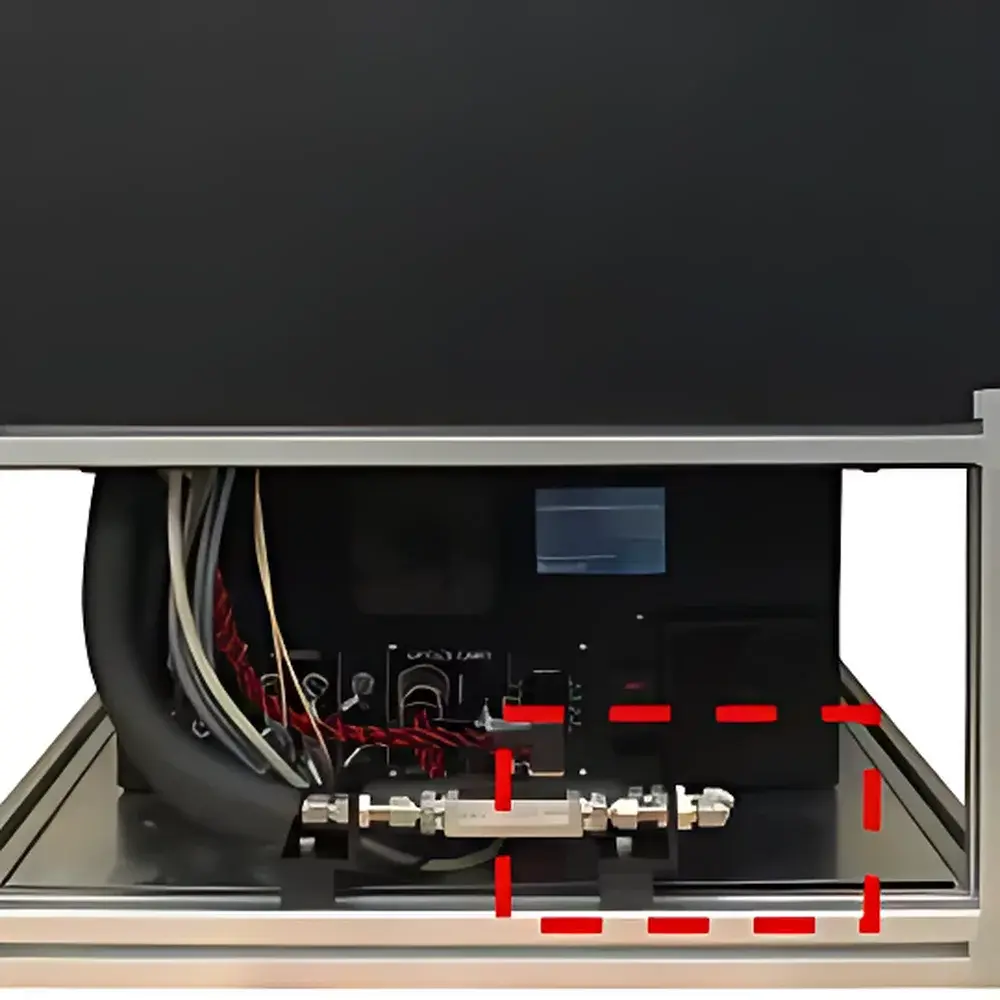
Aerodyne N2O Isotope Ratio Monitoring System
| Brand | Aerodyne |
|---|---|
| Origin | USA |
| Model | Aerodyne N2O |
| Instrument Type | Stable Gas Isotope Ratio Mass Spectrometer (IRMS) Equivalent |
| Detection Principle | Tunable Infrared Laser Direct Absorption Spectroscopy (TILDAS) |
| Measurement Targets | N₂O, δ¹⁵Nα (¹⁵N¹⁴N¹⁶O), δ¹⁵Nβ (¹⁴N¹⁵N¹⁶O), δ¹⁸O (N₂O) |
| Detection Limit | <1 ppt (v/v) for N₂O |
| Temporal Resolution | 1–10 Hz (configurable) |
| Path Length Options | 76 m or 400 m multipass cell |
| Precision (100 s) | δ¹⁵Nα ≤ 0.08‰, δ¹⁵Nβ ≤ 0.5‰, δ¹⁸O ≤ 0.5‰ |
| Operating Temperature Range | 10–35 °C (ambient) |
| with thermostatic enclosure | −20 to +40 °C |
| Temperature Stability | ±0.1 °C at setpoint (typically 30 °C) |
| Power Requirement | 500 W, 120/240 VAC, 50/60 Hz (pump excluded) |
| Dimensions (76 m) | 650 × 430 × 270 mm (W×D×H) |
| Weight | 35 kg |
| Dimensions (400 m) | 560 × 770 × 640 mm |
| Weight | 75 kg |
| Sampling Flow Rate | 0–20 slpm |
| Data Interfaces | RS-232, USB, Ethernet |
| Time Synchronization | GPS-enabled NTP server support |
Overview
The Aerodyne N2O Isotope Ratio Monitoring System is a high-precision, field-deployable gas analyzer engineered for continuous, real-time quantification and isotopic characterization of nitrous oxide (N₂O) in ambient air, soil flux chambers, eddy covariance towers, and industrial emission streams. Unlike traditional isotope ratio mass spectrometry (IRMS), this system employs Tunable Infrared Laser Direct Absorption Spectroscopy (TILDAS) in the mid-infrared spectral region (2100–2300 cm⁻¹), where N₂O exhibits strong, molecule-specific rovibrational transitions. By probing the fundamental ν₁ + ν₃ asymmetric stretch band, the instrument resolves isotopologues—including ¹⁴N¹⁴N¹⁶O, ¹⁵N¹⁴N¹⁶O (δ¹⁵Nα), ¹⁴N¹⁵N¹⁶O (δ¹⁵Nβ), and ¹⁴N¹⁴N¹⁸O (δ¹⁸O)—with quantum-limited sensitivity and minimal spectral interference. The absence of sample pre-concentration, cryogenic trapping, or chemical conversion eliminates memory effects and calibration drift, enabling unattended operation over multi-week deployments while maintaining metrological traceability to international isotope reference materials (e.g., USGS32, IAEA-N3).
Key Features
- Mid-infrared TILDAS architecture delivering sub-ppt detection limits (≤0.01 ppb N₂O at 100 s integration) and isotopic precision of ≤0.08‰ (δ¹⁵Nα), ≤0.5‰ (δ¹⁵Nβ), and ≤0.5‰ (δ¹⁸O) under field-relevant conditions.
- Two optical path configurations: a compact 76 m multipass cell for mobile platforms and a high-sensitivity 400 m cavity optimized for low-flux environments such as background atmospheric monitoring or chamber-based biogeochemical studies.
- Optimized optical depth control (0.1–1.0) ensures linear Beer–Lambert response while maximizing signal-to-noise ratio—critical for accurate isotopic ratio derivation without nonlinear fitting artifacts.
- Integrated thermostatic enclosure maintains internal temperature stability within ±0.1 °C at user-defined setpoints (standard: 30 °C), decoupling measurement performance from ambient fluctuations across −20 to +40 °C operational range.
- Real-time spectral acquisition and processing via TDLWintel software: each laser scan acquires full absorption line profiles plus adjacent baseline regions, with zero-current reset between scans to eliminate photodetector offset drift and enable absolute concentration retrieval.
- GPS-synchronized time stamping compliant with FLUXNET and ICOS metadata standards; supports NTP server configuration for network-wide temporal alignment in distributed sensor arrays.
Sample Compatibility & Compliance
The system accepts dry or humidified gas streams (5–95% RH) without condensation, accommodating raw ambient air, soil effluent, stack emissions, and laboratory-generated standards. It operates continuously at flow rates from 0 to 20 slpm, compatible with standard stainless-steel or PFA sampling lines and integrated particulate filters (0.2 µm). All hardware and firmware comply with CE marking requirements for electromagnetic compatibility (EMC Directive 2014/30/EU) and low-voltage safety (LVD Directive 2014/35/EU). Data handling workflows support audit-trail generation per FDA 21 CFR Part 11 when configured with secure user authentication and electronic signature modules. While not a certified IRMS, its isotopic accuracy has been validated against dual-inlet IRMS intercomparisons per ISO 17025-accredited protocols (e.g., EA-IRMS at MPI-BGC Jena), demonstrating agreement within ±0.3‰ for δ¹⁵N and ±0.4‰ for δ¹⁸O across multiple interlaboratory exercises.
Software & Data Management
TDLWintel serves as the unified control and analysis platform, providing both instrument orchestration and on-the-fly isotopic computation. It implements least-squares spectral fitting using Voigt line shapes convolved with instrumental line shape functions, correcting for pressure-broadening and temperature-dependent line intensities in real time. Raw spectra, calibrated concentrations, and δ-values are logged in HDF5 format with embedded metadata (GPS time, temperature, pressure, flow rate, laser current/voltage). Export options include CSV, NetCDF, and direct streaming via TCP/IP to third-party data loggers or cloud ingestion pipelines (e.g., InfluxDB, TimescaleDB). Remote diagnostics, firmware updates, and parameter reconfiguration are supported over encrypted SSH or TLS-enabled web interface. Optional Python API enables integration into custom flux inversion models or machine learning–based source attribution frameworks.
Applications
- Atmospheric science: Long-term monitoring of N₂O isotopic signatures at global baseline stations (e.g., NOAA GML, AGAGE network) to constrain stratospheric loss pathways and anthropogenic vs. natural source partitioning.
- Soil biogeochemistry: High-temporal-resolution δ¹⁵N–δ¹⁸O mapping in incubation experiments and field chambers to distinguish nitrification, denitrification, and fungal nitrous oxide reductase activity.
- Agricultural emissions: Real-time isotopic profiling of fertilizer-amended soils and manure management systems to evaluate mitigation efficacy and validate process-based models (e.g., DNDC, DayCent).
- Industrial compliance: Continuous stack monitoring for regulatory reporting under EPA GHG Reporting Program (Subpart A and Subpart O) and EU ETS, supporting isotopic fingerprinting for emission source verification.
- Climate modeling: Provision of observationally constrained isotopic constraints for inverse modeling of N₂O budgets in Earth system models (e.g., CESM, ICON-ART).
FAQ
Does this system require calibration gases or reference standards during routine operation?
No. TILDAS is an absolute spectroscopic technique: concentration and isotopic ratios are derived directly from fundamental physical constants (line strength, partition function, speed of light) and measured spectral parameters. Periodic validation with certified isotopic standards (e.g., USGS32) is recommended every 6–12 months for quality assurance, but daily calibration is unnecessary.
Can the 76 m and 400 m configurations be interchanged in the field?
No. The multipass cell is permanently integrated into the optical bench and sealed under vacuum. Selection between path lengths must be made at time of order. However, both versions share identical electronics, software, and mechanical interfaces, simplifying fleet-wide maintenance and training.
Is the system compatible with existing eddy covariance data acquisition systems?
Yes. Analog voltage outputs (0–10 V) and digital RS-232/USB/Ethernet interfaces allow seamless synchronization with Campbell Scientific CR-series loggers, LI-COR EC systems, and Picarro data concentrators via TTL triggers or NTP time alignment.
What maintenance is required beyond routine filter replacement?
Annual inspection of laser diode output power and detector responsivity is advised. No consumables (e.g., filaments, ion sources, or chromatographic columns) are used. The solid-state design eliminates moving parts except for optional internal sample pump (not included), reducing mean time between failures to >15,000 hours.




