
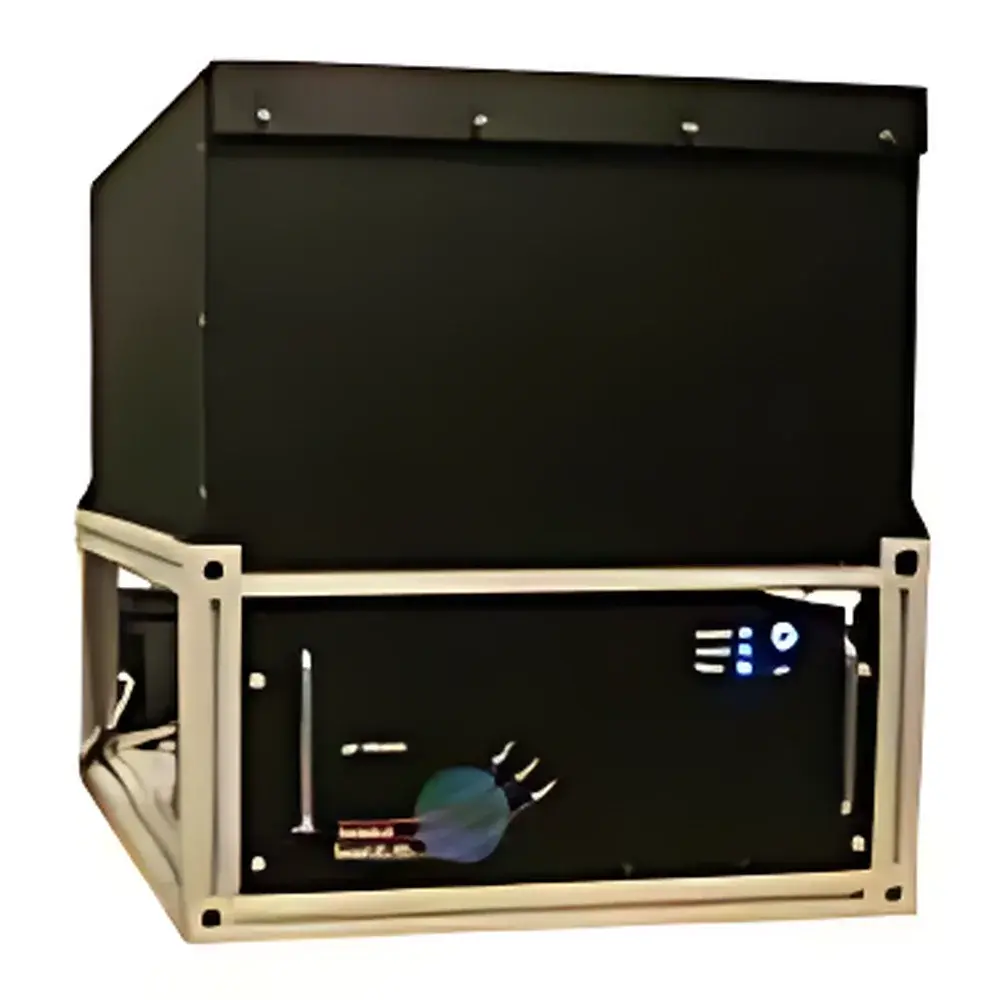
Aerodyne TILDAS Underground Trace Gas Isotope Monitoring System
| Brand | Aerodyne |
|---|---|
| Origin | USA |
| Manufacturer Type | Authorized Distributor |
| Product Type | Online Analytical System |
| Measurement Principle | Tunable Infrared Laser Direct Absorption Spectroscopy (TILDAS) |
| Response Time | 1 s (10 Hz acquisition rate) |
| Repeatability | ±0.2‰ for δ¹³C(CH₄), ±1.5‰ for δ¹⁴N¹⁵N¹⁶O, ±0.03 ppb for N₂O (100 s avg), ±0.05 ppb for CH₄ (100 s avg), ±0.03 ppm for CO₂ (100 s avg), ±0.03‰ for δ¹⁸O(CO₂), ±0.03‰ for δ¹⁸O(H₂O), ±0.1‰ for δHDO (100 s avg) |
| Measured Species & Isotopologues | CH₄, δ¹³C(CH₄), N₂O, δ¹⁵N¹⁴N¹⁶O, δ¹⁴N¹⁵N¹⁶O, δ¹⁴N¹⁴N¹⁸O, CO₂, δ¹³C(CO₂), δ¹⁸O(CO₂), H₂O, δ¹⁸O(H₂O), δHDO |
Overview
The Aerodyne TILDAS Underground Trace Gas Isotope Monitoring System is a field-deployable, online analytical platform engineered for high-temporal-resolution (up to 10 Hz), high-precision (<0.1‰ isotopic precision, sub-ppt concentration detection limits) measurement of stable isotope ratios and trace gas concentrations directly within the soil matrix. It integrates diffusion-based soil gas probes with a cryogenically cooled, mid-infrared tunable laser direct absorption spectrometer (TILDAS) featuring an astigmatic multi-pass absorption cell delivering an effective optical pathlength of up to 210 m. This architecture enables quantitative, calibration-free detection of multiple isotopologues—including position-specific isotopic signatures such as site preference in N₂O—based on fundamental rovibrational absorption cross-sections referenced to HITRAN spectral databases. The system operates on the principle of quantum-cascade laser (QCL)-based direct absorption spectroscopy, eliminating reliance on empirical calibrations or reference gases during routine operation. Its design targets biogeochemical process studies where centimeter-scale spatial resolution and minute-scale temporal dynamics are essential: e.g., tracking microbial metabolic shifts (nitrification, denitrification, methanogenesis, methane oxidation) in response to transient environmental drivers including soil moisture pulses, redox transitions, and freeze-thaw cycles.
Key Features
- Calibration-free, absolute quantification: Each measurement cycle includes a zero-spectrum acquisition with lasers off, enabling background-subtracted, non-differential absorption analysis—eliminating drift-induced bias inherent in cavity-enhanced methods.
- Dual-laser, multi-species capability: Simultaneous detection of ≥6 isotopologues across CH₄, N₂O, CO₂, and H₂O in a single instrument, minimizing inter-system variability and enabling cross-isotope correlation analysis without temporal misalignment.
- Spectral replay & re-fitting functionality (TDLWINTEL software): Raw interferometric spectra are permanently archived; users may retrospectively re-fit against HITRAN line lists to validate spectral purity, identify interfering contaminants (e.g., impure calibration standards), or refine isotopic ratio calculations under updated spectroscopic parameters.
- Active surface passivation: Patented inlet conditioning reduces adsorption/desorption hysteresis for polar and sticky molecules (e.g., NH₃, HNO₃, HONO), enabling co-quantification of reactive nitrogen species alongside non-reactive gases (CH₄, CO₂, N₂O) with consistent response times.
- Inertial particle removal interface: Designed specifically for long-term soil probe deployments, this stage removes particulate residue from humid, colloidal-rich soil gas streams without altering gas-phase composition or introducing memory effects.
- On-the-fly laser frequency stabilization: Integrated reference cavity continuously monitors and corrects QCL emission frequency drift in real time, ensuring long-term spectral fidelity critical for isotopic ratio stability over weeks-long unattended operation.
- Zero-gas purging protocol: High-purity nitrogen (99.9992%) is periodically introduced into the absorption cell to acquire background spectra, enabling dynamic correction for optical window fouling or detector baseline drift.
Sample Compatibility & Compliance
The system accommodates two classes of diffusion-based soil gas probes: (i) standard stainless-steel probes (32 mm Ø × 500 mm L; 500 cm² exchange area; 10 µm pore size) for mineral soils, and (ii) miniaturized hydrophobic probes (12 mm Ø × 150 mm L; 50 cm² exchange area; 0.1 µm pore size) rated for saturated, organic-rich wetland profiles. Both maintain thermodynamic equilibrium with ambient soil gas while minimizing disturbance to in situ concentration gradients. All wetted surfaces employ SilcoNert®-treated stainless steel to prevent catalytic decomposition or isotopic fractionation during transport. The entire system complies with GLP data integrity requirements: raw spectral data, instrument metadata (laser current/temperature, pressure, flow rate), and user-defined processing parameters are timestamped and stored in immutable binary format. Optional 21 CFR Part 11-compliant audit trail and electronic signature modules are available for regulated environmental monitoring applications.
Software & Data Management
TDLWINTEL v5.x provides full control of laser tuning, spectral acquisition, real-time fitting, and automated report generation. It supports concurrent streaming of concentration and isotopic ratio outputs via RS232, USB, and Ethernet (TCP/IP). Spectral archives are stored in HDF5 format with embedded provenance metadata (instrument ID, probe depth, soil temperature, barometric pressure). Batch reprocessing workflows allow application of updated spectroscopic parameters (e.g., new HITRAN editions) across entire datasets. Export options include CSV, NetCDF, and MATLAB-compatible structures. Remote diagnostics and firmware updates are supported via secure SSH tunneling. Data synchronization with cloud-based environmental observatory platforms (e.g., NEON, ICOS) is enabled through configurable REST API hooks.
Applications
- Quantifying microbial N-cycle partitioning via N₂O isotopocule mapping (δ¹⁵Nα, δ¹⁵Nβ, δ¹⁸O, site preference) to distinguish nitrifier-denitrification from fungal denitrification or codenitrification.
- Resolving CH₄ production vs. oxidation dominance using δ¹³C(CH₄) and C₂H₆/CH₄ ratios at cm-scale depth intervals during rewetting events.
- Tracking soil CO₂ respiration sources (root vs. heterotrophic) via δ¹³C(CO₂)–δ¹⁸O(CO₂) dual-isotope constraints coupled with δHDO(H₂O) to constrain evaporation effects.
- Validating ecosystem models by providing continuous, in situ constraints on isotopic fractionation factors under natural environmental variability—not laboratory-controlled conditions.
- Supporting ISO 14064-2 project-level GHG inventory verification through direct, process-resolved flux attribution rather than chamber-based extrapolation.
FAQ
How does TILDAS achieve calibration-free isotopic measurements?
By acquiring absolute absorption spectra with lasers off (zero spectrum) and applying Voigt-line fitting against first-principles HITRAN cross-sections, eliminating reliance on empirical transfer functions or repeated standard injections.
Can the system measure position-specific isotopes like N-site preference in N₂O?
Yes—its high spectral resolution (0.0005 cm⁻¹) and signal-to-noise ratio enable resolved detection of ¹⁴N¹⁵N¹⁶O, ¹⁵N¹⁴N¹⁶O, and ¹⁴N¹⁴N¹⁸O isotopologues, permitting calculation of intramolecular ¹⁵N distribution.
What is the minimum detectable change in δ¹³C(CH₄) at 1-second integration?
The 1σ repeatability is 1‰ at 1 s and improves to 0.2‰ at 100 s averaging—sufficient to resolve diel microbial activity shifts in well-aerated soils.
Is the system suitable for deployment in remote, unstaffed field sites?
Yes—field-rated enclosures maintain analyzer temperature stability (±0.1°C) across −20°C to +45°C ambient; solar/battery power management and cellular telemetry are integrated options.
How is spectral interference from water vapor mitigated during δ¹⁸O(H₂O) and δHDO analysis?
The software applies constrained multi-line fitting using H₂¹⁶O, H₂¹⁸O, and HD¹⁶O line lists simultaneously, with pressure-broadening coefficients optimized for soil gas matrix conditions (N₂/O₂-dominated, variable H₂O).
Related Products







