
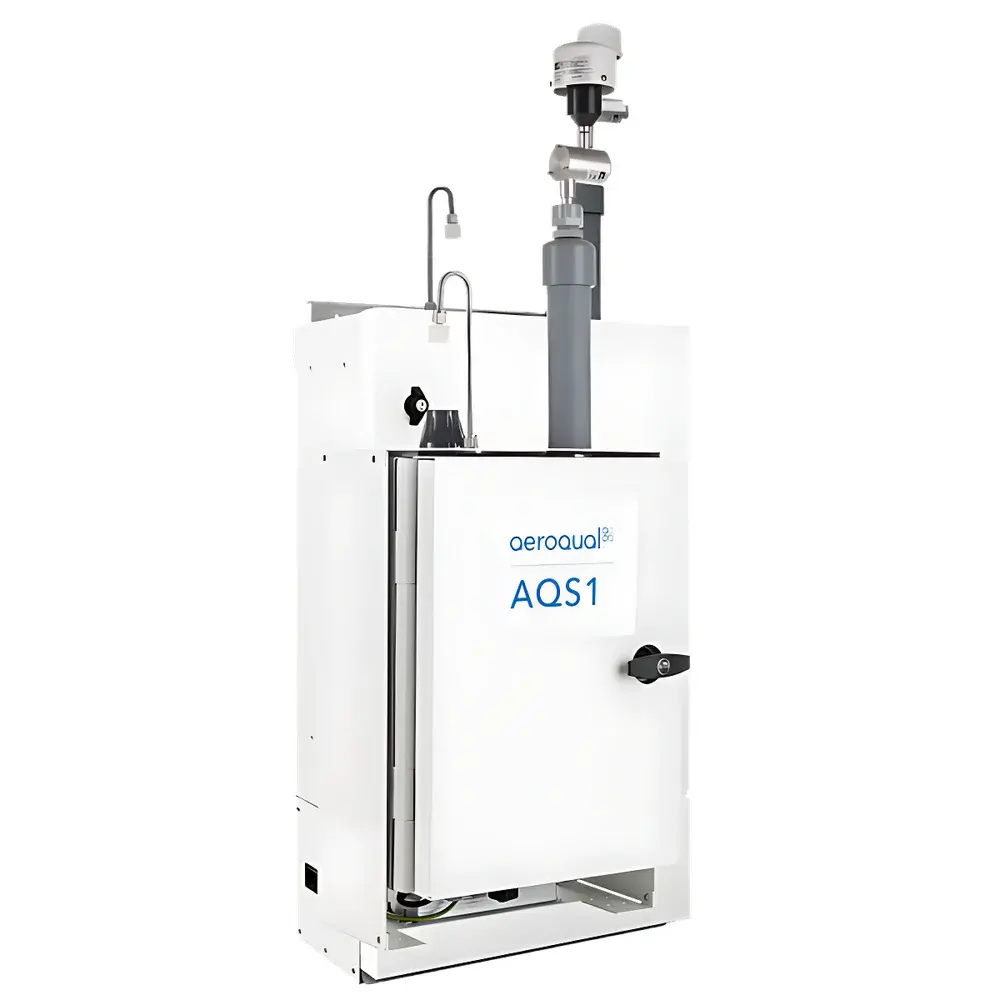
Aeroqual AQS 1 Automatic Air Quality Monitoring System
| Brand | Aeroqual |
|---|---|
| Origin | New Zealand |
| Model | AQS 1 |
| Particle Detection | PM₁, PM₂.₅, PM₁₀, TSP (via turbidimetric & optical counting) |
| Gaseous Pollutants | O₃, NO₂, CO, SO₂, NOₓ, H₂S, CO₂, VOC (ppb–ppm range), CH₄ |
| Detection Principle | Nephelometric turbidity (670 nm laser with sheath air), electrochemical (gases), and metal oxide semiconductor (VOC/CH₄) |
| Data Logging | Up to 32 GB internal storage (>5 years at 1-min intervals) |
| Environmental Rating | IP65 |
| Operating Temperature | −35 °C to +50 °C |
| Power Supply | 100–260 VAC (31.3 W typical) or 12 VDC (34.3 W, optional) |
| Dimensions | 483 × 330 × 187 mm (H×W×D) |
| Weight | <13 kg |
Overview
The Aeroqual AQS 1 is a compact, field-deployable automatic air quality monitoring system engineered for high-reliability, long-term ambient air surveillance in diverse environmental and urban settings. Designed to complement reference-grade monitoring networks—such as national regulatory stations and WHO-aligned air quality assessment frameworks—the AQS 1 implements dual-mode particulate measurement (nephelometric turbidity and optical particle counting) alongside multi-gas electrochemical and semiconductor sensing. Its core measurement architecture adheres to internationally recognized principles: 670 nm laser-based near-forward light scattering with integrated sheath air flow ensures stable aerosol signal integrity; electrochemical gas sensors operate under diffusion-limited kinetics calibrated against traceable standards; and temperature-controlled sensor housing maintains metrological stability across extreme climatic conditions (−35 °C to +50 °C). Unlike portable spot-check devices, the AQS 1 functions as a networked node within scalable, cloud-integrated environmental observatories—delivering continuous, time-synchronized data streams compliant with foundational requirements for trend analysis, exposure modeling, and early-warning response.
Key Features
- Modular sensor architecture enabling on-site replacement of individual gas or particulate modules without system downtime—fully compatible with Aeroqual’s certified calibration protocols.
- Integrated thermal management system maintaining sensor operating temperature within ±1 °C tolerance, critical for minimizing zero drift and ensuring reproducibility in sub-zero or high-heat deployments.
- IP65-rated GRP enclosure with integrated aluminum solar radiation shield—engineered for unattended outdoor operation with resistance to UV degradation, corrosion, and mechanical impact.
- Onboard embedded Linux controller supporting configurable averaging intervals (1 min to 24 hr), local data buffering (32 GB SSD), and dual communication paths: standard Ethernet/Wi-Fi plus optional 3G/LTE cellular failover.
- Factory-aligned calibration traceability to national reference laboratories; supports both manual field calibration using certified span gases and optional automated remote calibration via Aeroqual Cloud.
- Heated, omnidirectional PM inlet (36 cm height) with selectable sharp-cut cyclones for PM₁₀, PM₂.₅, or PM₁ fractionation—designed to meet ISO 29463 and EN 12341 sampling geometry recommendations.
Sample Compatibility & Compliance
The AQS 1 is validated for continuous ambient air sampling in accordance with methodological conventions referenced in ISO 12039 (gaseous pollutants), ISO 20988 (particulate matter), and US EPA EQOA-1 guidance for non-reference monitoring systems. While not classified as a Federal Equivalent Method (FEM) device, its performance specifications—including stated accuracy, detection limits, and 24-hour zero drift—are benchmarked against WHO Air Quality Guidelines and EU Directive 2008/50/EC indicative limit values. Sensor modules undergo batch-level verification per IEC 60751 and ASTM D6284-20 for electrochemical gas detectors. The system meets electromagnetic compatibility (EMC) requirements per IEC 61000-6-2/-4 and carries CE marking under the EU RoHS and EMC directives. Data integrity safeguards include timestamped audit logs, cryptographic hash validation of firmware updates, and configurable write-protection for raw sensor records.
Software & Data Management
Aeroqual Cloud serves as the primary SaaS platform for remote configuration, diagnostics, and data visualization. It provides role-based access control, real-time alerting (SMS/email/webhook) based on user-defined thresholds, and automated QA/QC flagging for out-of-spec readings (e.g., humidity-induced cross-sensitivity, pump flow deviation >±5%). Raw sensor outputs are stored with full metadata—including GPS coordinates, firmware version, calibration history, and environmental context (temperature, RH, pressure when co-deployed with weather sensors). Export formats include CSV, JSON, and NetCDF; API endpoints support integration with GIS platforms (ArcGIS, QGIS), statistical environments (R, Python Pandas), and enterprise data lakes. All data transfers comply with TLS 1.2+ encryption, and audit trails meet GLP-aligned record retention requirements for research-grade environmental epidemiology studies.
Applications
- Urban air quality networks: High-density deployment along traffic corridors, school zones, hospital perimeters, and residential neighborhoods to map micro-scale pollution gradients.
- Industrial fence-line monitoring: Continuous surveillance of SO₂, H₂S, VOCs, and PM near petrochemical facilities, power generation sites, landfills, and mining operations—supporting regulatory reporting and community engagement initiatives.
- Mobile monitoring campaigns: Vehicle-mounted installations for transient hotspot identification, construction site emissions tracking, and post-event air quality assessment (e.g., wildfire smoke dispersion).
- Short-term epidemiological studies: Time-resolved exposure assessment for cohort health investigations, particularly where spatial resolution exceeds that of sparse regulatory station networks.
- Smart city infrastructure: Integration with municipal IoT platforms for dynamic traffic management, public health advisories, and adaptive ventilation control in transit hubs and underground stations.
FAQ
Is the AQS 1 certified as a reference or equivalent method under US EPA or EU regulations?
No—the AQS 1 is classified as a performance-verified indicative monitor. It is not designated as a Federal Reference Method (FRM) or Federal Equivalent Method (FEM) by the US EPA, nor as an approved reference or indicative method under EU Directive 2008/50/EC. Its design targets “near-reference” comparability for trend analysis and screening applications.
Can the AQS 1 be deployed in arctic or desert environments?
Yes—the integrated thermal regulation system and IP65-rated enclosure enable reliable operation from −35 °C to +50 °C. Field validation includes multi-year deployments in northern Scandinavia and central Australia.
How frequently must the system be calibrated?
Aeroqual recommends zero/span calibration every 3–6 months depending on ambient conditions and regulatory requirements. Remote auto-calibration modules reduce onsite maintenance frequency by up to 70% compared to manual procedures.
Does the system support third-party meteorological sensor integration?
Yes—standard RS-485 and analog (0–10 V / 4–20 mA) interfaces allow seamless connection to Vaisala WXT520, Gill WindSonic, Met One MSO, Cirrus MK427, and other industry-standard environmental sensors.
What data security measures are implemented in Aeroqual Cloud?
All data transmissions use TLS 1.2+ encryption; user authentication employs OAuth 2.0; raw datasets are immutable once ingested; and audit logs record all configuration changes, login attempts, and export actions—supporting compliance with ISO/IEC 27001-aligned information security policies.
Related Products







