
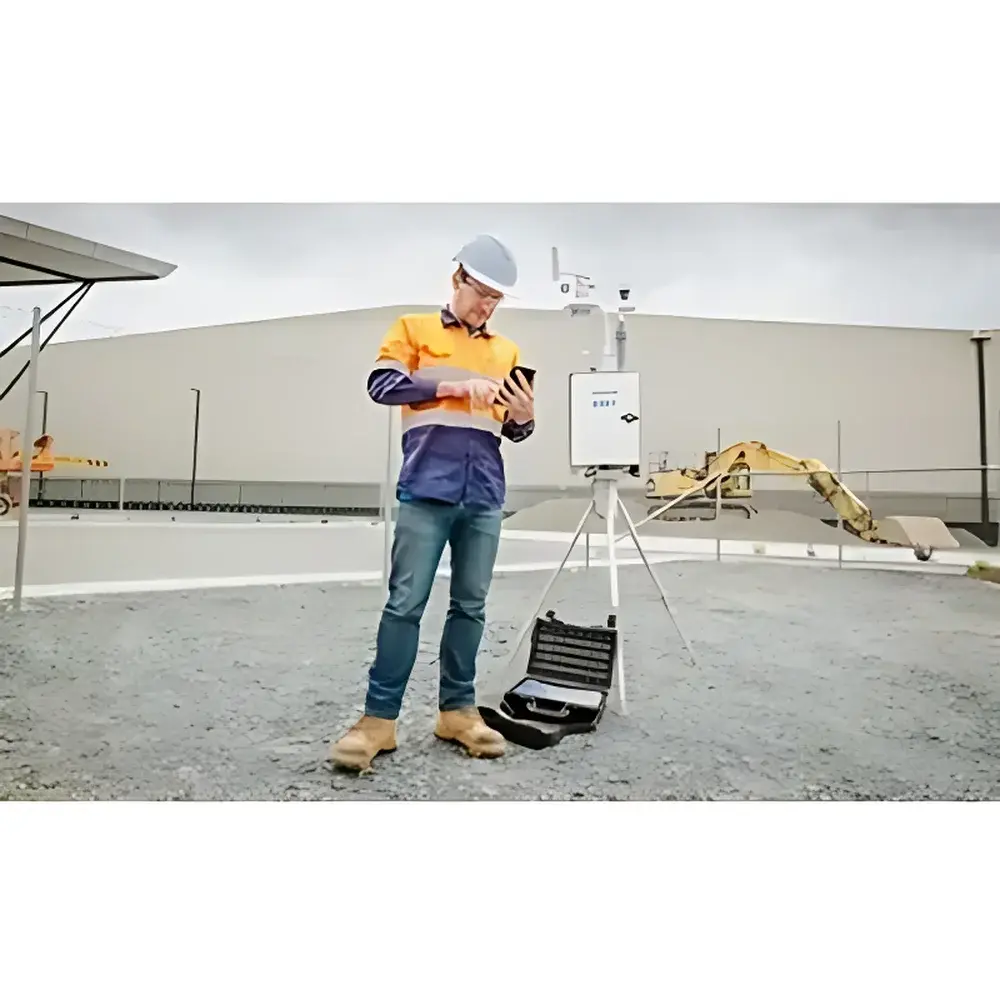
Aeroqual AQS1 Compact Air Quality Monitoring Station
| Brand | Aeroqual |
|---|---|
| Origin | New Zealand |
| Model | AQS1 |
| Particle Measurement | PM1, PM2.5, PM10, TSP |
| Gas Measurement | O₃ (0–0.5 ppm), NO₂ (0–0.5 ppm), VOCs (0–0.5 ppm) |
| Meteorological Inputs | Temperature, Relative Humidity, Barometric Pressure, Wind Speed & Direction, Solar Radiation, Rainfall |
| Noise Measurement | 30–100 dB(A) |
| Sampling Method | Pump-aspirated with heated inlet (PM), dual-stage active flow control |
| Detection Limits | PM <1 µg/m³ |
| Accuracy | PM ±(2 µg/m³ + 5% of reading) |
| Operating Temperature | −10 °C to +45 °C |
| Enclosure | IP65 fiberglass housing with aluminum solar radiation shield |
| Power | 100–260 VAC (31.3 W) or 12 VDC (34.3 W) |
| Data Storage | 32 GB SSD (≥5 years at 1-min interval) |
| Connectivity | Wi-Fi, Ethernet, optional 4G HSPA cellular modem |
| Software | Aeroqual Connect (on-device web interface), Aeroqual Cloud (secure encrypted cloud platform) |
| Compliance | Designed for alignment with ISO 12103-1 (aerosol calibration), EN 14625 (O₃ monitoring), EN 14626 (NO₂ monitoring), and US EPA EQOA requirements for near-reference-grade performance |
Overview
The Aeroqual AQS1 Compact Air Quality Monitoring Station is an integrated, field-deployable environmental measurement system engineered for high-fidelity, near-reference-grade monitoring of ambient air pollutants and meteorological parameters. Unlike low-cost sensor-based networks, the AQS1 employs proven optical scattering (for PM) and electrochemical (for O₃, NO₂) and photoionization (for VOCs) detection principles—each module calibrated traceably to international standards and validated against reference methods per ISO/IEC 17025-aligned procedures. Its architecture centers on dual independent sampling systems: a heated, pump-aspirated particle inlet (36 cm length, 2.0 L/min flow) minimizes hygroscopic bias and condensation artifacts, while gas modules operate under temperature- and pressure-compensated conditions to suppress cross-sensitivity from humidity and background gases. The embedded industrial controller—Intel Atom N2600 (1.6 GHz), 2 GB RAM, 32 GB SSD, running Ubuntu Linux—executes real-time signal processing, automatic baseline correction (ABC), and synchronized multi-parameter acquisition at user-defined intervals (1 minute to 24 hours). Designed for unattended operation in diverse outdoor settings—from urban street canyons to protected natural reserves—the AQS1 delivers metrologically defensible data suitable for regulatory reporting, model validation, and exposure assessment.
Key Features
- Modular, field-upgradable architecture supporting simultaneous measurement of particulate matter (PM₁, PM₂.₅, PM₁₀, TSP) and up to two gaseous pollutants (O₃, NO₂, or VOCs)
- Pump-aspirated, heated particle inlet with thermostatically controlled temperature stabilization to mitigate humidity-induced measurement drift
- Automatic Baseline Correction (ABC) algorithm continuously compensates for zero-point drift without manual intervention
- On-site traceable calibration capability via built-in span/zero gas ports—enabling audit-ready documentation compliant with GLP and ISO 17025 workflows
- IP65-rated fiberglass enclosure with integrated aluminum solar radiation shield and lockable access panel for secure long-term deployment
- Embedded Aeroqual Connect software accessible via any modern web browser (Chrome, Safari, Edge)—providing real-time diagnostics, configuration, firmware updates, and alarm management
- Secure, encrypted data transmission to Aeroqual Cloud with TLS 1.2+ encryption, role-based user access, and full audit trail for FDA 21 CFR Part 11–aligned environments
- Support for third-party meteorological sensors including Gill WindSonic (ultrasonic wind), Vaisala WXT536 (multi-parameter weather station), and Cirrus MK427 (Class 1 sound level meter)
- Low power consumption (≤34.3 W DC) enabling off-grid operation with solar/battery hybrid configurations
Sample Compatibility & Compliance
The AQS1 is validated for continuous ambient air sampling across diverse environmental regimes—including high-humidity subtropical zones, arid desert margins, and temperate coastal regions. Its particle measurement modules conform to ISO 12103-1 coarse test dust calibration protocols, while ozone and nitrogen dioxide channels meet EN 14625 and EN 14626 performance criteria for indicative monitoring. Though not certified as a Federal Equivalent Method (FEM) device under US EPA requirements, the AQS1’s documented accuracy, repeatability (<±2% RSD over 30 days), and inter-unit consistency support its use in non-regulatory but scientifically rigorous applications such as source apportionment studies, health exposure modeling, and air quality index (AQI) supplementation. All firmware and calibration logs are time-stamped, digitally signed, and retained locally and in the cloud—facilitating compliance with ISO 9001 quality management systems and GLP audit readiness.
Software & Data Management
Aeroqual Connect serves as the local edge interface, executing onboard data preprocessing—including temperature/pressure compensation, ABC-driven zero tracking, and outlier rejection based on statistical confidence thresholds. Raw and processed datasets are stored redundantly on the internal 32 GB SSD (supporting >5 years of 1-minute resolution data) and streamed asynchronously to Aeroqual Cloud via configurable protocols (HTTPS, FTP, SMTP). The cloud platform provides ISO 27001-certified infrastructure, granular permission controls, automated report generation (PDF/CSV), and API access for integration into GIS dashboards or enterprise EHS platforms. Optional features include SMS/email alerting triggered by user-defined threshold breaches, scheduled data exports, and version-controlled calibration certificate archiving—all meeting traceability requirements for ISO/IEC 17025 laboratories and environmental consultancies operating under contract to governmental agencies.
Applications
- Urban air quality surveillance: Real-time tracking of PM₂.₅ and O₃ as primary pollutants in metropolitan areas and transportation corridors
- Construction site emissions monitoring: Quantifying fugitive dust (TSP, PM₁₀) and NO₂ from diesel equipment in compliance with local permitting conditions
- Roadside and tunnel air quality assessment: High-temporal-resolution profiling of traffic-related pollutants under variable meteorological loading
- Natural ecosystem monitoring: Long-term baseline characterization in national parks, wetlands, and forested watersheds where traditional reference stations are logistically impractical
- Community exposure science: Deploying distributed sensor arrays to map intra-urban pollution gradients correlated with demographic and health outcome data
- Air dispersion model validation: Providing ground-truth input for CALPUFF, AERMOD, or CMAQ simulations requiring spatially dense, temporally resolved measurements
- Post-remediation verification: Continuous emission monitoring at brownfield sites during and after soil/vapor intrusion mitigation activities
FAQ
Is the AQS1 certified as a US EPA Federal Equivalent Method (FEM) device?
No. The AQS1 is designed for near-reference performance and scientific-grade monitoring but is not FEM-certified. It is appropriate for supplemental monitoring, research, and non-regulatory compliance applications.
Can additional gas modules be added after initial deployment?
Yes. The modular design supports hot-swappable sensor cartridges. New modules may be installed in the field without returning the unit to the factory.
What meteorological sensors are natively supported?
The AQS1 integrates seamlessly with Gill WindSonic (wind speed/direction), Vaisala WXT536 (temperature, humidity, pressure, rain, wind), Met One MSO series, and Cirrus MK427 (Class 1 noise) via standardized RS-485/SDI-12 interfaces.
How is data integrity ensured during network outages?
All measurements are buffered locally on the 32 GB SSD. Upon connection restoration, queued data is transmitted automatically with sequence-verified timestamps and cryptographic checksums.
Does the system support remote calibration verification?
Yes. Remote zero/span checks can be initiated via Aeroqual Connect, and calibration certificates—including gas standard traceability documentation—are archived in the cloud with immutable timestamps.
Related Products







