
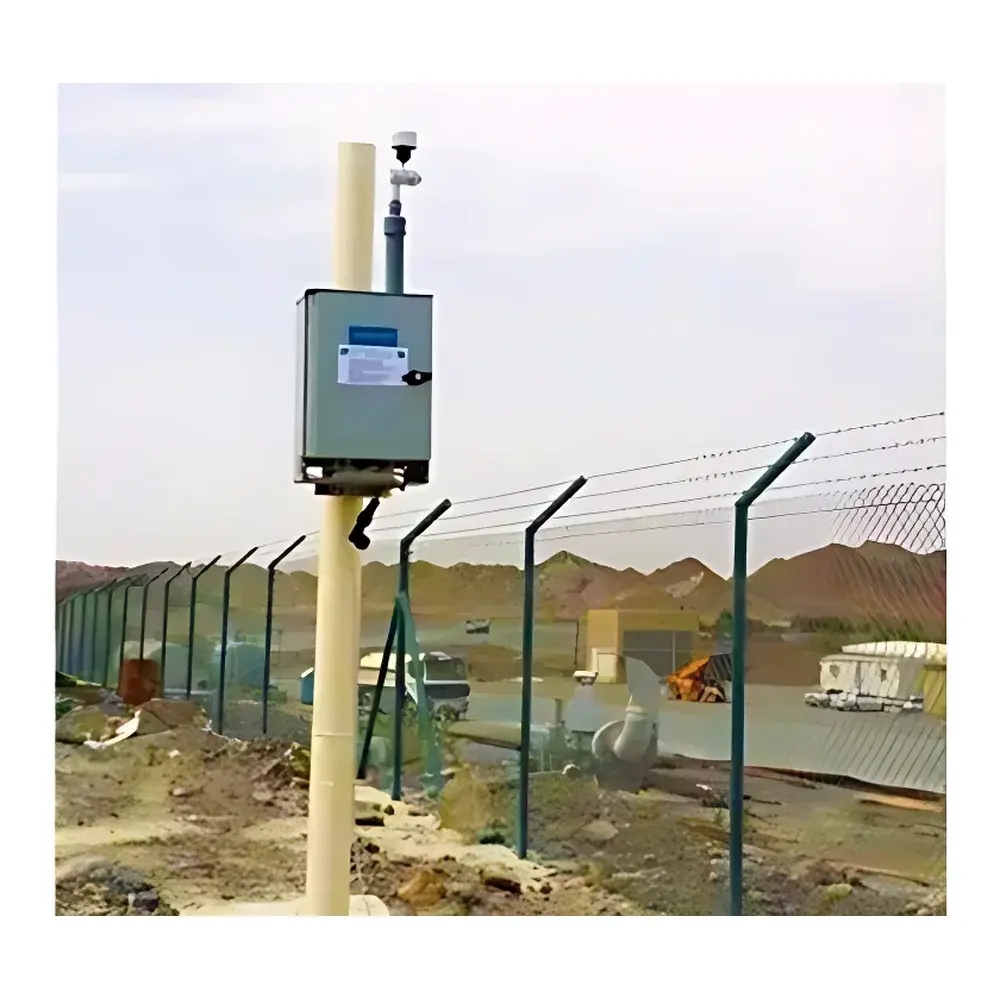
Aeroqual WS-APM02 Atmospheric Particulate Matter Monitoring Station
| Brand | Aeroqual |
|---|---|
| Origin | New Zealand |
| Model | WS-APM02 |
| Particle Measurement Principle | Optical Particle Counter (OPC) with Right-Angle Laser Scattering |
| Measured Fractions | TSP, PM₁₀, PM₂.₅, PM₁ |
| Mass Concentration Range | PM₁: 0–200 µg/m³, PM₂.₅: 0–2000 µg/m³, PM₁₀: 0–5000 µg/m³, TSP: 0–5000 µg/m³ |
| Detection Limit | <1 µg/m³ |
| Accuracy | ±(5 µg/m³ + 15% of reading) |
| Sample Flow Rate | 1.0 L/min |
| Inlet Length | 36 cm with integrated heating element |
| Output Interfaces | RS-232 (legacy mode), 4× 4–20 mA analog outputs, 2× relay outputs |
| Averaging Intervals | 1 min, 5 min, 10 min, 15 min, 30 min, 1 hr, 2 hr, 4 hr, 8 hr, 12 hr, 24 hr |
| Operating Temperature | −10°C to +50°C |
| Relative Humidity Range | 10–95% RH (non-condensing) |
| Enclosure Rating | IP65 |
| Housing Material | Lockable GRP cabinet with integrated solar radiation shield |
| Dimensions (H×W×D) | 483 × 330 × 187 mm (including radiation shield and mounting bracket) |
| Weight | <13 kg |
| Meteorological Parameters | Wind speed & direction, air temperature, relative humidity, barometric pressure, precipitation, global solar radiation, photosynthetically active radiation (PAR) |
| Power Options | 100–260 V AC (15 W / 24 W) or 12 V DC (15 W / 24 W) |
| Data Storage | High-capacity internal memory |
| Communication | Optional wireless telemetry module (e.g., LTE/4G, LoRaWAN) |
| Compliance | Designed for continuous ambient air quality monitoring in accordance with ISO 12103-1 (test dust), EPA EQOA-PM-01 guidance, and EU Directive 2008/50/EC Annex III technical requirements for PM monitoring |
Overview
The Aeroqual WS-APM02 Atmospheric Particulate Matter Monitoring Station is a field-deployable, multi-parameter environmental monitoring system engineered for high-temporal-resolution measurement of airborne particulate mass concentrations across four size fractions—TSP, PM₁₀, PM₂.₅, and PM₁—alongside comprehensive meteorological parameters. At its core resides the DUST PROFILER optical particle counter (OPC), which employs right-angle laser scattering to detect and size individual particles in real time. Unlike beta-attenuation or tapered element oscillating microbalance (TEOM) reference-grade instruments, the DUST PROFILER delivers rapid response (<1 s particle dwell time), low operational cost, and robust field performance without requiring consumables or frequent calibration drift correction. The system integrates a Campbell Scientific CR1000X datalogger, ensuring deterministic timing, deterministic data logging, and deterministic trigger-based sampling—critical for regulatory-grade data integrity and auditability. Its architecture supports both standalone deployment and scalable networked operation, making it suitable for national ambient air quality networks (NAAQNs), urban hotspot surveillance, industrial fence-line monitoring, and mobile source characterization.
Key Features
- Simultaneous real-time quantification of TSP, PM₁₀, PM₂.₅, and PM₁ mass concentrations using calibrated OPC technology
- Integrated meteorological suite: ultrasonic wind sensor (200-03002), capacitive humidity/temperature probe (SKH 2060), barometric pressure transducer (CS106), tipping-bucket rain gauge (7857), pyranometer (SKS1110), and PAR sensor
- Heated inlet assembly (36 cm length) mitigates hygroscopic growth artifacts and prevents dew/frost accumulation under high-humidity or sub-zero conditions
- IP65-rated GRP enclosure with built-in solar radiation shield ensures thermal stability and long-term outdoor reliability across −10°C to +50°C ambient ranges
- Configurable averaging intervals from 1 minute to 24 hours, enabling alignment with local regulatory reporting protocols (e.g., hourly averages per US EPA 40 CFR Part 58)
- Dual power flexibility: AC mains (100–260 V) or 12 V DC (solar-compatible), with optional battery backup and charge controller integration
- RS-232 serial interface plus four isolated 4–20 mA analog outputs and two programmable relays for SCADA integration or alarm triggering
Sample Compatibility & Compliance
The WS-APM02 is validated for ambient air sampling in accordance with internationally recognized methodological frameworks. Its OPC-based mass estimation algorithm applies Mie theory-derived calibration curves traceable to NIST-traceable PSL and ISO 12103-1 A2 test dusts. While not classified as a Federal Equivalent Method (FEM) or Federal Reference Method (FRM) device under US EPA regulations, the system meets the performance criteria outlined in EPA’s EQOA-PM-01 guidance for “equivalent” particulate monitors used in supplemental monitoring networks. It satisfies key requirements of EU Directive 2008/50/EC Annex III for indicative monitoring, including precision (≤25% RSD at low concentrations), detection limit (<1 µg/m³), and temperature/humidity stability. All firmware and data handling routines are designed to support GLP-compliant workflows, including timestamped raw counts, instrument status logs, and configurable metadata tagging.
Software & Data Management
Data acquisition is managed by the CR1000X datalogger running user-configurable PakBus or SDI-12 protocols, with onboard storage supporting >1 year of 1-minute resolution data (compressed binary format). Raw particle count distributions (8-channel binning) and meteorological time series are stored with millisecond-level timestamps. Export options include CSV, NetCDF, and JSON via USB, SD card, or optional LTE/4G telemetry modules. Aeroqual’s AQ Manager software provides visualization, QA/QC flagging (e.g., zero/span checks, flow validation), and automated report generation aligned with ISO 14001 and ISO 9001 documentation standards. For regulated environments, optional 21 CFR Part 11-compliant audit trail packages are available—including electronic signatures, role-based access control, and immutable log archiving.
Applications
- National and municipal ambient air quality monitoring networks requiring cost-effective, high-density spatial coverage
- Roadside and tunnel PM emission profiling, especially for transient vehicle fleet composition studies
- Industrial site perimeter monitoring (e.g., cement plants, quarries, bulk material handling facilities)
- Short-term epidemiological exposure assessments in schools, hospitals, and residential neighborhoods
- Environmental impact assessments (EIA) for construction, mining, or infrastructure projects
- Mobile monitoring platforms—including vehicle-mounted deployments and drone-carried lightweight variants
- Source apportionment modeling input, where co-located meteorological and PM time-series enable trajectory analysis and receptor modeling
FAQ
Is the WS-APM02 certified as a Federal Reference Method (FRM) or Federal Equivalent Method (FEM) monitor by the U.S. EPA?
No. The WS-APM02 is an indicative monitor designed for supplemental and investigative applications. It is not approved as an FRM/FEM device but complies with EPA EQOA-PM-01 performance specifications for equivalent monitors.
Can the DUST PROFILER sensor be recalibrated in the field?
Yes—field recalibration is supported using aerosol generators and reference gravimetric samplers. Calibration certificates and SOPs are provided upon request.
What is the recommended maintenance interval for the heated inlet and optical window?
Visual inspection every 3 months; cleaning of the optical window with isopropyl alcohol and lint-free wipe recommended quarterly under typical urban conditions.
Does the system support remote firmware updates and configuration changes?
Yes—via secure HTTPS API or PakBus over cellular or Ethernet connections, with rollback capability and version-controlled configuration archives.
How is data security handled during wireless transmission?
All wireless telemetry uses TLS 1.2+ encryption, device authentication via X.509 certificates, and configurable firewall rules on embedded gateway modules.







