
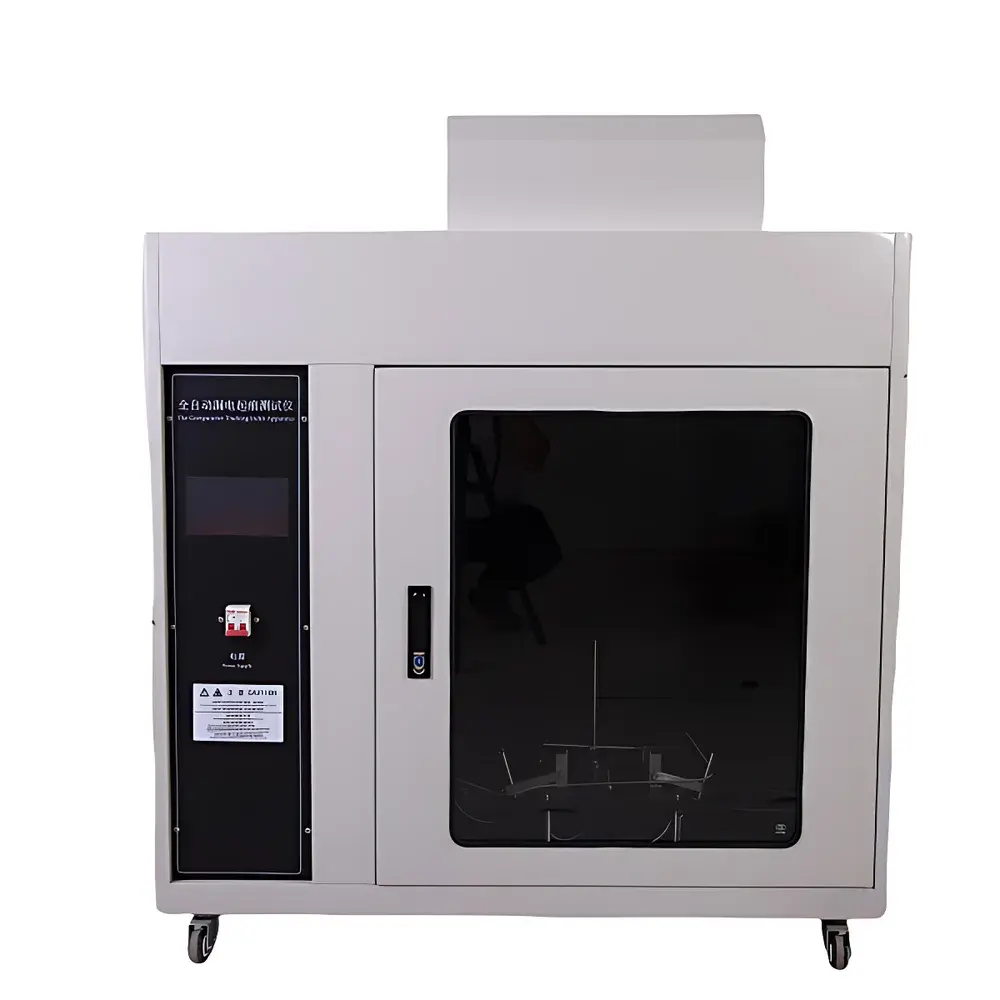
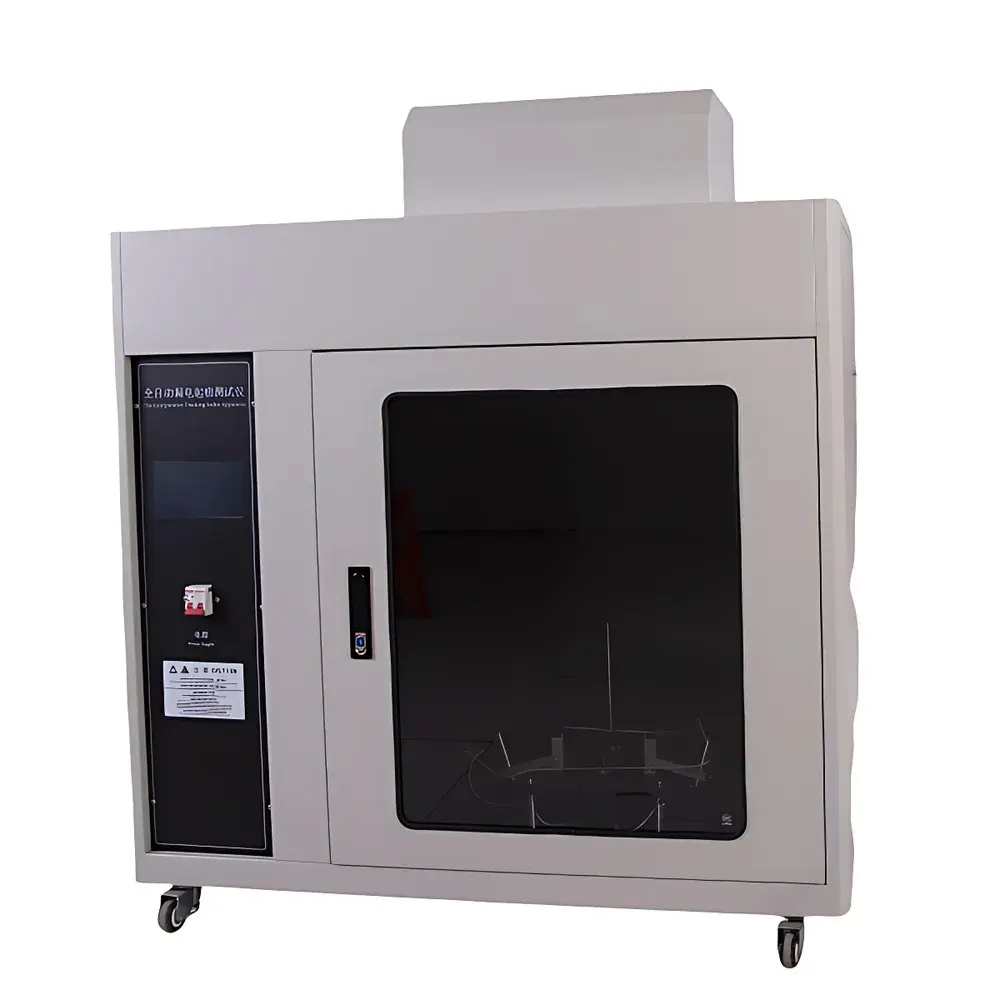
Aerospace LDQ-5 Comparative Tracking Index (CTI) Tester
| Brand | Aerospace |
|---|---|
| Origin | Beijing, China |
| Model | LDQ-5 |
| Voltage Range | 50–600 V AC/DC (±1% step accuracy) |
| Electrolyte | NH₄Cl solution (0.1–1.0 wt%), flow rate 0.5–2.0 mL/min (programmable) |
| Electrode Material | Pt-Rh alloy |
| Electrode Angle | 60° ± 5° |
| Electrode Force | 1.0 N ± 0.05 N |
| Trip Current Threshold | 0.5 A ± 10%, arc duration ≥ 2 s |
| Temperature Sensor Accuracy | ±1 °C |
| Humidity Range | 20–80 %RH |
| Data Acquisition | 16-bit resolution, current resolution 0.1 mA |
| Compliance | IEC 60112:2020, ASTM D3638-21, UL 746A, GB/T 4207-2022, VDE 0303-11, IEC 60695-2-2 |
Overview
The Aerospace LDQ-5 Comparative Tracking Index (CTI) Tester is a precision-engineered instrument designed to evaluate the electrical tracking resistance of solid insulating materials under controlled contamination and voltage stress. It operates on the principle of comparative tracking index determination per IEC 60112:2020—where a standardized ammonium chloride electrolyte solution is dripped onto an inclined test specimen while a regulated AC or DC voltage is applied across two platinum-rhodium electrodes. Under combined electrochemical and thermal stress, localized carbonization initiates conductive pathways; the instrument detects onset of sustained arcing via real-time leakage current monitoring. This process replicates field-relevant degradation mechanisms observed in high-voltage connectors, PCB substrates, motor windings, and polymer housings exposed to humid, dusty, or saline environments. The LDQ-5 delivers traceable, repeatable CTI values critical for material classification (e.g., CTI ≥ 600 for UL 94 V-0 rated polymers), safety certification, and comparative formulation screening in R&D labs.
Key Features
- Wide voltage range (50–600 V AC/DC) with ±1% programmable step resolution, enabling precise CTI and PTI (Proof Tracking Index) testing per IEC 60112 Annex A and B.
- Programmable electrolyte delivery system with calibrated flow control (0.5–2.0 mL/min) and concentration compatibility for NH₄Cl solutions (0.1–1.0 wt%), ensuring reproducible surface wetting dynamics.
- Pt-Rh alloy electrodes with fixed 60° ± 5° included angle and force-controlled loading (1.0 N ± 0.05 N) via precision counterweight assembly—minimizing electrode wear and inter-lab variability.
- Automated failure detection logic: simultaneous validation of leakage current ≥ 0.5 A ± 10% and arc duration ≥ 2 s triggers immediate voltage cutoff and event timestamping.
- Integrated environmental monitoring: high-stability temperature sensor (±1 °C) and capacitive humidity sensor (20–80 %RH) support ambient condition logging required for GLP-compliant reports.
- 16-bit data acquisition subsystem with 0.1 mA current resolution, synchronized with optional high-speed imaging and thermal profiling modules for root-cause analysis of tracking initiation sites.
Sample Compatibility & Compliance
The LDQ-5 accommodates standard test specimens measuring 100 mm × 50 mm × (2–10) mm, compatible with thermoplastics (e.g., PBT, PA66-GF), thermosets (epoxy, phenolic), elastomers, and fiber-reinforced composites. Specimen preparation follows strict pre-conditioning protocols: ultrasonic cleaning in isopropanol followed by 2-hour drying at 50 °C. Electrode spacing is mechanically fixed at 4.0 ± 0.1 mm using certified gauge blocks, and electrode force is verified with traceable 0.98 N calibration weights. The system meets full alignment with IEC 60112:2020 Clause 7 (test setup), ASTM D3638-21 Section 6 (electrode geometry), UL 746A Section 19 (tracking resistance), and GB/T 4207-2022 Annex C (Chinese national implementation). It also supports cross-referenced evaluation per VDE 0303-11 and interfaces with IEC 60695-2-2 for integrated fire safety assessment workflows.
Software & Data Management
The LDQ-5 operates under a deterministic real-time PLC control architecture with embedded firmware compliant with IEC 61131-3. Test sequences—including multi-step voltage ramping, drop-count sequencing, and conditional termination—are defined via intuitive PC-based configuration software. All raw analog inputs (voltage, current, temperature, humidity) are time-stamped and stored in CSV/Excel-compatible format with metadata embedding (operator ID, sample ID, calibration date, environmental logs). Audit trails record parameter changes, test starts/stops, and safety interlock events—supporting 21 CFR Part 11 compliance when deployed with user access controls and electronic signatures. System calibration is traceable to NIST-certified reference modules (e.g., CTI 250 MΩ verification kit), and periodic verification ensures adherence to ISO/IEC 17025:2017 clause 6.5 (equipment validation).
Applications
- Qualification of flame-retardant polymeric compounds for automotive EV battery enclosures and charging infrastructure.
- Comparative CTI benchmarking of halogen-free laminates used in high-density PCBs for aerospace avionics.
- Accelerated aging studies correlating tracking resistance with filler dispersion, surface hydrophobicity, and thermal conductivity in silicone rubber insulators.
- Regulatory submission support for UL Recognition, CE marking (LVD Directive), and CCC certification in China.
- Root-cause failure analysis of field-failed insulators using post-test SEM/EDS mapping of carbonized tracks.
FAQ
What standards does the LDQ-5 fully support for CTI testing?
The LDQ-5 implements all mechanical, electrical, and procedural requirements of IEC 60112:2020, ASTM D3638-21, UL 746A, and GB/T 4207-2022—including electrode geometry, solution delivery, voltage stability, and failure criteria.
Is the instrument suitable for GLP or ISO/IEC 17025-accredited laboratories?
Yes—the system includes full audit trail logging, user-level access control, calibration traceability documentation, and 16-bit DAQ with <0.1% linearity error, satisfying ISO/IEC 17025 clause 6.4 and GLP principles for data integrity.
Can the LDQ-5 perform both CTI and PTI determinations?
Yes—its programmable voltage stepping, drop counting, and adaptive trip logic enable both Comparative Tracking Index (CTI) per IEC 60112 Annex B and Proof Tracking Index (PTI) per Annex A without hardware modification.
How is electrode wear mitigated during long-term operation?
Pt-Rh alloy electrodes exhibit exceptional corrosion resistance and thermal stability; routine inspection intervals are defined per ASTM D3638-21 Section 8.2, with replacement recommended after 500 test cycles or visible pitting.
Does the system include safety interlocks for operator protection?
Yes—mechanical door interlocks disable high voltage upon chamber opening; forced-air exhaust maintains O₂ <19% during arc events; and a dedicated carbon particulate filtration module captures conductive residues per IEC 60695-2-2 Annex E requirements.





