
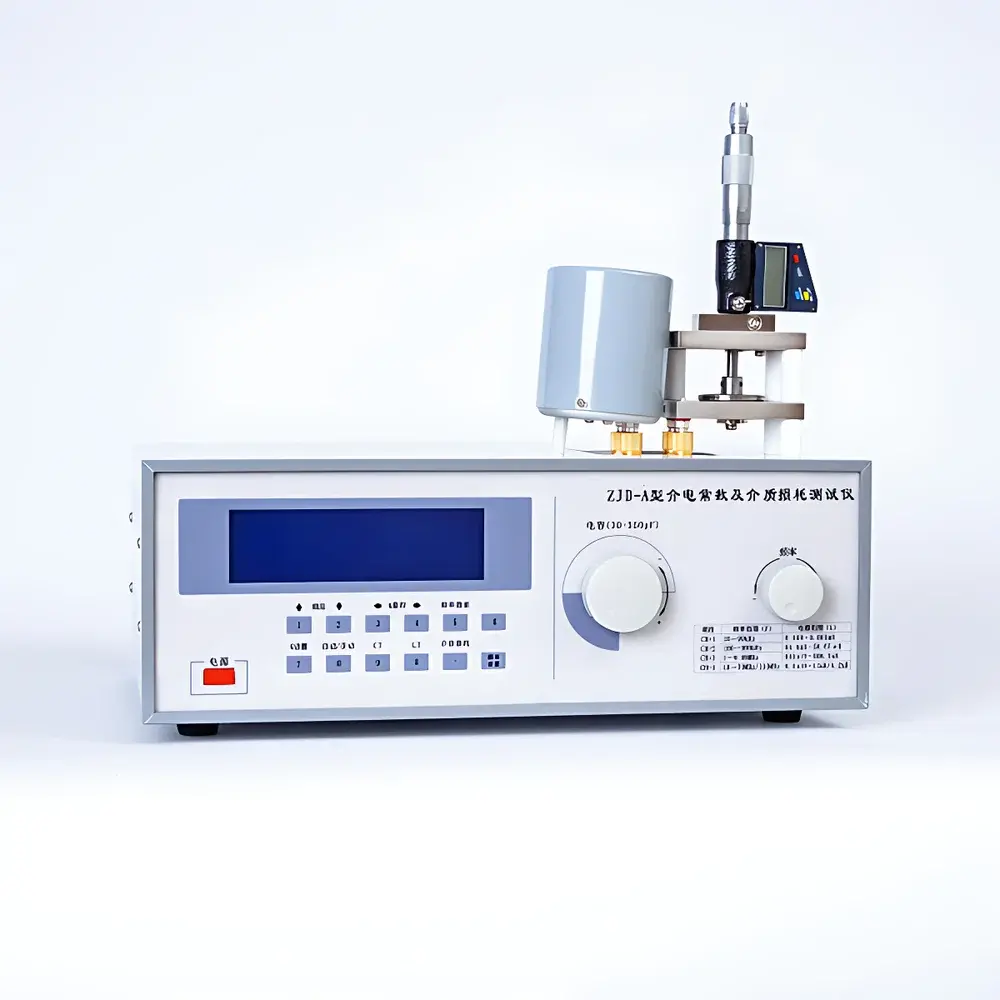
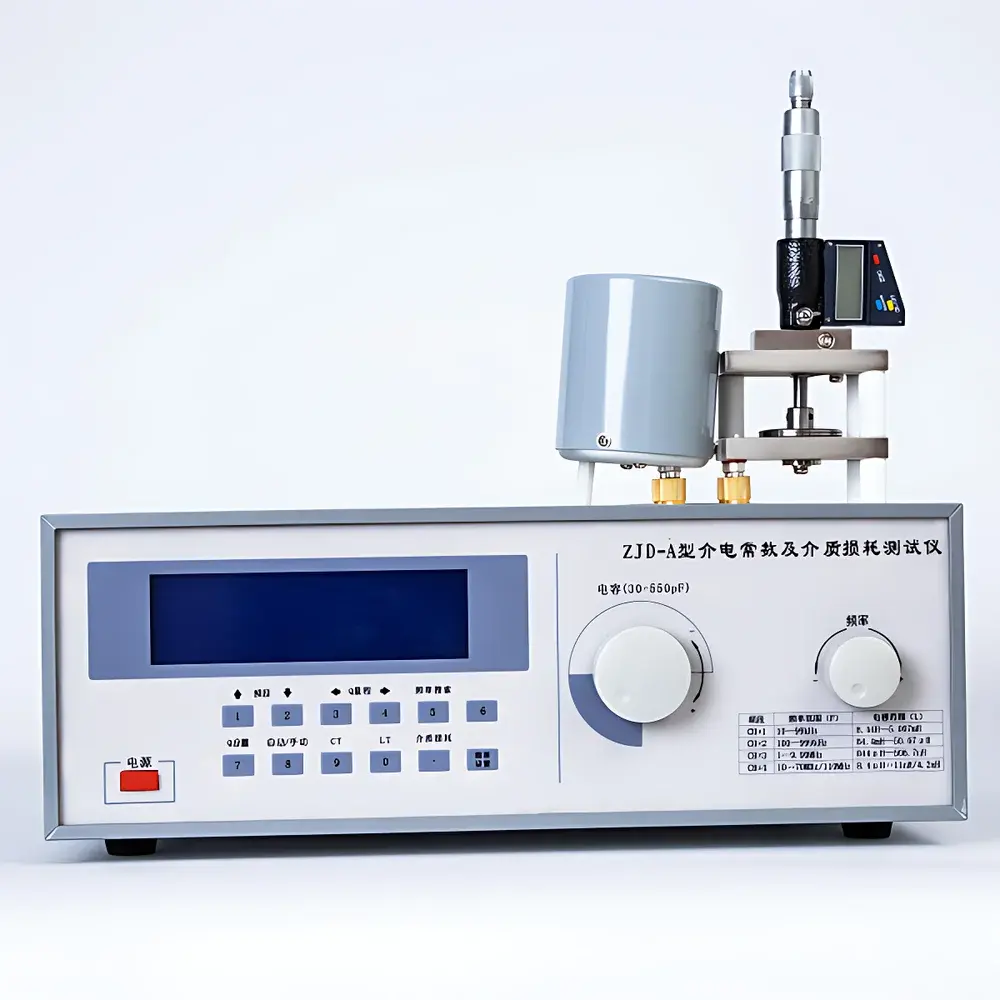
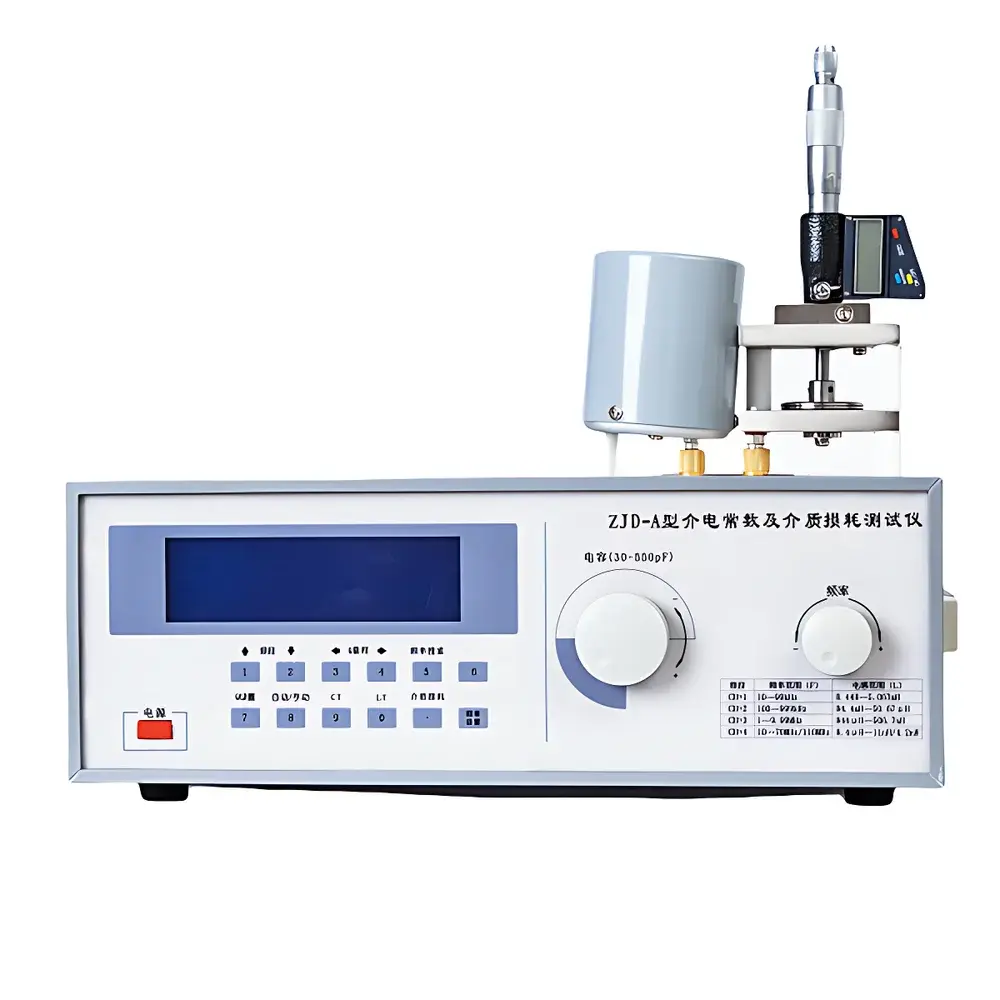
Aerospace ZJD-C Dielectric Constant and Dissipation Factor Tester
| Brand | Aerospace |
|---|---|
| Origin | Beijing, China |
| Model | ZJD-C |
| Frequency Range | 50 Hz – 1 MHz |
| Test Voltage | 0.1 kV – 10 kV |
| Temperature Control | Ambient to 300 °C |
| Sample Compatibility | Solid discs (Ø25–100 mm, thickness 0.1–10 mm), liquids, thin films |
| Measurement Accuracy | ε ≤ ±1%, tanδ ≤ ±1×10⁻⁴ |
| Compliance | IEC 60250, ASTM D150, GB/T 1409, IEEE 286 |
| Calibration | CNAS-accredited traceability |
Overview
The Aerospace ZJD-C Dielectric Constant and Dissipation Factor Tester is a precision laboratory instrument engineered for the quantitative characterization of dielectric properties under controlled alternating electric fields. It operates on the principle of high-precision AC bridge measurement—employing either automatic balancing or resonant null-detection methodologies—to determine the complex permittivity (ε* = ε′ − jε″) of insulating and semi-insulating materials. From this, the real part (ε′, relative permittivity or dielectric constant) and imaginary part (ε″, dielectric loss factor) are derived, enabling direct calculation of the dissipation factor (tanδ = ε″/ε′). Designed for rigorous R&D and quality assurance environments, the system supports variable-frequency excitation across 50 Hz to 1 MHz, programmable test voltages up to 10 kV, and active thermal conditioning from ambient to 300 °C—enabling comprehensive analysis of frequency dispersion, voltage dependence, and thermally activated relaxation processes in dielectrics.
Key Features
- High-stability AC bridge architecture with digital phase-sensitive detection, minimizing drift and harmonic distortion effects.
- Integrated high-voltage source (0.1–10 kV, RMS) with overvoltage protection and arc detection logic to prevent sample breakdown during ramped voltage tests.
- Modular electrode systems: interchangeable parallel-plate and three-terminal configurations compliant with ASTM D150 geometry requirements; precision-machined stainless-steel electrodes with PTFE insulation and calibrated gap control (±1 µm repeatability).
- Active temperature chamber with PID-controlled heating and forced-air circulation, supporting isothermal holds and linear ramp profiles (±0.5 °C stability at 200 °C).
- Shielded measurement enclosure meeting IEC 61000-4-3 immunity standards, reducing electromagnetic interference (EMI) in high-sensitivity tanδ measurements (<1×10⁻⁵).
- Real-time waveform monitoring (V(t), I(t)) with dual-channel 16-bit ADC sampling at 1 MS/s, enabling visual validation of sinusoidal fidelity and early detection of partial discharge onset.
Sample Compatibility & Compliance
The ZJD-C accommodates standardized solid specimens per IEC 60250 and ASTM D150—including rigid polymer sheets, ceramic wafers, elastomeric seals, and laminated composites—as well as low-conductivity liquids (e.g., transformer oils, silicone fluids) and vapor-deposited thin films. Electrode contact pressure is mechanically regulated to ensure uniform interfacial coupling without deformation-induced artifacts. All hardware and firmware comply with ISO/IEC 17025 technical requirements for calibration laboratories. Test procedures adhere strictly to ASTM D150 Annex A1 (parallel-plate method) and Annex A2 (guarded-electrode configuration), with full audit trails for parameter settings, environmental conditions, and raw acquisition timestamps. Data outputs include uncertainty budgets per GUM (JCGM 100:2008) and support GLP/GMP documentation workflows, including electronic signatures and 21 CFR Part 11–compliant user access controls.
Software & Data Management
The embedded Windows-based control suite (ZJD-Control v4.2) provides synchronized multi-parameter scripting—allowing concurrent sweeps of frequency, voltage, and temperature with user-defined step resolution and dwell times. Raw data (complex admittance Y*, phase angle θ, magnitude |Y|) are stored in HDF5 format with metadata tags for instrument configuration, calibration certificate IDs, and operator credentials. Post-processing modules compute Cole–Cole plots, Arrhenius activation energies, and Havriliak–Negami relaxation spectra. Export options include CSV, MATLAB .mat, and PDF reports conforming to ISO 17025 reporting clauses. Automated calibration verification routines execute before each test sequence using NIST-traceable reference capacitors and loss standards (certified by CNAS Lab No. L2345).
Applications
- Insulation qualification of power cable jackets, bushings, and epoxy-molded switchgear components per IEEE 286 and IEC 60502.
- Quality control of high-k dielectrics (e.g., BaTiO₃, HfO₂) used in MLCCs and gate oxides, tracking ε′ degradation and tanδ rise during thermal cycling.
- Moisture ingress assessment in polymeric encapsulants via tanδ peak shift at 1 kHz—correlating with FTIR-measured OH⁻ content.
- Curing kinetics monitoring of thermoset resins (epoxy, cyanate ester) through time-resolved ε′ and tanδ evolution at fixed frequency and elevated isotherms.
- Comparative screening of nanocomposite dielectrics (e.g., SiO₂/PVDF, BN/PI) for aerospace-grade printed wiring boards, evaluating filler dispersion homogeneity via loss tangent dispersion breadth.
FAQ
What measurement principle does the ZJD-C employ?
It utilizes an automated high-precision AC bridge method with digital phase-sensitive demodulation, conforming to the fundamental definitions in IEC 60250 and ASTM D150.
Is the system suitable for testing conductive or semiconductive materials?
No—it is optimized for insulators and low-loss dielectrics (σ < 10⁻⁹ S/m); conductive samples require four-probe DC resistivity instruments.
How often must the system be recalibrated?
Annual calibration is recommended; however, daily verification using certified reference standards is required prior to critical measurements per ISO/IEC 17025 Clause 7.7.
Can the ZJD-C perform variable-temperature dielectric spectroscopy (VTDS)?
Yes—integrated thermal control enables continuous or stepped VTDS from 25 °C to 300 °C with simultaneous frequency sweeps.
Does the software support custom test protocols for internal SOPs?
Yes—ZJD-Control v4.2 includes a script editor supporting Python-based protocol definition, conditional branching, and pass/fail logic tied to ε′ and tanδ thresholds.



