
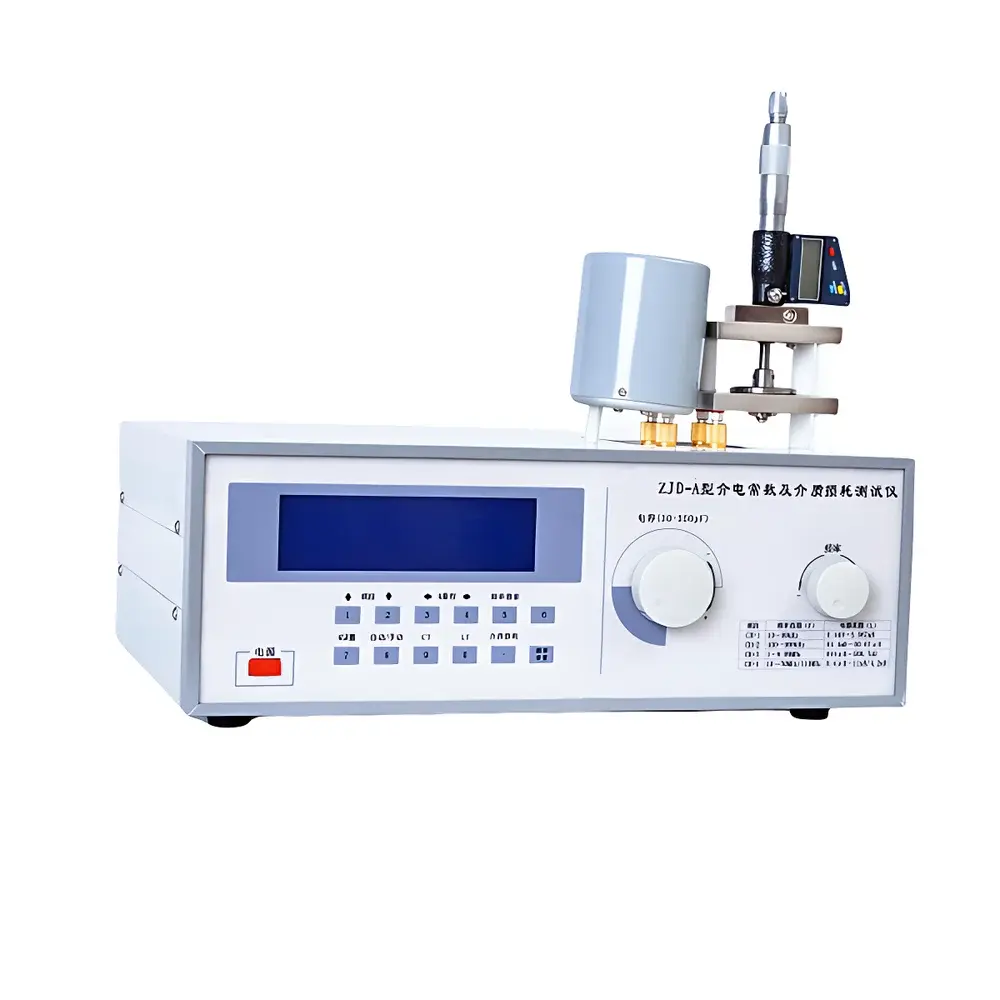
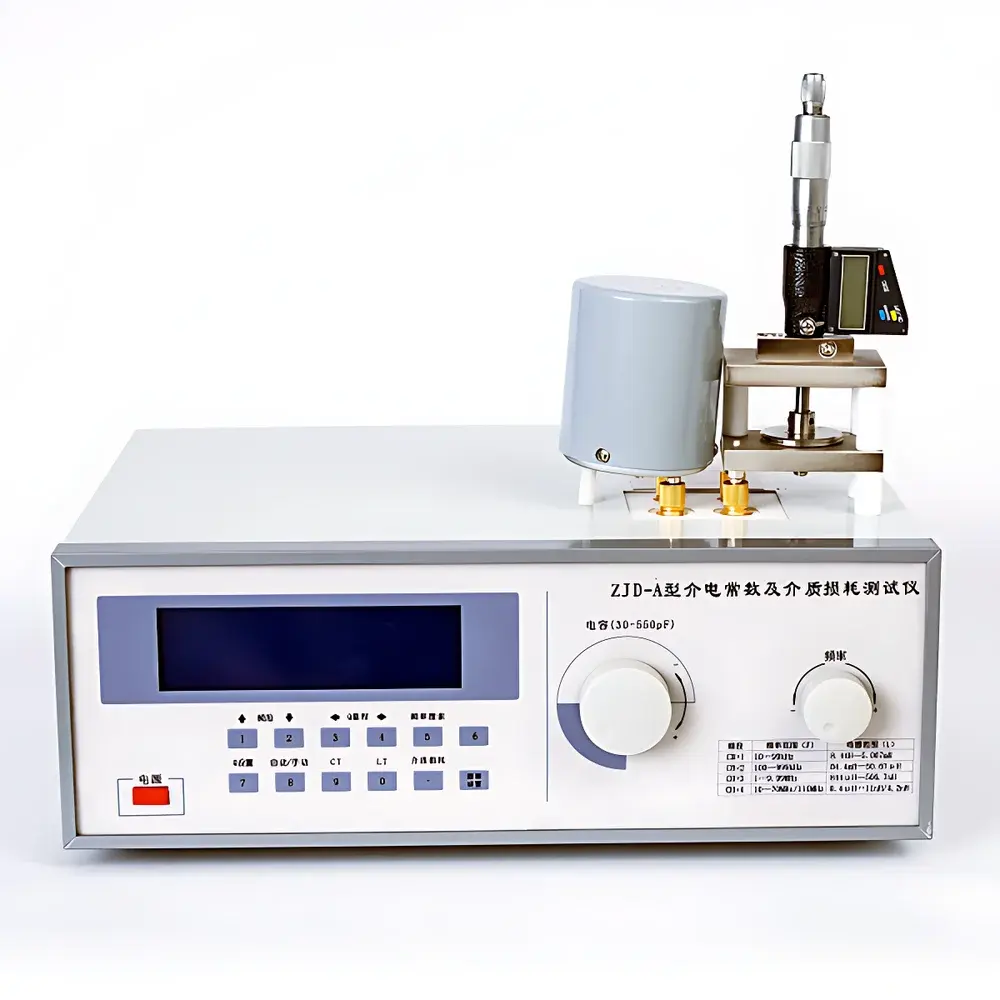
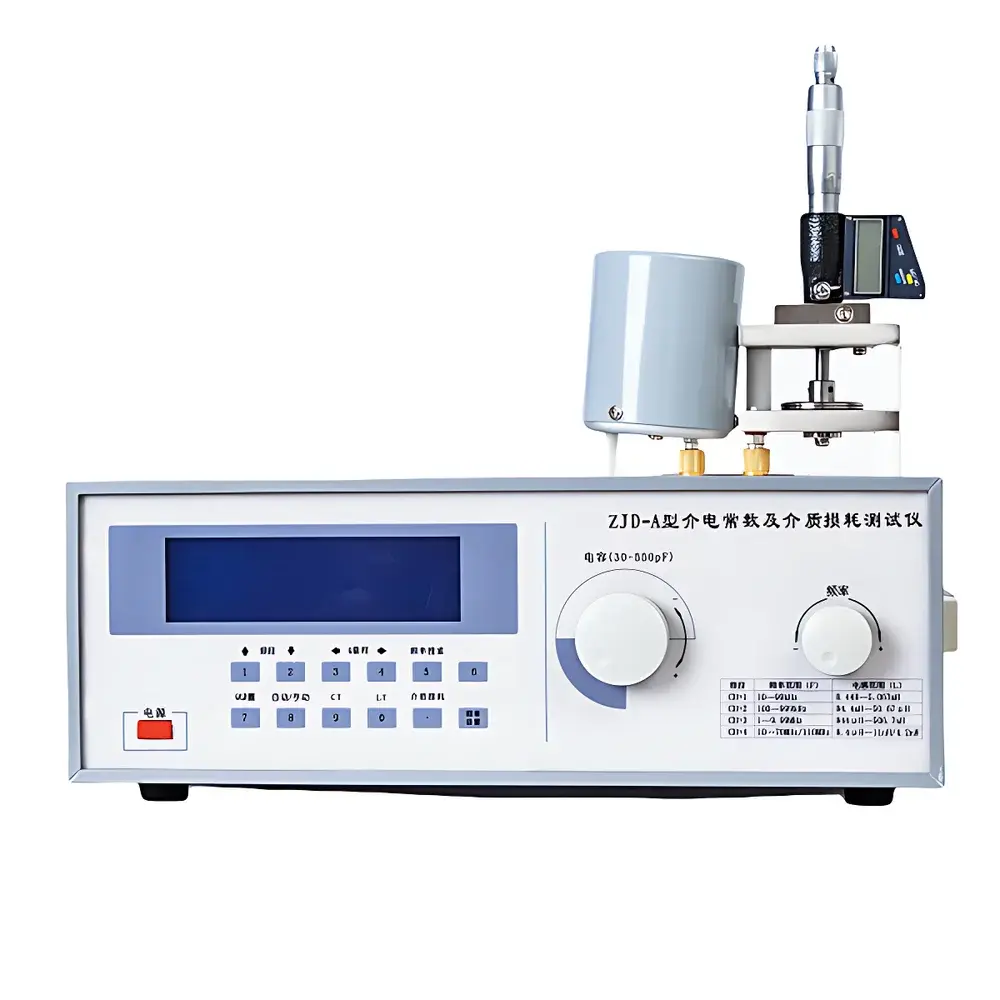
Aerospace ZJD-B Dielectric Constant and Loss Tangent Analyzer
| Brand | Aerospace |
|---|---|
| Origin | Beijing, China |
| Manufacturer Type | Authorized Distributor |
| Product Category | Domestic |
| Model | ZJD-B |
| Price Range | USD 4,200 – 11,200 (FOB Beijing) |
| Frequency Range | 1 kHz – 1 GHz (standard) |
| Dielectric Constant (ε′) Range | 1.0 – 35.0 (resolution: 0.1%) |
| Loss Tangent (tan δ) Range | 1×10⁻⁵ – 1.0 (resolution: 1×10⁻⁵) |
| Sample Compatibility | Solid discs (Ø20–100 mm, thickness 0.1–10 mm), liquids (parallel-plate or coaxial probe), thin films (3-electrode configuration) |
| Temperature Range | Ambient (23 °C ±1 °C) |
| optional thermal chamber | −50 °C to +150 °C |
| Voltage Gradient | 10–500 V/mm (adjustable per sample thickness) |
| Compliance | IEC 60250:2020, ASTM D150-18, GB/T 1409-2006 |
| Calibration | Open/short/load with NIST-traceable polystyrene reference dielectric and certified standard capacitors |
Overview
The Aerospace ZJD-B Dielectric Constant and Loss Tangent Analyzer is a precision impedance spectroscopy platform engineered for the quantitative characterization of dielectric properties in insulating and functional materials under controlled AC electric fields. It operates on the fundamental principles of complex permittivity measurement—where the real component (ε′) reflects energy storage capacity, and the imaginary component (ε″) quantifies energy dissipation—enabling direct derivation of relative permittivity (εr) and loss tangent (tan δ = ε″/ε′). Designed for R&D laboratories and QC environments in electronics, telecommunications, aerospace, and advanced battery development, the instrument supports critical material qualification workflows including capacitor dielectric screening, RF substrate validation, high-frequency PCB laminate assessment, and solid-state electrolyte evaluation. Its dual-method architecture—integrating automated bridge-based measurement (1 kHz – 10 MHz) and resonant cavity-assisted analysis (1 MHz – 1 GHz)—ensures traceable accuracy across low-loss polymers (e.g., PTFE, polyimide), high-κ ceramics (e.g., BaTiO₃, TiO₂), and polar liquids (e.g., transformer oils, ionic electrolytes), while maintaining strict adherence to international test standards.
Key Features
- Dual-mode measurement engine: Automatic switching between precision Schering bridge (for high-loss, low-to-mid frequency materials) and high-Q resonant cavity (for ultra-low-loss, high-frequency dielectrics)
- Advanced digital signal processing: Real-time Fourier transform filtering and adaptive noise suppression to eliminate 50/60 Hz power-line interference—even in electromagnetically noisy industrial labs
- Integrated high-voltage source (0–2 kV DC/AC) and calibrated reference capacitor—no external HV supply required for routine testing
- Full-touch 10.1-inch capacitive LCD interface with intuitive graphical workflow navigation; no specialized training required
- Onboard data management: Internal calendar-synchronized flash memory (≥16 GB), thermal printer (time-stamped reports), and USB host port for direct U-disk export
- Robust safety architecture: Ground fault detection, overcurrent cutoff, arc detection, and interlocked HV enable circuitry compliant with IEC 61010-1
- Modular electrode support: Standard parallel-plate fixture (for solids/liquids), optional coaxial probe (for non-destructive liquid screening), and three-terminal guard electrode assembly (for edge-effect-free thin-film measurements)
Sample Compatibility & Compliance
The ZJD-B accommodates diverse sample geometries and physical states without hardware reconfiguration. Solid specimens—including sintered ceramics, polymer films, and laminated composites—are measured using standardized disc electrodes conforming to ASTM D150 Annex A2. Liquid samples (e.g., insulating oils, battery electrolytes) are evaluated via temperature-controlled parallel-plate cells or broadband coaxial probes meeting IEC 60247 requirements. For sub-100 µm thin films, the optional three-electrode system eliminates fringing field errors and enables accurate ε′ and tan δ extraction per ISO 18064. All measurements are traceable to NIST-certified reference materials (polystyrene dielectric slab, SRM 1900), and calibration protocols follow ISO/IEC 17025 guidelines. The system supports full audit trails for GLP/GMP-regulated environments, with timestamped metadata, operator ID logging, and electronic signature capability via optional software module.
Software & Data Management
The bundled ZJD-Control Suite (v4.2) provides a Windows-based GUI supporting three primary test modes: single-point acquisition, frequency sweep (logarithmic or linear, step resolution ≤0.5% of center frequency), and temperature-step profiling (with external chiller integration). Raw impedance data (Z*, θ) is automatically converted into ε′, ε″, tan δ, and conductivity (σ) using validated Cole-Cole and Debye models. Built-in statistical tools include moving-average filtering (N = 3–20), outlier rejection (Grubbs’ test), and curve fitting (Levenberg-Marquardt algorithm). Export formats include CSV, XML, and PDF report templates compliant with ASTM E29 and ISO/IEC 17025 documentation requirements. Remote operation is supported via RS-232, USB CDC, or Ethernet (optional), enabling integration into automated test benches and LIMS platforms. All data files embed EXIF-style metadata (test date/time, operator, instrument serial, calibration certificate ID, environmental conditions).
Applications
- Capacitor dielectric development: Correlation of ε′ stability vs. temperature/frequency for Class I/X7R MLCC formulations
- 5G millimeter-wave substrate qualification: tan δ mapping at 26/28/39 GHz (via harmonic extension) for low-loss laminates (e.g., Rogers RO3000®)
- Power transformer oil diagnostics: Dissolved moisture and oxidation byproduct detection via tan δ trend analysis per IEEE C57.106
- Solid-state battery electrolyte screening: Ionic conductivity and interfacial polarization separation using complex permittivity spectra
- Aerospace composite certification: In-service degradation monitoring of radar-absorbing materials (RAM) and radome substrates
- Pharmaceutical excipient characterization: Polymorph differentiation and hydration state assessment via dielectric relaxation spectroscopy
FAQ
What frequency ranges does the ZJD-B support natively, and how is extended-bandwidth operation achieved?
The base configuration covers 1 kHz to 1 GHz using integrated synthesizer and resonant cavity modules. Optional ISM-band modules (2.45 GHz and 5.8 GHz) are available as plug-in RF front-ends, each factory-calibrated with cavity Q-factor compensation algorithms.
Does the system comply with FDA 21 CFR Part 11 for electronic records in regulated industries?
Yes—when configured with the Audit Trail & e-Signature add-on module, the ZJD-Control Suite meets ALCOA+ data integrity principles and provides role-based access control, immutable audit logs, and electronic signature enforcement per 21 CFR Part 11 Subpart B.
Can the instrument perform variable-temperature dielectric spectroscopy?
Standard operation is at ambient (23 °C ±1 °C). With the optional TC-150 thermal chamber (−50 °C to +150 °C, ±0.2 °C stability), users can execute programmable temperature ramps and isothermal sweeps synchronized with frequency scans.
How is calibration traceability maintained across operating conditions?
Each unit ships with a NIST-traceable calibration certificate covering all standard frequencies and voltage levels. Field recalibration uses open/short/load procedures with supplied polystyrene reference dielectric and certified air-gap capacitor—validating system response before every test session.
Is the ZJD-B suitable for measuring conductive or semi-crystalline polymer nanocomposites?
Yes—the bridge mode handles conductive fillers (e.g., carbon black, graphene) up to σ ≈ 10⁻² S/m, while resonant mode resolves interfacial polarization peaks in semi-crystalline systems (e.g., PVDF-HFP blends) via Cole-Cole plot analysis.



