
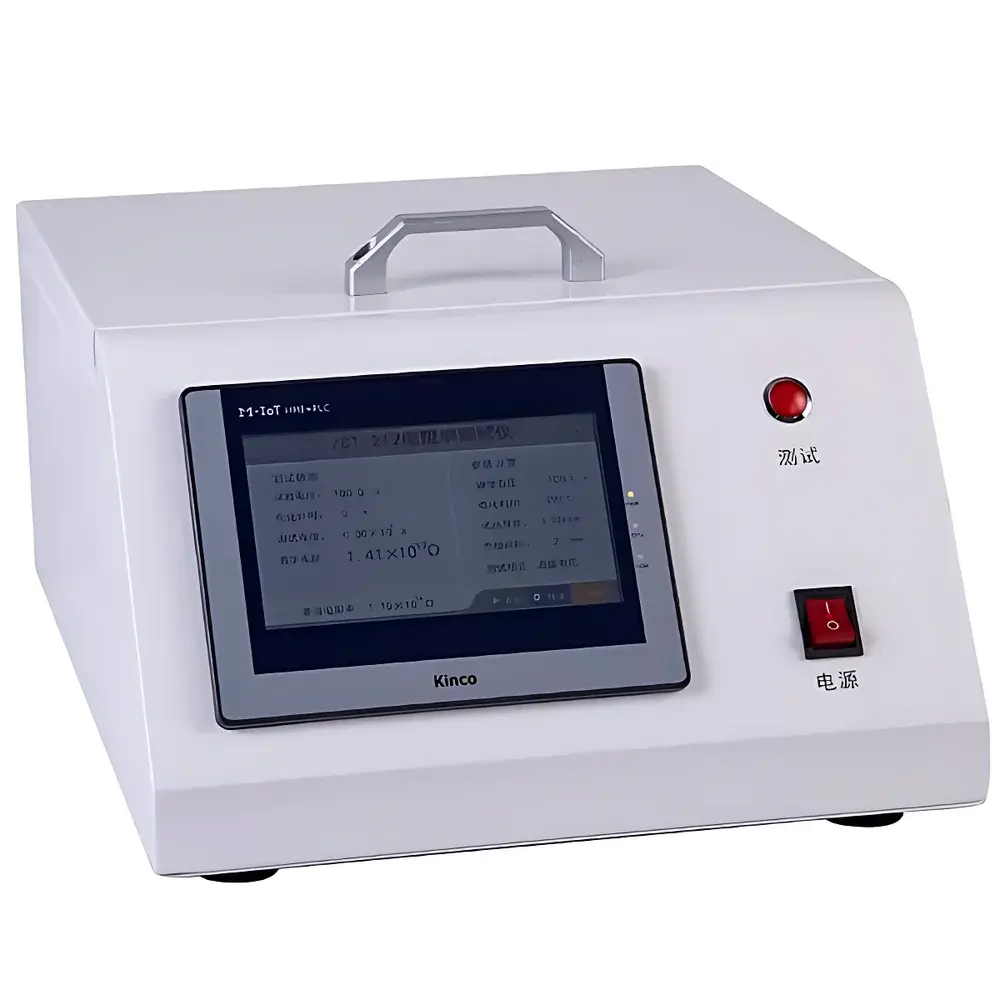
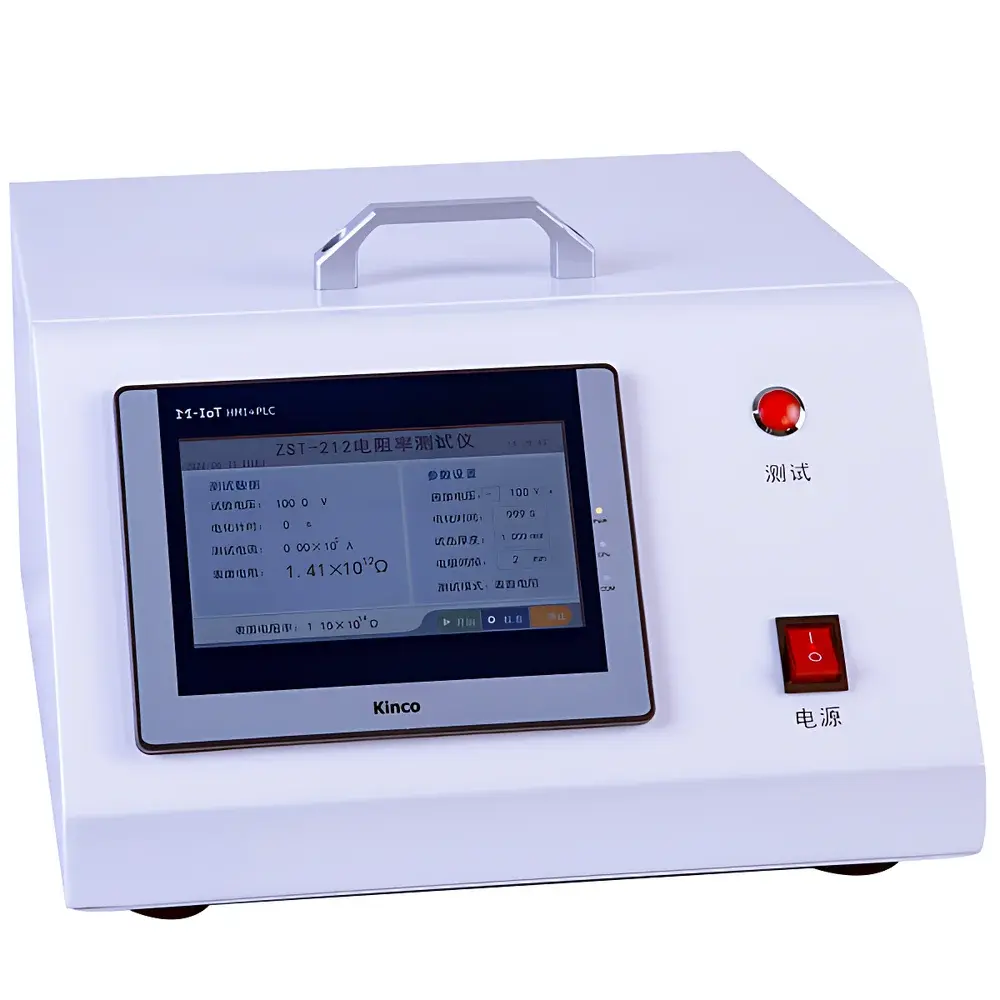
Aerospace ZST-212 Volume & Surface Resistivity Tester
| Brand | Aerospace |
|---|---|
| Origin | Beijing, China |
| Model | ZST-212 |
| Measurement Range | 1×10⁴ Ω to 1×10¹⁸ Ω |
| Current Range | 2×10⁻⁴ A to 1×10⁻¹⁶ A |
| Test Voltages | 10 V / 50 V / 100 V / 250 V / 500 V / 1000 V (selectable) |
| Display | Digital LCD |
| Accuracy | ±1% |
| Compliance | GB/T 1410–2006, ASTM D257–99, GB/T 10581–2006, GB/T 1692–2008, GB/T 2439–2001, GB/T 12703.4–2010, GB/T 10064–2006, GB/T 22042–2008, EN 1149-1:1995, FZ/T 64013–2008, SJ/T 10694–2006 |
Overview
The Aerospace ZST-212 Volume & Surface Resistivity Tester is a precision digital electrometer engineered for high-accuracy DC resistance and resistivity measurements of insulating, antistatic, and conductive materials. It operates on the fundamental principle of Ohm’s Law (R = V/I), employing synchronous dual-parameter acquisition—simultaneous high-stability measurement of applied test voltage and resulting current—to eliminate nonlinearity and drift inherent in conventional analog high-resistance meters. Unlike legacy instruments relying on fixed-voltage or single-current sensing architectures, the ZST-212 integrates custom large-scale IC circuitry to perform real-time V/I computation and digitize results with A/D conversion, delivering linear, stable, and traceable resistance readings across its full 14-decade range. Designed specifically for compliance-driven laboratories, it supports standardized volume resistivity (ρᵥ) and surface resistivity (ρₛ) calculations per IEC 60093 (equivalent to GB/T 1410–2006) and ASTM D257–99, making it suitable for QC validation, R&D characterization, and regulatory documentation in polymer science, electronics manufacturing, and protective textile development.
Key Features
- Ultra-wide resistance measurement range: 1×10⁴ Ω to 1×10¹⁸ Ω with ±1% basic accuracy at 23 °C ±5 °C and <80% RH
- Simultaneous dual-parameter readout: Direct digital display of both resistance value (Ω) and leakage current (A) on a high-contrast LCD screen
- Programmable test voltages: Six discrete DC output levels—10 V, 50 V, 100 V, 250 V, 500 V, and 1000 V—each selectable via front-panel controls without recalibration
- Microcurrent sensitivity: Current measurement capability from 2×10⁻⁴ A down to 1×10⁻¹⁶ A, enabling characterization of ultra-low-conductivity dielectrics and high-purity polymers
- Three-electrode measurement architecture: Compatible with standardized guarded electrode configurations (e.g., ASTM D257 Figure 3) to isolate surface conduction and suppress edge leakage errors
- Compact benchtop design: Dimensions 285 mm × 245 mm × 120 mm; mass ≈ 5 kg; power consumption <5 W (AC 220 V, 50 Hz)
Sample Compatibility & Compliance
The ZST-212 accommodates solid sheets, films, molded parts, powders, pastes, gels, and low-conductivity liquids through interchangeable electrode fixtures—including concentric ring electrodes for surface resistivity, parallel plate cells for volume resistivity of solids, and powder-specific compression cells with controlled pressure loading. All configurations adhere to the geometric constraints and guard requirements defined in GB/T 1410–2006 and ASTM D257–99. The instrument meets the electrical safety and metrological traceability expectations of ISO/IEC 17025-accredited testing laboratories and supports audit-ready documentation for GLP and GMP environments. Its compliance portfolio extends to industry-specific standards including EN 1149-1:1995 (electrostatic protective clothing), GB/T 22042–2008 (antistatic garment evaluation), and SJ/T 10694–2006 (ESD control in electronics production). No proprietary software drivers or operating system dependencies are required for basic operation.
Software & Data Management
While the ZST-212 operates as a fully standalone instrument with no mandatory PC interface, optional RS-232 or USB-to-serial adapters enable ASCII-based data streaming to external logging systems or LIMS platforms. Output format includes timestamped resistance (Ω), current (A), selected voltage (V), and measurement mode identifier. Raw data export supports CSV or tab-delimited formats compatible with Excel, MATLAB, or statistical process control (SPC) tools. For regulated environments, the instrument’s manual operation—without embedded firmware-based calculation logic—facilitates straightforward validation under FDA 21 CFR Part 11 when paired with controlled electronic records. Audit trails, user authentication, and electronic signatures are implemented externally at the data acquisition layer, preserving instrument simplicity while meeting documentation integrity requirements.
Applications
- Volume resistivity characterization of engineering plastics (e.g., PEEK, polyimide), elastomers (silicone, EPDM), and ceramic substrates used in high-voltage insulation
- Surface resistivity verification of ESD-safe work surfaces, conductive flooring, and antistatic packaging films per IEC 61340-2-3
- Quality control of carbon-black–filled rubber compounds and conductive polymer composites for automotive and aerospace applications
- Resistivity profiling of battery separator membranes, solid electrolytes, and dielectric coatings during formulation development
- Static dissipation assessment of technical textiles, cleanroom garments, and medical drapes in accordance with GB/T 12703.4–2010 and EN 1149 series
- Research-grade dark current analysis of photodetectors and optoelectronic devices where sub-picoampere stability is critical
FAQ
What sample geometries can be tested with the ZST-212?
The instrument supports flat solids (≥25 mm × 25 mm), powders (using compression electrodes), viscous liquids (in guarded liquid cells), and thin films (≥0.1 mm thickness). Electrode fixture selection determines whether volume or surface resistivity is measured.
Does the ZST-212 require annual calibration certification?
Yes—traceable calibration against NIST-traceable standard resistors (10⁴ Ω to 10¹⁸ Ω) is recommended annually or per internal quality procedures. Calibration certificates include uncertainty budgets per ISO/IEC 17025.
Can the ZST-212 measure conductivity as well as resistivity?
Yes—conductivity (σ) is calculated as the reciprocal of resistivity (σ = 1/ρ), using sample thickness and electrode geometry inputs entered manually per test standard equations.
Is the three-electrode method mandatory for all measurements?
For surface resistivity (ρₛ), the three-electrode guarded configuration is required by GB/T 1410–2006 and ASTM D257–99 to exclude edge currents. For volume resistivity (ρᵥ) of homogeneous solids, a two-electrode setup may be used if specimen geometry satisfies aspect ratio criteria.
How does environmental humidity affect measurement repeatability?
Relative humidity >80% introduces surface adsorption effects that artificially lower apparent surface resistance. Testing must be performed within specified ambient conditions (0–40 °C, <80% RH) and reported alongside environmental logs for compliance documentation.



