
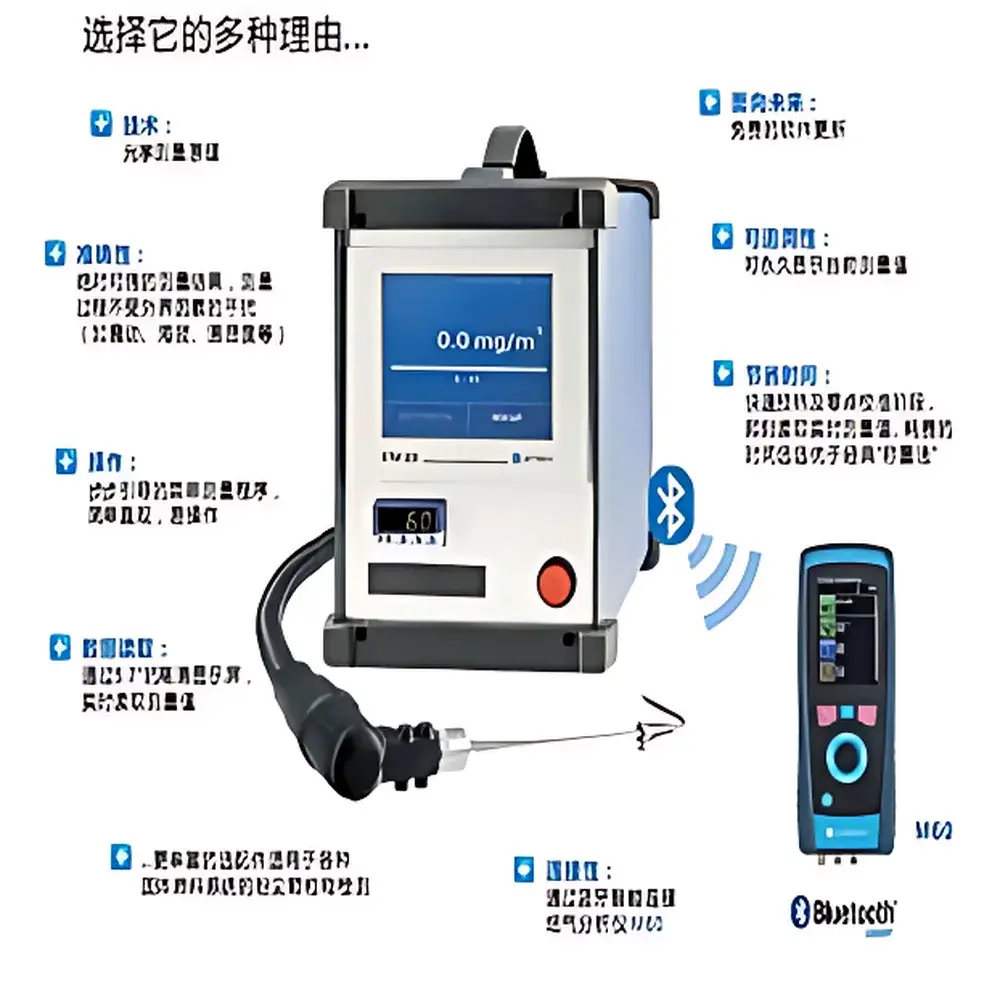
AFRISO STM225 Portable Laser Dust Monitor for Flue Gas Applications
| Brand | AFRISO |
|---|---|
| Origin | Germany (manufactured under AFRISO engineering specifications |
| Model | STM225 |
| Instrument Type | Portable Laser-Based Dust Monitor |
| Measurement Principle | Dual-Beam Laser Light Scattering |
| Dust Range | 0–300 mg/m³ |
| Resolution | 0.1 mg/m³ |
| Accuracy (Indicated Error) | ±0.5% FS |
| Repeatability | ±0.2% FS |
| Response Time (T90) | ≤0.1 s |
| Drift (1-h Stability) | <±0.5% FS over 1 h |
| Operating Temperature | –5 to +40 °C |
| Storage Temperature | –20 to +50 °C |
| Display | 5.7" color TFT touchscreen |
| Power Supply | AC 230 V, 50 Hz |
| Communication | Bluetooth 4.2, USB 2.0 |
| Enclosure Rating | IP40 |
| Dimensions (W×H×D) | 190 × 275 × 330 mm |
| Weight | 7.5 kg |
| Compliance | Designed to support ISO 16940, EN 13284-1, and ASTM D6216 measurement protocols for particulate matter in industrial flue gases |
Overview
The AFRISO STM225 is a portable, laser-based dust monitor engineered for real-time, in-situ measurement of suspended particulate matter (PM) concentration in industrial flue gas streams. It employs a dual-beam laser light scattering principle—where two independent optical paths operate within separate, thermally stabilized measurement chambers—to simultaneously quantify fine-mode (e.g., sub-2.5 µm) and coarse-mode (e.g., >2.5 µm) particulates. This architecture eliminates cross-sensitivity between particle size fractions and enables robust differentiation of combustion-derived soot, fly ash, and unburned char—critical for biomass, coal, and wood-pellet boiler emissions monitoring. Unlike filter-based gravimetric methods requiring post-sampling lab analysis, the STM225 delivers continuous, on-site concentration readings with no consumable filters during operation. Its optical design features a maintenance-free laser diode with >50,000-hour operational lifetime and temperature-compensated photodetectors to ensure long-term signal stability across ambient fluctuations.
Key Features
- Dual-chamber, dual-beam laser scattering optics for independent fine- and coarse-particulate quantification
- 5.7-inch high-resolution color touchscreen interface with intuitive touch-driven calibration and data navigation
- Integrated electro-heated sampling probe (280 mm or 400 mm options) to prevent condensation-induced measurement artifacts in wet flue gas
- Automatic zero-point calibration in ambient air upon startup (completed within ~20 minutes)
- Standardized 15-minute measurement cycle with on-device averaging and display of time-weighted mean concentration (mg/m³)
- Bluetooth 4.2 synchronization with compatible flue gas analyzers (e.g., AFRISO M60 series) for concurrent O₂, CO, COhigh, and NOx reporting alongside PM data
- Rugged PE instrument case with ergonomic shoulder strap and impact-resistant handles for field deployment
- USB 2.0 interface for firmware updates and raw data export in CSV format
Sample Compatibility & Compliance
The STM225 is validated for use in flue gas streams from solid-fuel combustion systems—including biomass boilers, pellet stoves, coal-fired thermal units, and municipal waste incinerators—where particulate loadings range from 1 to 300 mg/m³ at standard conditions (dry, 273.15 K, 101.325 kPa). It meets the physical and environmental operating constraints defined in EN 13284-1 (2017) for manual dust measurement systems and aligns with the optical performance benchmarks referenced in ISO 16940:2017 for laser scattering-based PM monitors. While not certified as a reference method per EPA Method 5 or ISO 9096, its output is suitable for process optimization, regulatory pre-screening, and continuous emission monitoring system (CEMS) validation when deployed alongside certified analyzers. The device supports GLP-aligned documentation through timestamped measurement logs and operator ID tagging via optional software configuration.
Software & Data Management
Data acquisition and reporting are managed via embedded firmware compliant with IEC 62443-3-3 cybersecurity principles for industrial instrumentation. Each 15-minute measurement session generates a structured dataset containing raw scatter signals, temperature/pressure compensation values, and averaged concentration results. Exported CSV files include metadata fields for sampling location, operator ID, probe serial number, and calibration status. When paired with AFRISO’s optional PC-based analysis suite (STM-Link v3.x), users can generate compliance-ready reports aligned with EU BREF LCP (Best Available Techniques Reference Document for Large Combustion Plants) reporting templates. Audit trails—including calibration events, firmware updates, and user logins—are retained onboard for ≥12 months and accessible via USB dump. The system does not implement FDA 21 CFR Part 11 electronic signature functionality but supports external integration with LIMS platforms via standardized API endpoints.
Applications
The STM225 serves as a primary tool for environmental engineers and plant operators conducting periodic stack testing, combustion efficiency audits, and fuel-switching evaluations. Its portability and rapid deployment make it ideal for comparative measurements across multiple boiler zones or grate positions in multi-stage combustion systems. In biomass facilities, it supports real-time adjustment of air-to-fuel ratios by correlating PM spikes with incomplete combustion signatures observed on co-located gas analyzers. For regulatory agencies, it provides rapid screening capability prior to formal stack testing—reducing downtime and laboratory turnaround. Field service teams utilize its Bluetooth sync capability to correlate particulate trends with flue gas O₂ excess, CO slip, and dew point excursions—enabling root-cause diagnostics for opacity violations or filter bag failures.
FAQ
What particle size ranges does the STM225 detect?
It measures total suspended particulates (TSP) in the 0.1–100 µm aerodynamic diameter range, with optimized sensitivity for combustion-relevant fractions (0.3–10 µm). Size segregation is achieved optically—not physically—via differential scattering response in the dual-beam chamber design.
Is the STM225 suitable for wet or corrosive flue gas?
Yes, when used with the optional electro-heated sampling probe (standard at 180 °C tip temperature) and integrated condensate trap. The optical head is isolated from direct gas contact and rated for exposure to SO₂ ≤500 ppm and HCl ≤100 ppm at ≤150 °C stack temperature.
How often must the instrument be calibrated?
Factory calibration is traceable to NIST-traceable aerosol standards. Field verification using clean air zero checks is recommended before each measurement campaign. Full recalibration is advised annually or after 2,000 operating hours, whichever occurs first.
Can the STM225 be used for ambient air monitoring?
No—it is designed exclusively for extractive sampling from pressurized, elevated-temperature flue ducts. Ambient applications require dedicated low-concentration PM monitors meeting ISO 12103-1 or ISO 21501-4 specifications.
Does the device store historical measurement data internally?
Yes. Internal flash memory retains up to 10,000 measurement records (including timestamps, averages, and environmental compensation parameters) with automatic overwrite protection for the most recent 500 entries.







