
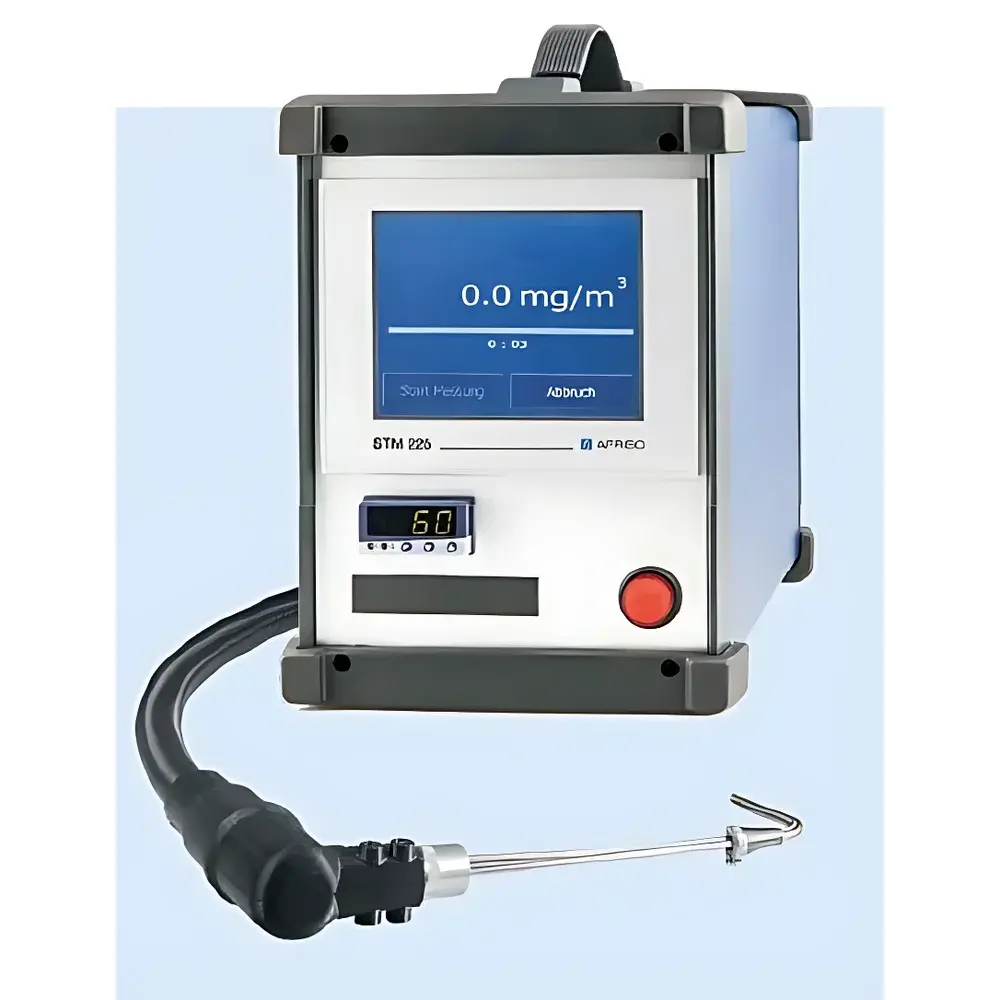
AFRISO STM225 Portable Laser Dust Monitor for Flue Gas Applications
| Brand | AFRISO |
|---|---|
| Model | STM225 |
| Type | Portable dust monitor |
| Measurement principle | Dual-beam laser scattering |
| Dust concentration range | 0–300 mg/m³ |
| Resolution | 0.1 mg/m³ |
| Accuracy (indicated error) | ±0.50 mg/m³ |
| Repeatability | ±0.2 mg/m³ |
| Response time | 0.10 s |
| Stability | ±1% over 1 h |
| Operating temperature | −5 to 40 °C |
| Storage temperature | −20 to +50 °C |
| Dimensions (W×H×D) | 190 × 275 × 330 mm |
| Weight | ~7.5 kg |
| Ingress protection | IP40 |
| Display | 5.7" color touchscreen |
| Power supply | AC 230 V, 50 Hz |
| Communication interfaces | Bluetooth, USB |
Overview
The AFRISO STM225 Portable Laser Dust Monitor is an industrial-grade, field-deployable instrument engineered for real-time quantification of particulate matter (PM) concentrations in flue gas streams. It employs a dual-beam laser scattering measurement principle—where two independent optical paths operate within separate, thermally stabilized measurement chambers—to simultaneously resolve fine and coarse particulate fractions across the 0–300 mg/m³ range. This architecture mitigates cross-sensitivity to particle morphology, refractive index variation, and flow turbulence, delivering high reproducibility under dynamic combustion conditions. Designed specifically for compliance-oriented environmental monitoring in thermal power generation, biomass heating systems, and solid-fuel-fired boilers, the STM225 meets the operational demands of EN 15267-3 certified emission monitoring frameworks and supports routine verification against ISO 12141 and EPA Method 9 protocols. Its integrated thermal management system ensures stable optical alignment across ambient temperature fluctuations, while the sealed optical path prevents contamination during extended deployment.
Key Features
- 5.7-inch high-resolution color touchscreen interface with intuitive icon-based navigation and multilingual OS support (English, German, Spanish, Chinese)
- Dual-beam laser photometric detection system with redundant calibration reference channels for drift compensation
- Automated zero-point calibration using built-in air filtration module (5-piece filter set included)
- Fixed 15-minute measurement cycle with on-device averaging algorithm compliant with EN 14181 QAL2 requirements
- Bluetooth 4.2 LE interface enabling synchronized data acquisition with compatible flue gas analyzers (e.g., AFRISO M60 series)
- Rugged polyethylene carrying case with ergonomic shoulder strap, impact-resistant housing, and IP40-rated enclosure
- Low-maintenance design: no consumable optics, non-contact measurement, and field-replaceable sampling probes (280 mm and 400 mm straight-type options available)
Sample Compatibility & Compliance
The STM225 is validated for use with flue gases from solid-fuel combustion sources—including coal, wood pellets, agricultural residues, and municipal solid waste—where particulate loadings exhibit broad size distribution (sub-µm to >10 µm). Its heated sampling probe (optional electrically heated version available) prevents condensate formation in saturated exhaust streams up to 200 °C. All hardware and firmware comply with CE marking directives (2014/30/EU EMC, 2014/35/EU LVD), RoHS 2011/65/EU, and IEC 61000-6-2/6-3 immunity standards. Data logging integrity adheres to GLP principles, with timestamped records traceable to internal RTC and audit-trail-capable storage. While not intrinsically safe for Zone 1 hazardous areas, the instrument may be deployed in classified zones when used with approved barrier systems per ATEX 2014/34/EU Annex II.
Software & Data Management
Data export is supported via USB mass storage mode (FAT32 formatted) and Bluetooth pairing to Windows/macOS PCs or Android/iOS tablets running AFRISO’s proprietary DataLink software (v3.2+). The software enables batch processing of .csv-formatted measurement logs, statistical analysis (mean, SD, CV%), and graphical overlay of concurrent O₂/CO/COhigh traces when paired with M60-series gas analyzers. All stored datasets include metadata fields: operator ID, location tag, calibration status flag, ambient pressure/temperature, and probe serial number. Firmware updates are delivered via signed binary packages with SHA-256 hash verification. Audit trails record all configuration changes, calibration events, and user logins—supporting 21 CFR Part 11-compliant environments when deployed with validated electronic signature workflows.
Applications
- Routine stack testing for regulatory reporting under EU Industrial Emissions Directive (IED 2010/75/EU) Annex VI
- Performance validation of electrostatic precipitators (ESPs), fabric filters, and wet scrubbers
- Commissioning and tuning of biomass pellet boilers and district heating plants
- On-site QA/QC during periodic maintenance of coal-fired CHP units
- Research-grade PM characterization in pilot-scale pyrolysis and gasification facilities
- Mobile emissions surveys for municipal incineration and cement kiln operations
FAQ
Does the STM225 require periodic factory recalibration?
No—field zero calibration using the supplied air filter kit is sufficient for daily operation. Annual verification against NIST-traceable aerosol standards (e.g., PSL spheres) is recommended for ISO 17025-accredited labs.
Can the STM225 measure PM2.5 or PM10 mass fractions separately?
Not directly—the instrument reports total suspended particulate (TSP) concentration. Size-selective fractionation requires integration with cyclone pre-separators (e.g., GK2.05 or BGI SCC 1.062), which are compatible via standard 1/4″ NPT inlet threading.
Is the Bluetooth interface secure against unauthorized data access?
Yes—pairing requires manual confirmation on both devices, and encrypted transmission uses AES-128 cipher suites. No open network broadcast or default credentials are implemented.
What is the expected service life of the laser diodes?
Rated minimum operational lifetime exceeds 50,000 hours at nominal drive current, per IEC 62282-3-100 reliability testing protocols.
How does the instrument handle high-humidity flue gases?
The optional heated probe (up to 180 °C) maintains sample temperature above dew point; internal condensate traps and hydrophobic Teflon membrane filters (5-pack included) prevent optical chamber ingress.







