
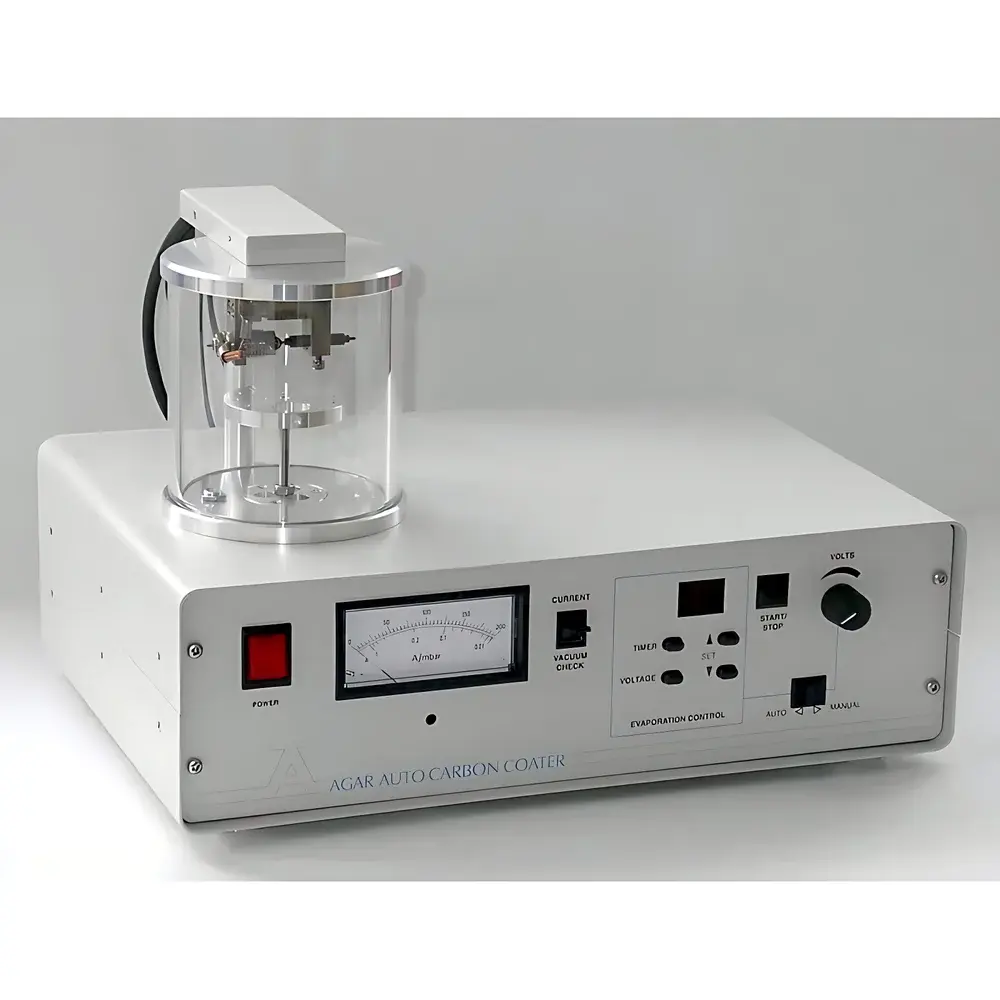
Agar Scientific AGB7367A Carbon Coater for SEM Sample Preparation
| Brand | Agar Scientific / Oxford Instruments |
|---|---|
| Origin | United Kingdom |
| Model | AGB7367A |
| Chamber Dimensions | 120 mm Ø × 120 mm H (glass) |
| Sample Stage | Stainless steel, accommodates up to 12 pin-type stubs, height adjustable over 30 mm range |
| Evaporation Source | High-purity graphite rod, 6.15 mm diameter |
| Power Control | Microprocessor-based, remote voltage/current sensing |
| Max Current | 180 A |
| Voltage Range | 0.1–5.5 V (digital setpoint) |
| Current Range | 0–200 A |
| Vacuum Gauge | Analog, 1 atm to 0.001 mbar |
| Pumping Speed | 2 L/s mechanical pump, reaches ≤0.1 mbar in 25–30 s |
| Operating Voltage | 220 V, 50/60 Hz |
| Optional QCM Thickness Monitor | 6 MHz quartz crystal, in-situ nanometric resolution (±0.1 nm for carbon) |
| Safety | Vacuum interlock, overcurrent protection |
| Operation Modes | Automatic (programmable timer: 1–30 s) and manual |
| Auto-vent Function | Yes |
| Compatibility | Zeiss, JEOL, Hitachi, Thermo Fisher (FEI), Tescan, Phenom SEM platforms |
Overview
The Agar Scientific AGB7367A Carbon Coater is a precision-engineered thermal evaporation system designed specifically for high-fidelity conductive coating of non-conductive specimens prior to scanning electron microscopy (SEM) analysis. Utilizing resistive heating of ultra-high-purity graphite rods (6.15 mm diameter), the instrument generates fine-grained, low-contamination carbon films with exceptional uniformity and minimal topographic masking—critical for high-resolution imaging, energy-dispersive X-ray spectroscopy (EDS), and electron backscatter diffraction (EBSD). The system operates under high vacuum conditions (down to 0.001 mbar), ensuring reduced oxidation, minimized particle aggregation, and improved film adhesion. Its compact glass chamber (120 mm Ø × 120 mm H) features a robust stainless-steel sample stage capable of holding up to twelve standard 25 mm pin-type stubs, with vertical adjustment over a 30 mm range to optimize source-to-substrate distance for consistent thickness distribution.
Key Features
- Microprocessor-controlled evaporation with real-time remote voltage and current sensing for stable thermal output and process repeatability
- Dual-mode operation: fully programmable automatic mode (1–30 s digital timer + 0.1–5.5 V voltage setpoint) and intuitive manual override
- Integrated vacuum safety interlock and electronic overcurrent protection ensure compliance with laboratory electrical and vacuum safety protocols
- Fast-pumping 2 L/s rotary vane pump achieves ≤0.1 mbar within 25–30 seconds—enabling rapid cycle times without compromising base pressure integrity
- Optional 6 MHz quartz crystal microbalance (QCM) provides in-situ, real-time thickness monitoring with ±0.1 nm resolution for carbon—supporting GLP-aligned documentation and process validation
- Auto-vent functionality enables safe, controlled chamber repressurization post-deposition, minimizing operator intervention and contamination risk
Sample Compatibility & Compliance
The AGB7367A is validated for use with standard SEM stubs (including aluminum, copper, and stainless-steel varieties) and accommodates diverse specimen geometries via its adjustable stage height and open-chamber design. It supports routine preparation of biological tissues, polymers, ceramics, geological sections, and nanomaterials requiring charge dissipation without introducing elemental interference—making it especially suitable for EDS quantification workflows where metallic coatings (e.g., Au/Pd) would compromise spectral fidelity. The system meets general requirements for ISO/IEC 17025-compliant laboratories when operated with documented SOPs and calibrated QCM sensors. While not inherently FDA 21 CFR Part 11–compliant, audit-ready data logs (when paired with optional PC interface and time-stamped QCM output) support GMP/GLP traceability in regulated R&D environments.
Software & Data Management
The AGB7367A operates as a standalone hardware platform with embedded digital control logic; no proprietary software is required for basic operation. However, when equipped with the optional QCM module, analog or RS-232 outputs enable integration with third-party data acquisition systems (e.g., LabVIEW, MATLAB, or custom Python scripts) for automated thickness logging, batch reporting, and statistical process control (SPC). All parameter settings—including voltage, timer duration, and vacuum status—are retained across power cycles. For quality assurance, users may implement manual logbooks or electronic lab notebooks (ELNs) aligned with ASTM E2500 and ISO 9001 documentation practices.
Applications
- Preparation of non-conductive specimens for high-magnification SEM imaging (≥100,000×) with minimal edge artifacts
- Thin carbon support film fabrication for TEM grid coating and replica preparation
- Conductive underlayer deposition prior to sputter-coating with Pt or Ir in dual-beam FIB-SEM workflows
- Quantitative EDS analysis where ZAF correction requires known, homogeneous, low-atomic-number matrix composition
- EBSD pattern indexing on insulating phases (e.g., oxides, silicates) requiring nanoscale surface conductivity without lattice distortion
- Routine QC in materials science labs, geoscience core facilities, and academic microanalysis centers operating Zeiss Sigma, JEOL JSM, Hitachi SU series, Thermo Fisher Helios, and Phenom desktop SEMs
FAQ
What vacuum level is required for optimal carbon film uniformity?
A base pressure of ≤0.1 mbar is recommended prior to initiation of evaporation; final operating pressure during deposition typically stabilizes between 10−2 and 10−3 mbar depending on outgassing rate and pump performance.
Can the AGB7367A be used for metals other than carbon?
No—the system is engineered exclusively for graphite rod evaporation; it lacks crucible compatibility, shutter mechanisms, or electron-beam sources required for metal or oxide deposition.
Is the QCM thickness monitor factory-calibrated for carbon?
Yes—each quartz crystal is pre-characterized for carbon’s density (2.26 g/cm³) and acoustic impedance; recalibration is only necessary after crystal replacement or extended exposure to aggressive cleaning agents.
How does stage height adjustment affect film thickness distribution?
Adjusting the sample-to-source distance alters angular flux distribution; a 25–35 mm working distance is empirically optimized for ±5% thickness uniformity across 12 stubs in the standard configuration.
Does the unit comply with CE or UKCA marking requirements?
Yes—the AGB7367A carries CE marking per EMC Directive 2014/30/EU and Low Voltage Directive 2014/35/EU; UKCA marking is applicable for post-Brexit UK supply under identical technical conformity assessment.





